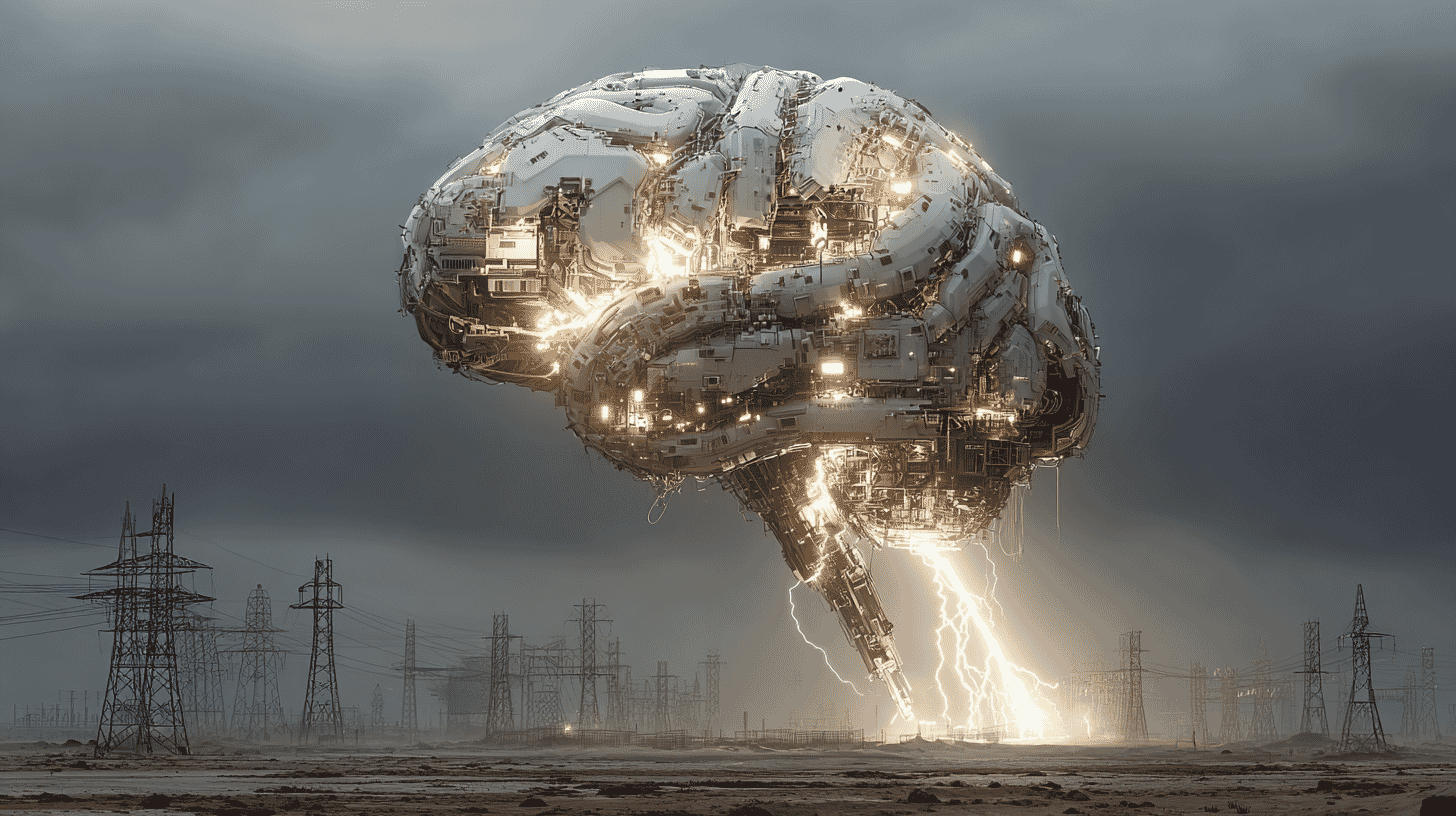
As generative AI spreads rapidly across industries, Japan is experiencing a data center construction boom. However, beneath this digital transformation lies a growing crisis: the nation's electricity supply capacity is reaching its limits. According to the fiscal 2025 demand outlook from the Organization for Cross-regional Coordination of Transmission Operators (OCCTO), maximum power demand from new data centers and semiconductor factories was projected to increase approximately 13-fold by fiscal 2034 compared to fiscal 2025. Japan's total electricity demand is projected to grow only a few percent over the same period, but data centers and semiconductor plants account for most of that increase.
In its 2025 report "Energy and AI," the International Energy Agency (IEA) projects that global data center electricity consumption will more than double, from around 415 terawatt-hours in 2024 to roughly 945 terawatt-hours by 2030. That is slightly more than Japan's entire annual electricity consumption today, which is why securing supply is a global question, not just a Japanese one.
The Massive Power Consumption of AI Servers
The primary driver of surging data center electricity consumption is the deployment of high-performance GPU servers designed for AI processing. According to Naohiro Masunaga, Secretary General of the Japan Data Center Council, while conventional server racks required approximately 10 kilovolt-amperes (kVA) of power, equivalent to just over three average households, AI servers consume ten times more electricity.
This enormous demand stems from how generative AI processes information. A widely cited 2024 estimate put a single query to a model like ChatGPT at about 2.9 watt-hours, roughly ten times a standard Google search. That figure has since been called too high: newer measurements suggest a typical text query is closer to 0.3 watt-hours. The range is wide, though, and long reasoning chains or image and video prompts push consumption far higher.
Cooling Systems Create a Dual Power Burden
The power challenge of AI servers extends beyond the processors themselves. High-performance GPU chips generate tremendous heat during operation, necessitating massive energy expenditure for cooling. Conventional air conditioning systems prove inadequate, requiring advanced liquid cooling systems to operate 24/7, creating another major factor in electricity consumption.
The cooling challenge is reshaping data center architecture. Existing facilities cannot accommodate the high-load AI servers and their cooling requirements, with industry experts suggesting that entire buildings may need reconstruction. This represents not merely equipment upgrades but a fundamental infrastructure overhaul.
Japan's Power Supply Constraints
While Japan's data center market ranks among global leaders, power supply capacity has become the critical bottleneck. Data centers maintain extremely stable electricity demand operating 24/7 with annual variation of less than 1%, making reliable supply essential. Additionally, multiple power source redundancy is required to guard against outages.
The Low Carbon Society Strategy Center of the Japan Science and Technology Agency (JST) estimates that without energy-saving measures under current technology, domestic data center power consumption could reach 90 billion kilowatt-hours by 2030 and 12 trillion kilowatt-hours by 2050, roughly a 133-fold increase from 2030. This is a ceiling scenario that assumes no technological progress, and actual demand will depend heavily on efficiency gains. Even so, if supply cannot keep pace, rolling blackouts remain a possibility.
Pursuing Regional Dispersal and Renewable Energy
To address these challenges, the government is promoting data center dispersal to regional areas as part of its "Digital Garden City Nation" initiative. Plans call for developing Hokkaido and Kyushu as third and fourth core hubs alongside Tokyo and Osaka. Rural regions offer greater potential for renewable energy development, providing advantages in power supply.
Indeed, data center clusters are emerging in Chiba Prefecture's Inzai City and Hokkaido's Ishikari City, leveraging power supply advantages. Mega cloud providers like Microsoft and Google are actively pursuing virtual power purchase agreements (PPAs) with renewable energy projects, balancing environmental considerations with power security.
Hope Through Technological Innovation
Meanwhile, expectations are building for technological breakthroughs to improve power efficiency. NTT's proposed "IOWN" photonics-electronics convergence technology could achieve dramatic energy savings compared to conventional electronic circuits. Advanced semiconductor chip packaging technologies may also sharply reduce power consumption.
Historically, warnings about microprocessor heat density and data center power consumption were averted through technological solutions. Some experts suggest AI server power challenges may similarly prove less severe than predicted, thanks to semiconductor innovations and cooling system efficiency improvements.
The Challenge of Achieving Carbon Neutrality
The data center power issue transcends mere supply quantity. With Japan and many nations committed to carbon neutrality goals, massive fossil fuel combustion for electricity generation is no longer viable. The unprecedented challenge lies in balancing increasing data center power demand with decarbonization.
Ireland, where data centers are projected to account for 32% of national electricity demand by 2026, has implemented regulations restricting new data center grid connections. Germany has introduced measures including residential area data center permit restrictions and mandatory renewable energy utilization.
Uncertain Future Outlook and National Debate
The Japan Data Center Council describes future AI-driven power demand projections as "completely uncertain." Depending on the pace of technological change, demand could climb 5-fold, 10-fold, or more, or efficiency breakthroughs could rein it back in just as sharply.
Amid this uncertainty, Japan is conducting nationwide discussions through expert committees. A multifaceted approach is needed: expanding power supply capacity, accelerating renewable energy adoption, driving technological innovation, and raising individual energy conservation awareness.
The advancement of AI technology represents an unstoppable tide. The question is how to enjoy its benefits while overcoming power infrastructure constraints. Japan faces the challenge of balancing industrial competitiveness with energy policy in the AI era. Where you live, has the AI boom's appetite for electricity started to show up on the grid yet?
[Update] The premise shifted within a year. In the fiscal 2026 outlook published on January 21, 2026, OCCTO put the average annual growth rate for peak demand through fiscal 2035 at 0.4%, and for electricity volume at 0.5%. The upward trend holds. But compared with fiscal 2034 in the previous outlook, industrial "other" demand came in 2.7% lower, about 10.2 billion kWh. The reason is not that the demand vanished; it slid later. OCCTO attributes the shift to construction delays and design changes at data center operators, which pushed back both start-up dates and the point at which sites reach full demand.
A survey by an Agency for Natural Resources and Energy working group is more specific. More than half of extra-high-voltage applicants for data center use had revised their plans, and 70% of those had delayed the point at which they would reach full demand, in some cases by more than ten years. Some operators appear to be reserving grid capacity in advance, and grid planners are now calling for stricter rules. It is less that the forecast was wrong than that the demand itself is a moving target (as of September 2026).


Global Discussion
20 comments