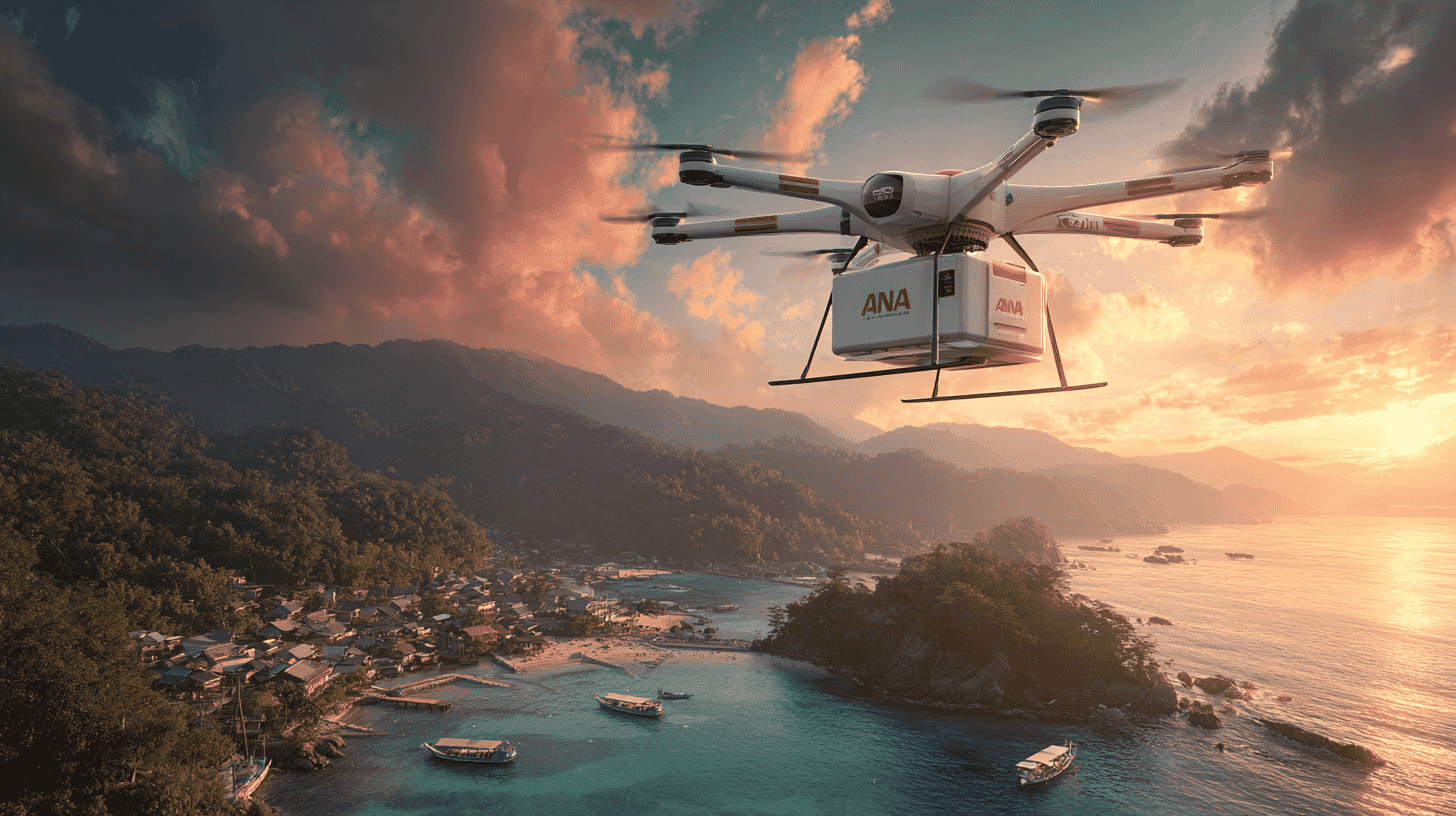
ANA Holdings, Japan's largest airline group, is moving to commercialize drone logistics nationwide. Its fiscal 2026-2028 mid-term management strategy sets a commercial launch for 2027, with nationwide operations by fiscal 2028, built first around medical deliveries to remote islands. ANA started its drone project in 2016; a decade on, the idea has become a business plan.
The Critical Logistics Crisis Facing Remote Islands
Japan has more than 400 inhabited remote islands, many of which are experiencing rapid aging and population decline. For decades, these communities have struggled to maintain stable access to medicines and daily necessities. Maritime transport remains vulnerable to weather disruptions, making emergency responses particularly difficult.
Medical supplies present unique challenges, as many require special storage and handling conditions. Delivering temperature-sensitive medications like insulin or time-critical prescriptions promptly is essential for protecting the health and lives of island residents. Drone logistics holds tremendous promise for bridging these healthcare gaps.
What Level 4 Made Possible
In December 2022, Japan revised its Civil Aeronautics Act to permit "Level 4" drone flights. Level 4 classification refers to beyond-visual-line-of-sight (BVLOS) autonomous drone operations over populated areas. This landmark change made drone delivery legally possible across a wide range of locations, including urban environments.
However, Level 4 operations require aircraft certification and pilot licensing from the Ministry of Land, Infrastructure, Transport and Tourism. Japan has adopted a gradual approach to deregulation, balancing safety considerations with the push for practical implementation.
100 Kilometers in 64 Minutes, Over Okinawa
ANA Holdings entered the drone industry early, leveraging its extensive operational management expertise from aviation. The company's core strengths lie in its deeply ingrained safety culture and nationwide network infrastructure.
The most recent trial ran in Okinawa from October 19, 2025 to January 29, 2026, testing long-distance delivery of prescription medicines and research blood samples with a large VTOL fixed-wing drone built by U.S. firm Skyways. A VTOL fixed-wing aircraft takes off and lands vertically like a helicopter, then cruises at speed on fixed wings like a plane. Two routes were flown: Itoman to Kumejima, about 100 km in 1 hour 4 minutes, and Itoman to Nago, about 89 km in 1 hour 1 minute. The trial was selected for the transport ministry's drone delivery hub development program.
Distance was not the only thing being tested. In the normal-operations scenario, refrigerated and room-temperature medicines went from a wholesaler's warehouse to Okinawa Prefectural Hokubu Hospital and Kumejima Public Hospital, and research blood, red cells and fresh frozen plasma, went from the prefecture's Red Cross blood center to Kumejima. Temperature-controlled boxes carried several categories at once, and the run also checked whether ordering and flight coordination between organizations held together. In the disaster scenario, ANA joined the prefecture's general disaster drill, coordinated flights with the prefectural response headquarters, and worked through an emergency delivery to Kumejima Hospital. Making one model serve both cases was the point of the exercise.
Off the back of it, ANA signed a long-term partnership with Skyways Air Transportation, the US maker of the aircraft, covering service development across the Asia-Pacific, and set up in-house training and certification for Skyways pilots. The company had already flown Japan's first Level 4 operation with its own pilots, in Kumejima in November 2023, using a type-certified airframe and a first-class unmanned aircraft pilot licence. The long-distance trial builds on that.
The business plan calls for landing hubs positioned so each covers a radius of roughly 500 km, carrying medicine and daily goods to islands in normal times and relief supplies to cut-off areas after a disaster. Yoshiaki Tsuda, the senior executive officer leading the business, has said that if cargo can be moved across a 500 km radius treated as an area rather than a line, the number of possible destinations becomes effectively unlimited.
The 2024 Problem, and What Still Doesn't Work
Japan's logistics industry faces what is known as the "2024 Problem": stricter overtime regulations for truck drivers that threaten to reduce overall transportation capacity. Driver shortages had been a concern for years, but the new regulations have intensified worries about the industry's ability to meet delivery demands.
Against this backdrop, drone logistics is increasingly viewed as a crucial tool for addressing labor shortages. Drones offer particular advantages for remote islands and mountainous areas where traditional ground transportation is inefficient. Automating small-package delivery can also help reduce the burden on human drivers.
Several technical hurdles remain before drone logistics can achieve widespread adoption. Battery technology continues to limit flight range and payload capacity, making drones unsuitable for large cargo or long-distance transport at present.
Other challenges include operating in adverse weather conditions, automated obstacle avoidance, and maintaining stable communications. ANA plans to apply its aviation weather expertise and implement redundant safety systems, maintaining rigorous safety standards as it scales operations.
Who Else Is Flying, at Home and Abroad
ANA is not alone. In March 2023, Japan Post ran the country's first Level 4 delivery trial in Okutama, western Tokyo, moving about one kilogram in roughly five minutes. Sagawa Express followed with Tokyo's first Level 3.5 flight in 2024.
Other countries are further along. In China, the delivery giant Meituan runs drone delivery at scale in Shenzhen and elsewhere, and Amazon launched Prime Air in the United States in 2022. Japan's cautious regulatory path has left it with fewer live services, but the gap has narrowed since Level 4 opened up.
What Changes on the Ground
The impact of drone logistics extends far beyond mere changes in delivery methods. For remote islands and depopulated areas, improved access to medical services could dramatically enhance residents' quality of life. Faster delivery of fresh food and daily necessities might even encourage younger generations to relocate or remain in these communities.
Nevertheless, challenges remain, including concerns about noise pollution, privacy issues, and potential impacts on existing transportation providers. Building community acceptance through ongoing dialogue with local residents will be essential for successful service deployment.
Tokyo has branded drone development an "aerial industrial revolution." Whether an airline can profitably run freight this way is less a technical question than one of economics and route design. How much demand actually sits inside that 500 km area? The answer arrives from 2027.
In Japan, drone delivery is becoming a real solution for remote island logistics challenges. How widespread is drone delivery in your country? What expectations or concerns do you have about drone logistics? We'd love to hear your thoughts in the comments!






Global Discussion
16 comments