160-Year Mystery Solved: New Stingray Species "Ariake Red Stingray" Discovered Among Japan's Most Common Rays

Resolving Taxonomic Confusion Dating Back to Siebold's Era

On December 25, 2025, a research team led by Professor Atsuko Yamaguchi and researcher Keisuke Furumitsu at Nagasaki University revealed that Japan's most familiar coastal ray, the "red stingray" (Akaei), had actually comprised multiple species confused as one for over 160 years.

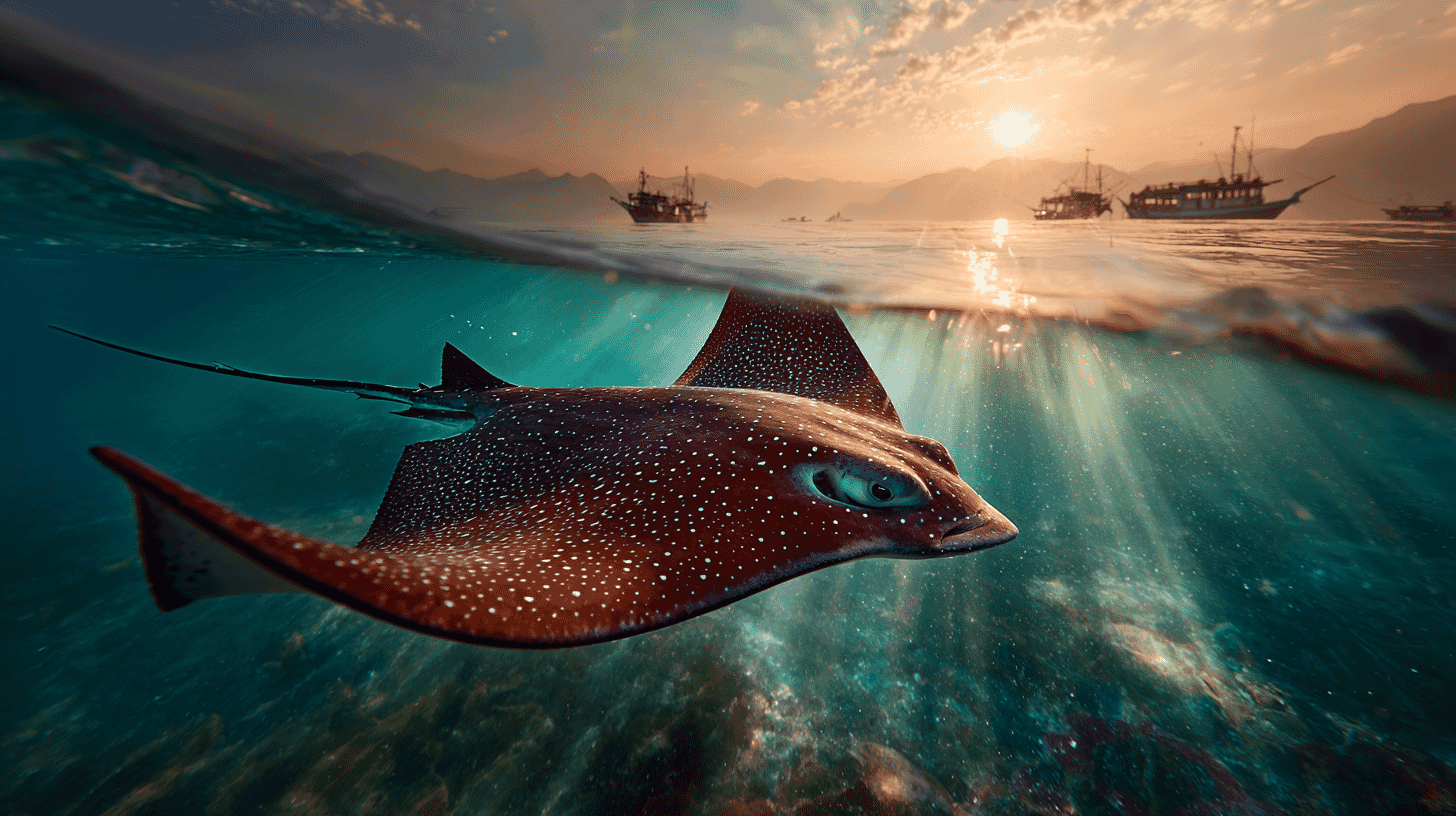
Through this research, a cryptic species (a species difficult to distinguish due to its similar appearance) primarily found in the Ariake Sea was formally described as the new species "Ariake Red Stingray" (Hemitrygon ariakensis).

The Story Begins in Edo-Period Japan

The classification history of the red stingray traces back to Japan's Edo period. Philipp Franz von Siebold arrived in Nagasaki's Dejima island in 1823 as a physician attached to the Dutch trading post. During his stay, he enthusiastically collected specimens of Japan's flora and fauna.

Based on six stingray specimens collected by Siebold and others and sent to the Royal Dutch Museum (now Naturalis Biodiversity Center), German zoologists Johannes Müller and Jakob Henle described the "red stingray" as a new species in 1841. At the time, all specimens appeared so similar that they were assumed to be the same species.

Over Two Decades of Painstaking Research

The Nagasaki University research team began their taxonomic study of red stingrays in 2003. Their investigation was sparked by noticing populations in the Ariake Sea with subtly different characteristics from conventional red stingrays.

In 2010, they revealed the existence of a cryptic species and proposed the Japanese name "Ariake Akaei" (Ariake Red Stingray), but could not determine its scientific name. This was because they discovered that the original 1841 description was based on specimens containing multiple species.

The research team traveled to the Naturalis Natural History Museum in the Netherlands to directly examine specimens nearly 180 years old. Their investigation confirmed that the seven type specimens indeed contained multiple species. Furthermore, they found that the lectotype (the specimen designated as the standard for the scientific name) was a juvenile whose morphological features were difficult to distinguish.

How to Tell the Two Species Apart

After years of research, distinguishing features between the two species were identified.

Characteristics of the Ariake Red Stingray

  • The ventral skin fold on the tail is black with white edges
  • A transverse groove exists near the fifth gill slit on the ventral side

These features are difficult to identify without expertise, making it nearly impossible for ordinary beachgoers to distinguish between the species when encountered in the wild.

The Ariake Red Stingray Was Already in the Glover Atlas

Intriguingly, examination of the historical "Fish Atlas of Southern and Western Japan" (commonly known as the Glover Atlas) held in Nagasaki University Library revealed that the only illustration labeled as "red stingray" was actually the Ariake Red Stingray.

The Glover Atlas is a meticulously crafted collection of 806 fish illustrations compiled by Thomas Albert Glover (Japanese name: Tomisaburo Kuraba), son of Scottish merchant Thomas Blake Glover, from the late Meiji era through early Showa period. The fact that the Ariake Red Stingray was already documented in this resource—counted among Japan's "Four Great Fish Atlases"—proves this species has inhabited Japanese waters since ancient times.

Significance of the Discovery

This discovery extends far beyond merely resolving a taxonomic issue. Now that we know what was lumped together as "red stingray" actually comprises multiple species, accurate assessment of each species' ecology, distribution, and population becomes possible.

Red stingrays are not only consumed as food but are also popular exhibits at aquariums. They also play important ecological roles as predators of bottom-dwelling organisms in marine ecosystems.

The research paper has been published in the international journal Ichthyological Research and is scheduled for inclusion in Vol.73 No.3 (2026). The holotype (the single specimen that serves as the standard for the scientific name) for the new Ariake Red Stingray was designated as a specimen collected off Shimabara in the Ariake Sea, Nagasaki Prefecture.

Conclusion

This discovery—that an "unfamiliar" species had been hiding in plain sight among "familiar marine creatures" for over 160 years—teaches us that mysteries of biodiversity still exist all around us waiting to be solved.

Have there been discoveries in your country or region where creatures long thought to be the same species turned out to be multiple species? We'd love to hear about the hidden biodiversity in your local environment!


References

Reactions in Japan

160 years unnoticed means they were thought to be the same species since Siebold's era? Science still has so many discoveries to make. It's amazing that such a major finding came from a familiar creature.

I agree 0
I disagree 0

The Nagasaki University research team showed incredible perseverance with over 20 years of research. Going all the way to the Netherlands to examine specimens—academic research really is built on such steady, dedicated efforts.

I agree 0
I disagree 0

I'm from the Ariake Sea area, so the name 'Ariake Red Stingray' makes me so happy! It's such a proud feeling to know a new species was living in my local waters.

I agree 0
I disagree 0

I never paid attention when seeing red stingrays at aquariums, but now I'll definitely wonder which species I'm looking at. Though I doubt I could tell them apart as a non-expert...

I agree 0
I disagree 0

There's something romantic about it being depicted in the Glover Atlas. The artists over 100 years ago drew it as 'red stingray' not knowing it was actually a different species.

I agree 0
I disagree 0

Simple question here: does this mean what I've been eating as 'red stingray' might have actually been Ariake red stingray? I wonder if they taste different?

I agree 0
I disagree 0

Stingrays have that dangerous image because of their venomous spines, but the researchers studied these risky creatures for decades. Such professional dedication.

I agree 0
I disagree 0

Honestly, basic research like this tends to be overlooked and doesn't get much attention, but it's truly important for understanding biodiversity. I hope they get more research funding.

I agree 0
I disagree 0

Isn't it amazing that specimens Siebold collected in Nagasaki are still preserved in the Netherlands? It's incredible that specimens from over 180 years ago can still be used for academic research.

I agree 0
I disagree 0

Fish actually have quite a lot of cryptic species. Like this red stingray case, I bet we'll see more 'turns out they were different species' revelations.

I agree 0
I disagree 0

The ventral tail fold being black with white edges—makes sense when you hear it, but regular people never look at the underside lol. Experts are amazing.

I agree 0
I disagree 0

So this means ecosystem surveys in the Ariake Sea can now be more accurate. It may seem minor, but it's important research for environmental conservation.

I agree 0
I disagree 0

Isn't Professor Yamaguchi the one who makes the Glover Atlas calendars? She's so passionate about Ariake Sea research. Amazing that this kind of result came from her work!

I agree 0
I disagree 0

But honestly, for ordinary people, whether it's red stingray or Ariake red stingray, it's just 'stingrays are dangerous, stay away' lol

I agree 0
I disagree 0

Being published in Ichthyological Research means this is an internationally recognized discovery. It's great to see Japanese researchers making such contributions.

I agree 0
I disagree 0

Voices from Around the World

Dr. Michael Chen

As a marine biologist, cryptic species discoveries like this are fascinating. Without advances in molecular biology, distinguishing such species would have been impossible. I have great respect for the Nagasaki University team's persistent research.

Emma van der Berg

As Dutch, I'm proud that Siebold's collection still contributes to scientific research today. Naturalis Museum has many specimens from Japan, and there may be more mysteries waiting to be solved.

James Wilson

Overlooked for over 160 years is remarkable. While not uncommon in science, finding cryptic species within supposedly 'well-known' species reminds us how much we still don't know about nature.

Sofia Rodriguez

Stingray research involves danger, so I admire the researchers' dedication. Considering Steve Irwin's accident, continuing to study stingrays for over 20 years is truly brave.

Hans Mueller

As a German, I feel proud of Siebold's achievements. He was both a physician and naturalist who greatly contributed to scientific exchange between Japan and Europe. It's wonderful that his legacy continues to lead to new discoveries.

Li Wei

Red stingrays also inhabit Chinese coastal waters. This research suggests we may need to investigate whether similar cryptic species exist in our waters too.

Sarah Thompson

This is a great example of the importance of basic science research. Taking over 20 years to clarify the classification of a single species—not glamorous, but essential work for understanding ecosystems.

Park Min-jun

Stingrays are sometimes used as food in Korea too. The discovery of a new species in Japan suggests there might be undiscovered species in Korean waters as well. Fascinating research.

François Dubois

The use of 180-year-old museum specimens in modern research demonstrates the value of natural history museums. Preserving collections is also for the science of the future.

Maria Santos

Taxonomy is often considered a mundane field, but it's the foundation of biodiversity conservation. Without accurate species identification, protection is impossible.

Tom Anderson

Stingray accidents are a concern in Australia too. If behavior patterns differ between species, this kind of taxonomic research could also help with safety measures.

Yuki Tanaka

I'm Japanese living abroad. It's wonderful to see such international research achievements from Japanese universities. This proves that excellent research can be done even at regional universities.

Alessandro Rossi

This is an interesting discovery from a history of science perspective too. It shows the limitations of 19th-century taxonomists and how modern technology can overcome them.

Nina Petrov

I've heard the Ariake Sea has a unique ecosystem even within Japan. It's probably no coincidence that the new species was discovered there. Preserving such distinctive environments is crucial.

David O'Brien

Honestly, you might think distinguishing stingrays doesn't matter to ordinary people. But accurate species identification is essential for fisheries management and ecosystem conservation.