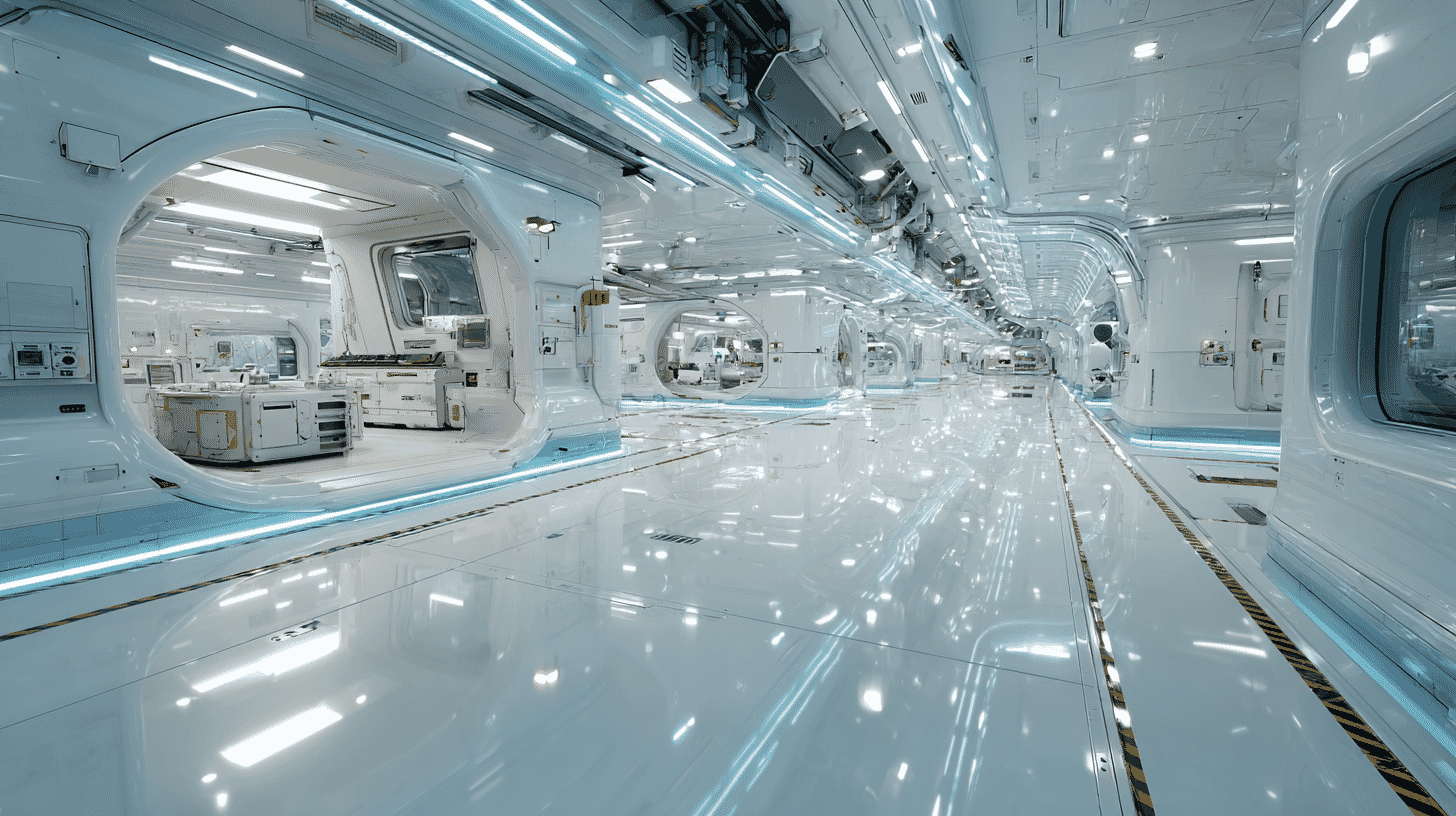
Small carriers run quietly along the ceilings of semiconductor plants, moving sealed pods of wafers without shedding a single particle. More than half the world market for those systems belongs to Daifuku, a materials-handling company based in Osaka. Its record results for the year ended December 2025 offer a way into what that position is built on.
The Unseen Enemy in Chip Production
Semiconductor manufacturing represents one of humanity's most precise industrial achievements. Today's cutting-edge chips feature circuit widths of just a few nanometers, roughly 1/20,000th the diameter of a human hair.
This extreme precision makes dust the industry's greatest enemy. A single particle invisible to the naked eye can land on a wafer, short-circuit the delicate pathways, and instantly transform an expensive chip into worthless scrap.
Daifuku: Dominating Clean Room Logistics
In this battle against contamination, the world's semiconductor manufacturers place their trust in Daifuku, a Japanese materials handling company. Daifuku commands over 50% of the global market share for AMHS (Automated Material Handling Systems), the technology that moves wafers through semiconductor fabrication facilities.
Founded in 1937 and headquartered in Nishiyodogawa ward, Osaka, Daifuku began as a manufacturer of conveyor systems for automotive and electronics production lines. It is also the world's largest material-handling company by revenue, posting a record ¥660.7 billion for the year ended December 2025. (The company moved its fiscal year end from March to December, so the transitional year ended December 2024 covered only nine months at its main domestic entities.) Operating profit passed ¥100 billion for the first time, at ¥100.8 billion, for a margin of 15.3 percent, and its three main profit lines set records for a fourth consecutive year. Electronics was the largest sector at ¥251 billion, the semiconductor boom showing up directly in the accounts. It forecasts ¥700 billion for the year ending December 2026 and has set a long-term goal of ¥1 trillion in revenue and ¥150 billion in operating profit by 2030. As the semiconductor industry grew, Daifuku refined its expertise in ultra-precise clean room transport.
Why the World Chooses Daifuku
Moving Wafers Without Shedding Particles
Semiconductor fabs require "Class 1" cleanrooms, the highest cleanliness standard achievable. This means fewer than one particle larger than 0.5 micrometers per cubic foot of air.
Daifuku's transport systems maintain this pristine environment while moving wafers. The company pioneered the handling of FOUPs (Front Opening Unified Pods), sealed containers that protect wafers during transport and prevent the wafers themselves from becoming contamination sources.
The Overhead Hoist Transport
Daifuku's flagship product is the OHT (Overhead Hoist Transport) system. These ceiling-mounted rail systems carry wafers above the factory floor, with transport vehicles moving along overhead tracks.
By utilizing ceiling space, OHT systems maximize floor layout flexibility and eliminate interference with workers and equipment. They also dramatically reduce the risk of stirring up particles from the floor.
The Value of Not Stopping
Nearly every major semiconductor manufacturer, TSMC, Samsung, Intel, Micron, relies on Daifuku systems. Decades of proven performance and stability in 24/7 operations have built unshakeable trust.
Semiconductor production lines generate massive losses when stopped. Daifuku's systems deliver "logistics that never sleep," maintaining the continuous operation essential to factory profitability.
Keeping Pace With Miniaturization
As semiconductors grow ever smaller, transport systems must become even more precise. Daifuku continues developing technologies that minimize vibration during transport and control systems that balance speed with pinpoint accuracy.
Riding the Semiconductor Investment Wave
The 2020s have brought unprecedented semiconductor demand, spurring massive fab construction worldwide. The U.S. CHIPS Act, Japan's semiconductor revival policies, and EU chip investments reflect geopolitical imperatives driving manufacturing capacity expansion.
That trend works in Daifuku's favor. Each new fab needs a transport system at its core. Major Japanese projects such as TSMC's Kumamoto fab and Rapidus's Hokkaido facility have kept the company prominent at home as well.
Update: With investment in chips for generative AI still running high, Daifuku completed a new clean room division building at its Shiga site in April 2026, lifting production capacity there to 1.3 times the previous level. In the first quarter of 2026, orders reached ¥221.3 billion, up 54.7% year on year and a quarterly record, driven by semiconductor production lines and airport systems. The order backlog passed ¥700 billion for the first time.
The smartphones, computers, cars, and appliances we use daily all contain semiconductor chips, and every one of those chips began as a wafer moved by a Daifuku system. The name never appears on the product. Take the system out, though, and the industry stops.
What's the awareness of semiconductor industry and related businesses like in your country? How do you view the importance of "invisible technologies" in manufacturing? We'd love to hear your thoughts in the comments!
References
- https://www.daifuku.com/
- https://www.daifuku.com/solution/semiconductor-flat-panel-display/
- https://azcms.ir-service.net/DATA/6383/ir/140120260212556155.pdf - Daifuku, results presentation for the year ended December 2025
- https://www.lnews.jp/2026/02/s0212505.html - LNEWS on the record ¥660.7 billion result







Global Discussion
15 comments