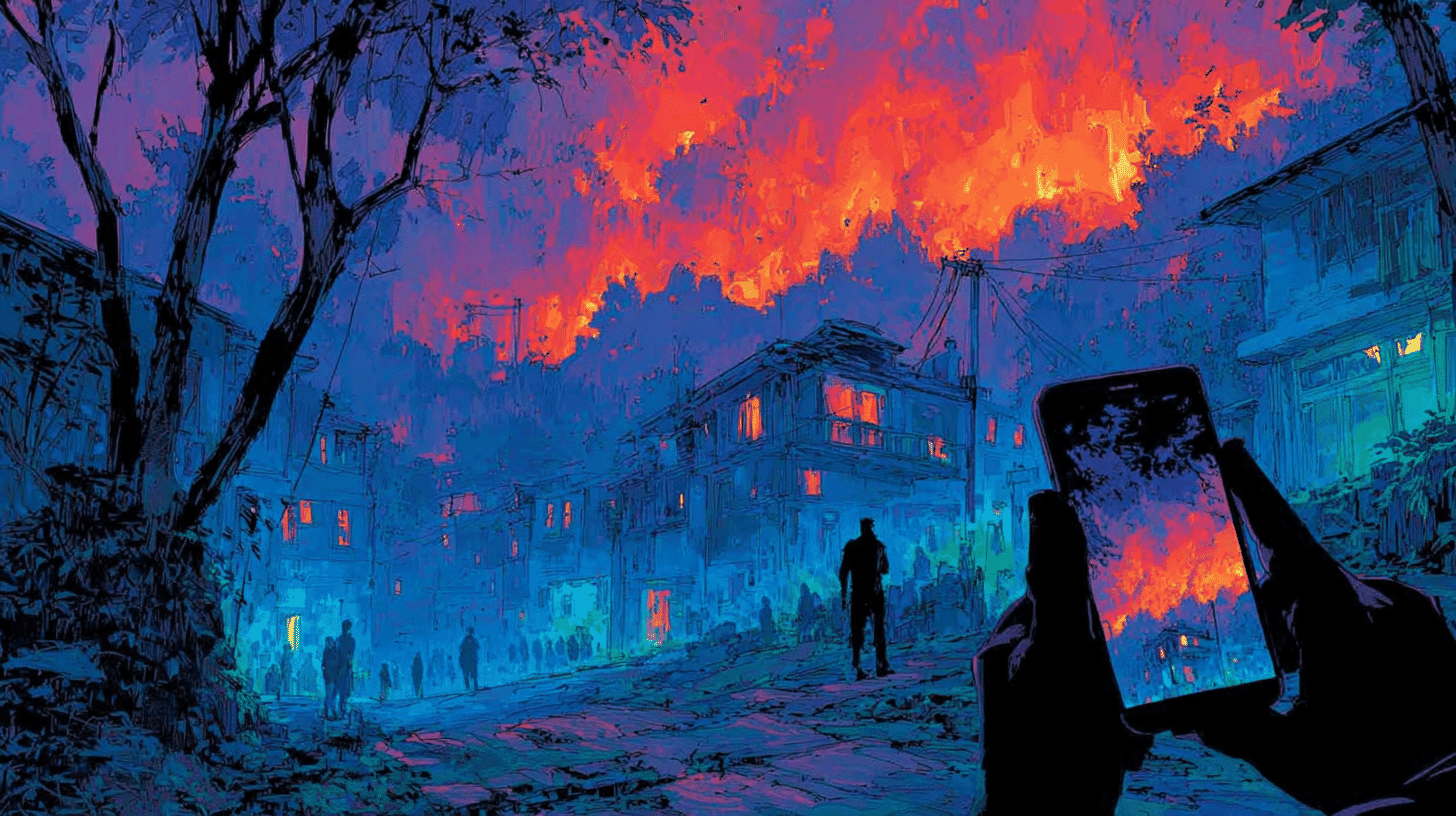
In October 2025, rocket fireworks were fired at a used car business run by Pakistani residents in the Kakuyama district of Ebetsu City, Hokkaido. Men also entered the property carrying baseball bats and knives in acts of intimidation. Security camera footage captured men, believed to be Japanese, arriving in multiple vehicles and firing rocket fireworks at the premises one after another.
These were not isolated incidents. At one point in October the harassment ran almost daily. The affected Pakistani business owners filed police reports and submitted the security camera footage as evidence. No injuries were reported.
Background: Illegal Construction and Spread of Misinformation
The trigger was a September 2025 session of the Ebetsu City Council, which took up illegal construction in an urbanization control area, a zoning category where building is restricted under the City Planning Act. The city said it had confirmed 76 illegal structures, among them a mosque built by Pakistani residents. According to the city, that prayer facility was first spotted on patrol in September 2021 and later designated an illegal structure, with corrective guidance issued.
A crucial fact gets overlooked here. Of those 76 structures, foreign-linked cases account for 20% or less; the vast majority were built by Japanese citizens. The figure also covers the entire city, not the Kakuyama district alone. A city official has said the claim circulating online, that Kakuyama contains 76 illegal buildings put up by foreigners, is simply wrong.
Despite this reality, misinformation spread online claiming that "all illegal buildings were constructed by Pakistanis." The situation deteriorated further when YouTubers visited the area and posted videos containing factual inaccuracies, fueling anti-Pakistani sentiment.
Provocative Videos by Content Creators
Multiple YouTubers visited mosques and workplaces, posting videos claiming they were "told to leave because they weren't Japanese," "taken to the mosque and surrounded by Pakistanis," or "chased by Pakistani men."
A Pakistani resident who spoke to broadcaster HTB Hokkaido through an interpreter described a very different sequence of events.
One YouTuber, he said, had asked to be let inside the mosque himself, saying he was interested in Islam. A Pakistani man at the mosque agreed and showed him around. The video that went up afterward described being taken to the mosque, surrounded, and frightened.
In another case, a YouTuber filmed company signage without permission and a Pakistani worker told him to stop taking pictures. That, the resident suspects, is what became "they told me to go home because I'm Japanese." Separately, when police were called over unauthorized filming on the property and the YouTuber drove off, Pakistani residents followed to note the license plate. The resulting video was posted as "chased by Pakistanis."
The Pakistani Community in Ebetsu
Ebetsu City has roughly 224 Pakistani residents, about seven times the figure of a decade ago.
Most work in used car dismantling and export. The area handles heavy used-vehicle traffic and sits close to automobile auction venues, which is what drew Pakistani entrepreneurs in the first place.
These residents hold proper work visas and secondhand goods dealer licenses, and operate within the law. Many have lived in Japan for over a decade.
Efforts Toward Community Integration
Before these attacks, the Pakistani community actively worked to integrate into local society. Many diligently studied Japanese, enrolled their children in local schools where they made friends, and participated in community events.
One Pakistani resident expressed: "We want to eliminate the perception that we're scary or unapproachable. We want to make it easy for anyone to talk to us." Indeed, until last year, community members willingly participated in local media interviews and organized cultural exchange events.
The recent wave of misleading videos and physical attacks has dramatically changed this situation. Many Pakistani residents now refuse media interviews, fearing that their words will be taken out of context, spread online, and invite further harassment and violence.
Expert Warnings
Professor Takashi Miyairi of Hokkai Gakuen University, an expert on foreign workers and multicultural coexistence, warns of dangerous consequences:
"When people are attacked with fireworks and explosives, distrust toward the broader community grows. If Pakistanis become isolated and withdraw inward, that's the most dangerous outcome. If they can live without any interest in Japanese customs and lifestyle, minor encounters could escalate into conflicts. Daily mutual interaction and points of contact are most crucial."
Future Challenges
This case starkly illustrates how misinformation can cause real-world harm. What began as legitimate concerns about illegal construction became distorted through factual manipulation and ethnic generalization, ultimately escalating into violence.
As Japan faces declining birth rates and an aging population, foreign workers will continue to increase. Ebetsu Mayor Yoshito Goto acknowledges: "National policy means foreign residents will keep growing in number. We need to create an environment where everyone can live together safely and peacefully."
[Update] Ebetsu City Hall received more than 450 protests and inquiries in a little over a month, according to NHK. On November 20, 2025, the city issued administrative guidance demanding removal of the mosque built without permission.
In the new year, fires broke out at two Pakistani-run yards and at the mosque in the Kakuyama district between mid-February and early March 2026. On February 15, a prefabricated office inside one used car exporter's yard burned down completely. On the 26th the city met the operator and stated in writing that rebuilding was not permitted in an urbanization control area; the operator reportedly indicated he would not rebuild. On April 10, however, a city patrol found a new structure on the site. The operator had returned to Pakistan, leaving the city unable to establish what happened. At a June 11 press conference, Mayor Goto called it "malicious to do it knowing the rules," while stressing that corrective guidance must be applied "the same way regardless of nationality" (Sankei Shimbun, May 8 and June 11, 2026).
The fires have since been treated as arson. In May, Hokkaido police arrested a 37-year-old farmer from Chitose on suspicion of attempting to set fire to a Pakistani-run company office and residence. In June he was rearrested on suspicion of using a plastic bottle of gasoline to burn down the building used as the mosque on February 28, and on July 7 he was indicted on charges including arson of an uninhabited structure. On July 13 he was rearrested again over the February 15 fire at the company office and residence, this time on suspicion of arson of an inhabited building; three people were inside at the time and all escaped unharmed. He has remained silent under questioning (Asahi Shimbun, July 13, 2026; as of September 2026).
Distorted, cherry-picked clips have cast a long shadow over the community. The distance from a single video online to real fireworks fired at a storefront turned out to be shorter than anyone assumed. In your country, have you seen online misinformation spill over into real violence or discrimination?







Global Discussion
20 comments