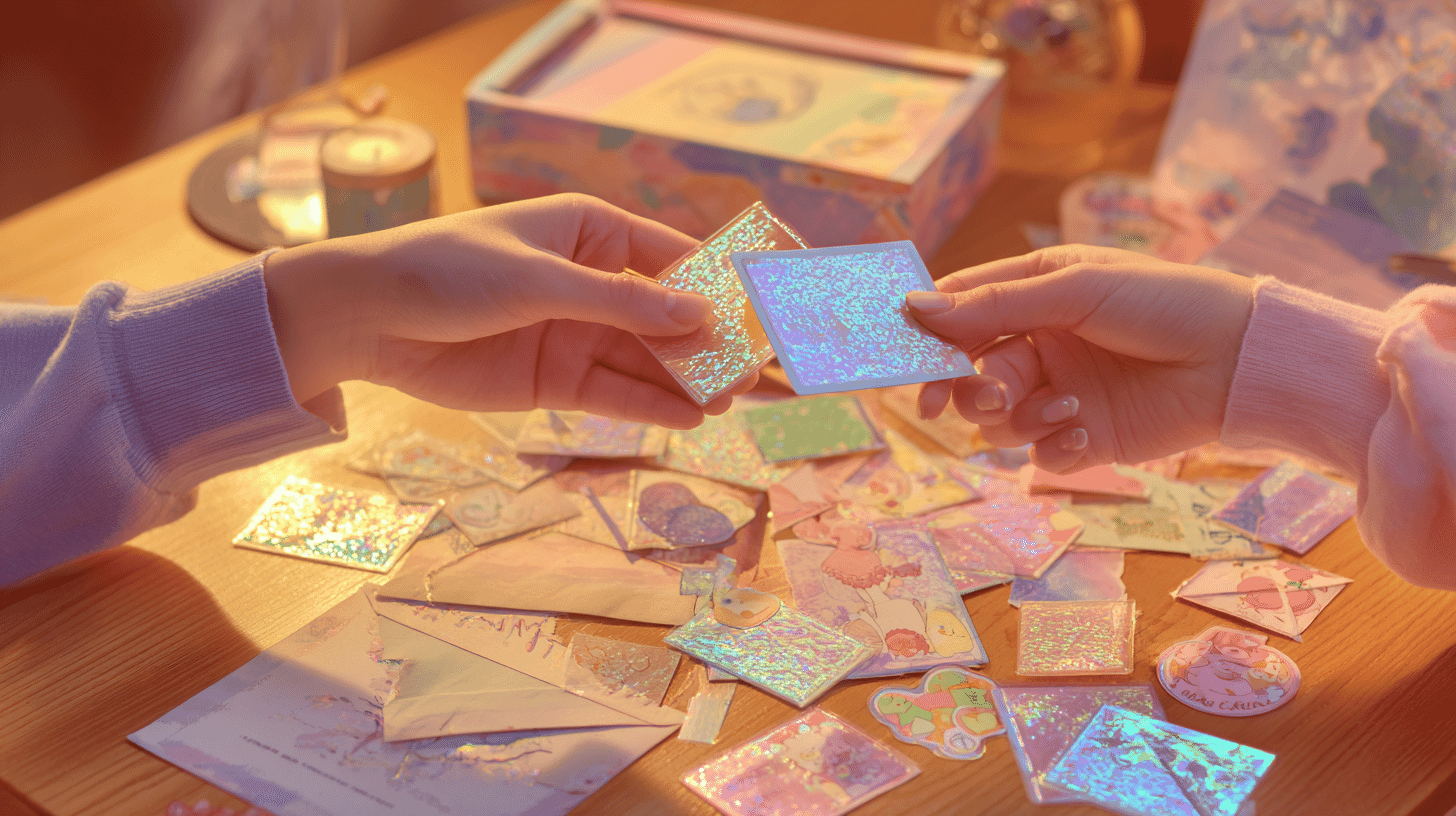
From the 1990s through the 2000s, trading stickers was essential to being a Japanese elementary school girl. You collected your favorites, swapped them with friends, and pasted them into a sticker book. That Heisei-era pastime is back in the Reiwa era, and it is no longer just for the girls who lived it. "Heisei joji," roughly "Heisei-era girlhood," was nominated for Japan's 2025 buzzword of the year, and sticker trading has spread to schoolchildren, young adults, and men.
What Sticker Exchange Actually Was
Sticker exchange meant swapping character stickers and stationery-brand freebies with friends. Girls carried sticker books to school and traded during breaks and after class.
The most sought-after stickers looked like this:
- Sanrio characters (Hello Kitty, Pompompurin, Cinnamoroll and others)
- Tamagotchi and Pokemon tie-ins
- Fancy stickers from goods makers such as Sun Hoseki and Crux
- Scented stickers and puffy stickers
- Freebies from capsule machines and snack packages
The trade ran on unwritten rules. Holographic stickers carried a higher "rate" than ordinary ones, and children worked out for themselves how many low-rate stickers a high-rate one was worth. In an age with no social media and few handheld games, those rules were somehow shared nationwide, which in hindsight is genuinely strange.
Why the Comeback Is Happening Now
Following the Showa retro wave, Heisei culture is being reappraised as something both nostalgic and fresh. It also helps that the children of that era are now adults with money to spend.
Then social media arrived on top of it. Hashtags like #sticker book and #sticker exchange connect people of the same generation on X and Instagram. The Japanese hashtag for sticker books passed 36,000 posts on Instagram by late November 2025. Trading partners once limited to classmates and neighbors now span the country.
Manufacturers noticed. Kamio Japan reissued Pukupuku Awawachan and Love Tomo stickers in December 2024 under a Heisei Fancy line, drawing a wave of recognition online. San-X launched the second phase of its San-X Universe campaign in October 2025, with ads showing Rilakkuma and Sumikkogurashi gathered in a sticker book on displays at Tokyo and Osaka stations. Shogakukan's Ciao magazine bundled 182 stickers with its December 2025 issue.
Demand outran supply. Bonbon Drop stickers, made by Osaka-based Crux by pouring resin into the design, have sold 15 million sheets cumulatively since their March 2024 launch, as of the end of December 2025. Several overseas factories have been added and still cannot keep up; shoppers track delivery times and race each other to the shelves. The range now runs to about 150 designs, from original characters to Sanrio and traditional Japanese patterns.
The boom has a shadow side. Scarcity brought resale at inflated prices and counterfeit copies. It is also worth noting the direction of travel: a product aimed at girls in the lower primary grades is selling out because adult women are buying it for nostalgia.
How Reiwa Sticker Trading Works
Adult trading added methods the Heisei playground never had. People post that they are looking for partners, arrange the swap by direct message, and mail the stickers. Envelopes get decorated with stationery sets and washi tape, and plenty of traders film the unboxing to share. Handwritten letters often turn a swap into something closer to a pen-pal friendship.
Face-to-face trading is growing too. A bar in Osaka's Kita ward held a customer sticker-swap event in September 2025, and the response was strong enough that it now runs every other week. Adults spread their sticker books open over drinks.
Trading was a girls' pastime in the Heisei era. In Reiwa, men are conspicuous participants, usually invited in by family or partners and then hooked. Some describe it as close to collecting model kits or figures, obsessing over layout and composition on the page.
Collecting itself has changed. People photograph their sticker books to build databases, and communities form around debating what a rare sticker is worth, mixing the digital with the analog.
The Value of Something You Can Touch
Nostalgia is not the whole story.
As everything migrates to the smartphone, physically handing an object to another person has become the scarce thing. The pleasure of collecting something pretty, the fun of connecting through a trade, the satisfaction of watching a book fill up. The low cost and low effort of starting matter too.
Stickers are also a way into conversation. Relationships that begin with "that one's cute" are forming online and off. A Heisei playground game may be reminding people of a kind of exchange that efficiency and convenience cannot measure.
Is there a childhood pastime in your country that adults have revived? If you have beloved traditions that span generations, like Japan's sticker exchange culture, we'd love to hear about them!
References
- https://news.yahoo.co.jp/articles/ea963b5778e0ffba0dc775aa13980d3498b5b2b2
- https://senken.co.jp/posts/bonbon-260206 (Senken Shimbun on 15 million sheets sold)
- https://toyokeizai.net/articles/-/924113 (Toyo Keizai on resale and counterfeits)
- https://www.oricon.co.jp/special/72856/
- https://www.ktv.jp/news/feature/251208-heisei/




Global Discussion
16 comments