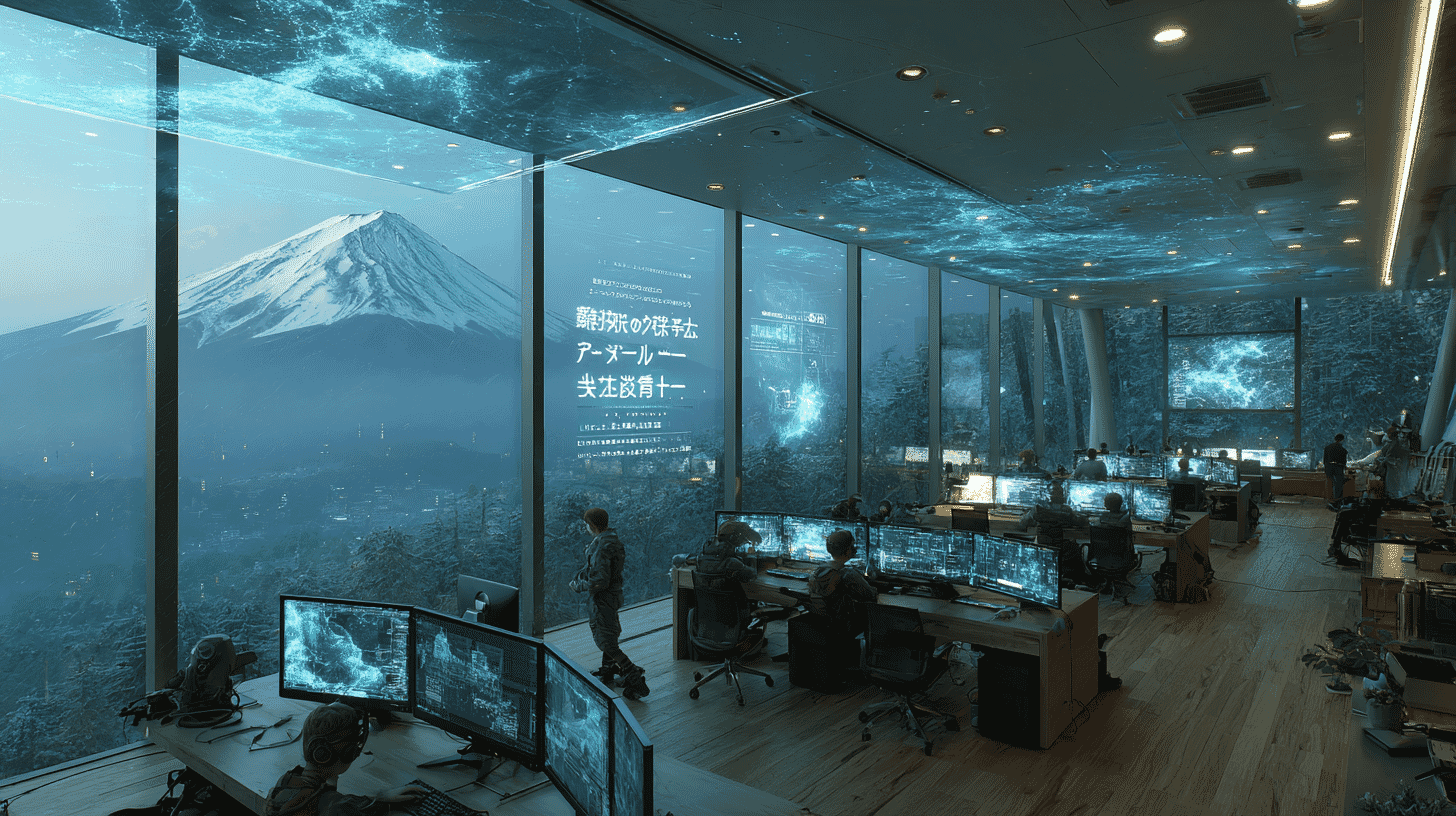
Japan's government and private sector have launched a full-scale effort to develop domestic artificial intelligence, with total investment reaching ¥3 trillion ($20 billion). The outline of the public-private plan emerged in December 2025, and on June 30, 2026, the company at its center, Noetra (formerly Japan AI Foundation Model Development), was selected for a public grant program run by NEDO, the state research and development agency under the Ministry of Economy, Trade and Industry (METI). The framework for Japan's counteroffensive in an AI race long dominated by the US and China is now in place.
Noetra was founded with SoftBank, NEC, Sony Group, and Honda as its core members, and 44 Japanese companies spanning electronics, finance, construction, and pharmaceuticals ultimately took stakes. The goal is a foundation model on the "1 trillion parameter" scale reached by the world's leading AI systems, and development began in earnest in July 2026.
The Framework of the Initiative
The New Company and Its Structure
Roughly 100 engineers, contributed by the core member companies, will take part in development. The National Institute of Advanced Industrial Science and Technology (AIST), also under METI, will support Noetra in cooperation with research institutions in Japan and abroad.
The foundation model will be opened up to Japanese companies, allowing each to adapt the AI to its own needs. The ultimate objective is a model that can serve as the brain of "physical AI," which autonomously controls robots and machinery in the real world. The plan is to achieve this within five years, through fiscal 2030, drawing on the industrial data accumulated in Japan's manufacturing sector.
Massive Investment Plan
METI will provide roughly ¥1 trillion in support over five years starting in fiscal 2026. For the first year, ¥387.3 billion has been committed as development funding for Noetra and AIST. Support will be disbursed in stages, with progress reviewed each year. Because the program aims at low-power AI development, it will be funded through GX Economy Transition Bonds.
SoftBank, for its part, will invest ¥2 trillion over six years in data centers for AI development and deployment. Facilities under construction in Tomakomai, Hokkaido, and Sakai, Osaka, are the candidate sites for the domestic AI project, with investment proceeding in stages according to corporate AI demand.
Why Domestic AI Now?
Japan's Significant Lag Behind US and China
The United States and China currently lead AI development by a wide margin. According to 2024 data, US private sector AI investment reached approximately ¥16 trillion, while China invested about ¥1.4 trillion. Japan's investment amounted to roughly ¥140 billion, less than one-hundredth of the US figure.
The gap is equally evident in research. China has surpassed the US in AI paper output and citations, and Japan does not appear among the top 100 most-cited AI papers. Japanese AI research has fallen far behind on the global stage.
Economic Security Considerations
AI has become a technology that directly affects industrial competitiveness and national security. METI sees dependence on foreign AI as carrying real risks for Japanese industry.
Japan's digital services already rely heavily on foreign companies, from operating systems to cloud services. The country's digital trade deficit has expanded year after year, reaching ¥5.5 trillion in 2023. If widely used generative AI also remains exclusively foreign, license fees and other payments threaten to widen that deficit further.
SoftBank's Strategy
Ongoing Domestic AI Development
SoftBank established SB Intuitions in October 2023 with the goal of developing the highest-quality Japanese-language generative AI. The company has built up its domestic LLM series "Sarashina" and, on June 30, 2026, launched its latest generation, "Sarashina3." Over the medium to long term, it aims to scale up to the 1 trillion parameter class.
President Junichi Miyakawa has explained: "The mainstream approach to building generative AI these days is to first create a large-scale model and then optimize it down to the size that fits the purpose. Since we're following this approach, we've decided to target 1 trillion parameters."
Business Model Prospects
SoftBank expects domestic AI development to act as a catalyst, generating demand for new products and services within Japan and producing usage fees that justify the massive investment.
The aim is a generative AI that understands Japanese business practices and culture: a "refined LLM" offering high accuracy, fast responses, and low power consumption.
Challenges Facing Japan
AI Talent Shortage
The average starting salary for AI doctorate holders in Japan is reported to be around ¥6 million, less than half the US level. Promising young researchers keep moving to overseas institutions, and major automakers like Toyota and Honda have had to recruit AI engineers from the US for autonomous driving development.
Slow Corporate Adoption
According to the Ministry of Internal Affairs' white paper on information and communications, only 26.7% of Japanese respondents reported having used generative AI, strikingly low compared with 68.8% in the US and 81.2% in China.
Among companies, just 49.7% said they would "actively utilize" AI or "use it in limited areas," a cautious stance compared with over 80% in the US and China.
Cultural Barriers
Japan's strong preference for risk avoidance and group harmony creates an environment where new technologies struggle to gain traction without clearly written rules. As one worker put it: "Using ChatGPT at work is treated like a secret trick. There's no atmosphere where you can openly use it."
Will the Money Turn Into Results?
The ¥3 trillion public-private framework is now in place. The remaining question is whether the investment translates into results. Talent development, corporate culture, and regulatory fit are challenges money alone cannot solve. Fiscal 2026, when Noetra begins development in earnest, will be the first real test of Japan's AI comeback.
[Update] On July 16, 2026, Noetra and its four core companies announced that research and development had formally begun. The investor list was finalized at 44 companies, including manufacturers such as Asahi Kasei, Kawasaki Heavy Industries, Kobe Steel, Fanuc, Yaskawa Electric, and Nippon Steel, alongside the three megabanks, Nippon Life, Rakuten Group, Sakana AI, and the Matsuo Institute. Engineers are being seconded from the four core firms as well as AIST and Preferred Networks.
The roadmap also became concrete. From fiscal 2026 the company will build reasoning models covering Japanese-language understanding and logical inference, followed by an omni-modal model handling text, images, video, and audio in fiscal 2028, and a "real-world native AI" that understands spatial and physical properties in fiscal 2030. For now it is using computing capacity already held by domestic operators; a dedicated cluster with roughly 27,500 of NVIDIA's latest Rubin GPUs is set to begin construction in April 2027 and start running in June 2028. President Hirotora Tamba said Japan needs a multimodal foundation model to underpin its industrial competitiveness, and that the company aims to build trusted AI infrastructure. External access to the models will be opened up in stages, depending on how research and deployment progress (as of September 2026).
Seen from outside Japan, this is one country's attempt to own the foundation layer of AI rather than rent it. Is there a similar push for a homegrown foundation model where you live?







Global Discussion
20 comments