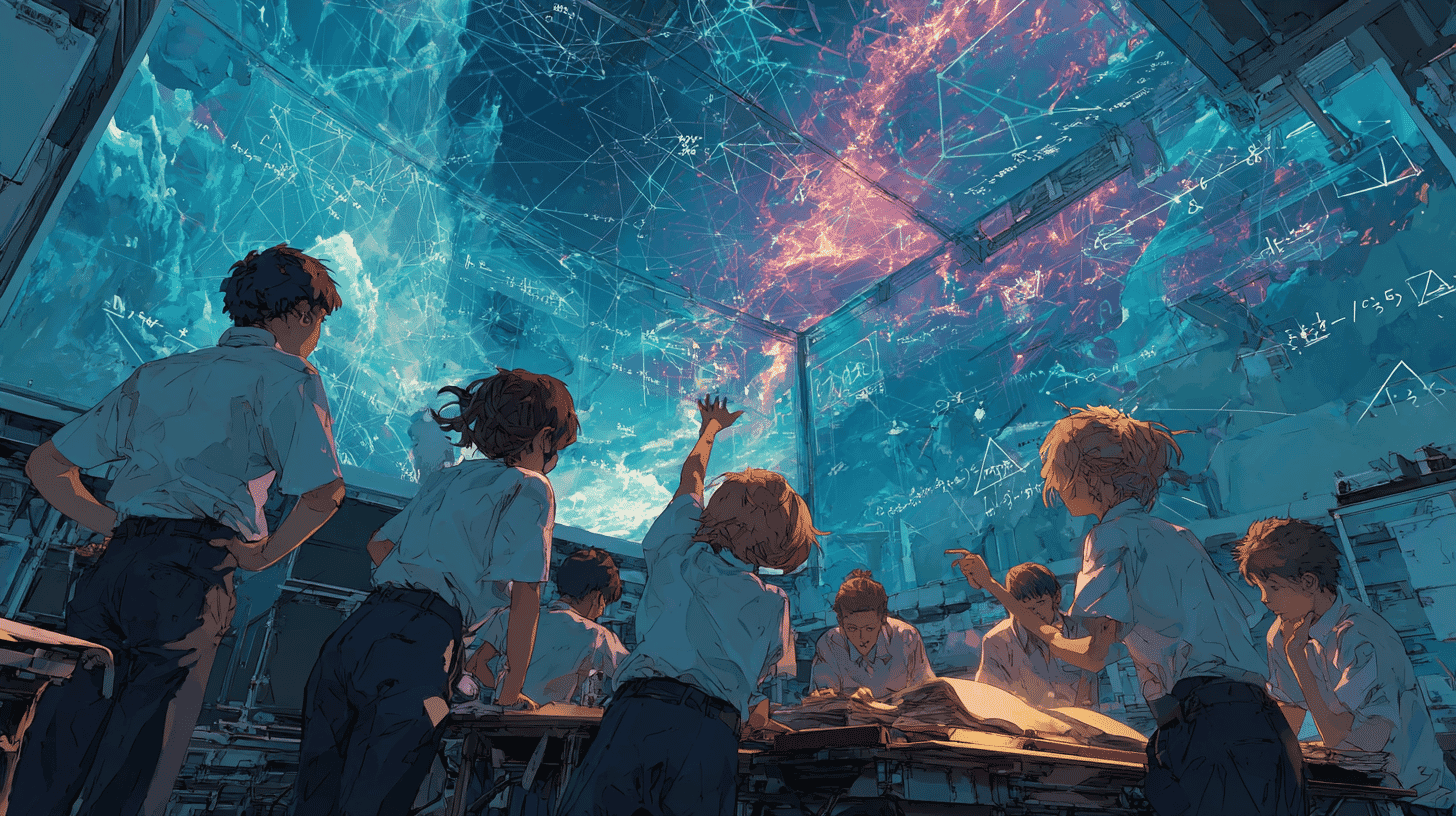
On December 22, 2025, Japan's Ministry of Education, Culture, Sports, Science and Technology (MEXT) presented a proposal to incorporate artificial intelligence (AI) and data science fundamentals into "Mathematics I," a mandatory high school subject. The change would take effect from 2032 as part of the next curriculum guidelines.
If adopted, all high school students, regardless of whether they pursue humanities or sciences, would learn the basics of AI and data science. Handling AI and data has come to be described as the "new reading, writing, and arithmetic," whatever field a student ends up in.
Two New Units Added to Mathematics I
The proposal adds two units to Mathematics I: "Mathematics for Understanding Society" and "Mathematics Guidance," both working titles.
"Mathematics for Understanding Society" connects mathematical concepts like matrices and probability to real-world phenomena. Students will learn how mathematics powers everyday technologies such as social media recommendation algorithms, weather forecasting systems, and stock price predictions, creating a gateway to AI and data science.
"Mathematics Guidance" opens the course with a map of high school mathematics as a whole: how junior high content feeds into it, and how it connects to the natural sciences, information science, and the social sciences. The point is to answer "why study mathematics?" before the equations start.
Major Restructuring of Mathematics A, B, and C
Currently, Japanese high school mathematics includes mandatory subjects (Mathematics I, II, III) and elective subjects (Mathematics A, B, C). However, the structure of these electives will undergo significant changes.
Under the current system, the content that matters most for AI and data science is scattered: probability in Mathematics A, statistical inference in Mathematics B, matrices tucked inside Mathematics C's "Devising Mathematical Representations." Mathematics B and C are taken unit by unit, and few schools get as far as matrices. Students aiming at humanities-track private universities routinely graduate without touching material their entrance exams do not test.
The proposal dissolves the A/B/C framework and folds it into one new subject, with schools and students choosing units by career path and interest. The aim is to stop essential mathematical grounding from falling through the gaps in course selection.
Strengthening International Competitiveness
In its "AI Strategy 2019," the Japanese government emphasized the importance of developing human resources capable of thriving in the AI era. For realizing Society 5.0, a super-smart society, personnel who can utilize data and digital technology are considered indispensable.
Currently, universities nationwide are implementing the "Mathematics, Data Science, and AI Education Program Certification System," with many institutions receiving certification. However, insufficient high school-level education often requires university students to learn basics from scratch after enrollment.
Teach the fundamentals systematically in high school, the reasoning goes, and the handoff to university gets smoother. That is the sequence MEXT is betting on.
Challenges and Expectations for Educational Settings
This large-scale reform faces several challenges.
Teachers come first. Anyone teaching the basics of AI and data science has to understand them, which puts in-service training ahead of everything else in the queue.
Class time is the other squeeze. Adding new material without thinning the existing foundations means every school rebuilds its curriculum.
However, many education professionals have high expectations for this reform. Some note that clarifying real-world relevance could reduce math anxiety and boost learning motivation. The ability to interpret data and understand AI mechanisms represents universal skills useful in any profession.
Essential Skills for the Digital Age
Shopping recommendations, safety systems in self-driving cars, diagnostic support tools in hospitals: AI and data science are already embedded in daily life.
Teaching young people the mathematical principles underlying AI and data goes beyond mere technical education. It cultivates "digital literacy," the ability to critically interpret information and make rational, data-driven decisions.
Global Trends and Japan's Position
Countries worldwide are advancing educational reforms. In the United States, United Kingdom, and Singapore, STEM education (Science, Technology, Engineering, Mathematics) has been strengthened, with programming and data analysis integrated into compulsory education.
Japan has also made "Information I" mandatory in high schools since 2022, ensuring all students learn programming and database fundamentals. The current introduction of AI basics into Mathematics I represents a continuation of this trajectory.
Update: On May 15, 2026, the MEXT working group circulated a draft summary. It organizes elementary through high school content into six fields, Numbers and Expressions, Geometry, Change and Relationships, Data and Uncertainty, Reasoning, and Mathematics for Understanding Society, and extends "Mathematics Guidance" to junior high school as well. A draft breakdown of the merged A/B/C subject lists six units: counting and probability, statistical inference, matrices, sequences, geometric vectors, and complex numbers and the complex plane.
Then on August 31, a Central Council for Education special committee presented a draft summary covering the whole of the next curriculum. It states for the first time that AI will be used in teaching, and it folds information studies into elementary and junior high school as a subject area. Elementary schools will rename the Period for Integrated Study as the Period for Integrated Inquiry and add an "information domain" inside it; junior high schools will split home economics and technology into a new Information and Technology subject and home economics. The hours envisaged are up to 30 to 35 class periods a year in elementary school and roughly 35 to 70 for the junior high subject.
The timing is the notable part. Elementary schools start in fiscal 2028 and junior high schools in fiscal 2029, both ahead of the high school change in 2032. MEXT says the goal is for students to be able to use AI and data science by the time they graduate high school, which recasts the Mathematics I revision as one piece of a redesign running from elementary school upward. The council's formal report is expected around the winter of 2026 (as of September 2026).
How About Your Country?
In Japan, such bold educational reforms are under active discussion. How does your country approach AI and data science education? What discussions are taking place about the skills needed by younger generations? Please share your country's situation and perspective with us.






Global Discussion
20 comments