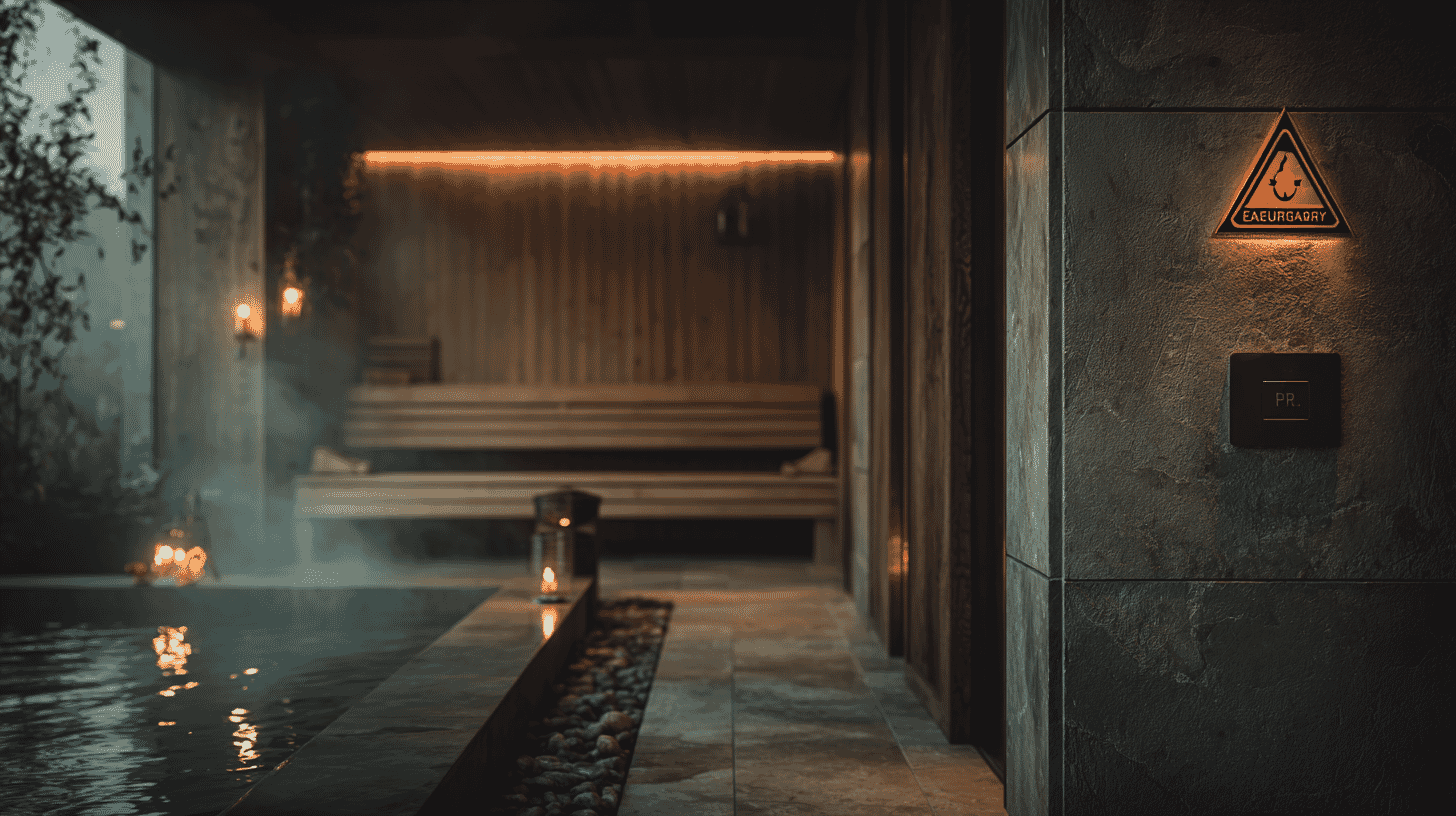
At around 12:25 p.m. on December 15, 2025, a fire at the private sauna "SAUNATIGER" in Akasaka, Tokyo, took the lives of a couple in their 30s. The victims were Masaya Matsuda, 36, who ran a hair salon, and his wife Yoko, 37, a nail artist, both from Kawasaki. They had a three-year-old child.
The venue, operated by SAUNA&Co of Tokyo's Minato ward, was a members-only luxury private sauna, with single visits starting at 19,000 yen and monthly plans ranging from 60,000 to 390,000 yen. It was overseen by Italian TV personality Girolamo Panzetta and known among celebrities. The Matsudas were first-time visitors, using a two-hour, 19,000-yen visitor plan.
A Detached Knob and a Receiver Switched Off
When found, the sauna room's doorknob had come off on both the inside and outside and lay on the floor. The room had originally had an L-shaped wooden doorknob, which apparently detached, leaving the door impossible to open. The couple had collapsed near the door; investigators found traces of an attempt to break the glass with hot sauna stones wrapped in a towel, as well as subcutaneous bleeding on their hands from pounding on the door.
More disturbing still, although the emergency button inside had apparently been pressed, the receiver in the office had been switched off, so no call for help got through. The operator reportedly said the receiver had never once been turned on since opening. Staff noticed the fire from the alarm bell, but when firefighters arrived, the private room's door was still locked from the outside.
More than six months before the fire, a customer had been briefly trapped in another room when a doorknob came off. A companion freed them from outside, so no one was hurt, but the operator knew it had happened. An interior contractor proposed switching to a knob-less push door for safety; the operator didn't take it up. The knob on the room where the couple died had been replaced at least twice.
Several possible ignition sources have been floated: too little clearance between the stove and combustibles such as towels, or a lithium-ion battery brought into a hot, humid room. Because both victims collapsed near the door, some specialists believe they lost consciousness to carbon monoxide or oxygen depletion rather than burns.
Update: The Metropolitan Police continue to investigate for professional negligence resulting in death. Current executives say the push-door proposal was rejected by the previous owner, who argued it would let heat escape, and on February 19, 2026, police searched premises linked to that former owner in Chiba. As of September 2026 no charges had been filed. The founding president has since stepped down from the top posts of affiliated companies and renamed the business.
A Third Boom, and a New Kind of Venue
Behind it lies Japan's rapid sauna boom.
In Japan's sauna history, the 1964 Tokyo Olympics sparked a first boom, and the rise of "super sento" bathhouses in the 1990s a second. Now the country is in the middle of a "third sauna boom." The 2019 drama "Sado" spread the word "totonou" (to get balanced), and popularity exploded, especially among younger people.
Reported accidents are climbing too. In a June 5, 2024 advisory, the Consumer Affairs Agency counted 78 sauna-related incidents in the accident database it runs with the National Consumer Affairs Center as of the end of April 2024, with 82 people hurt and two deaths. Reports averaged about four a year through fiscal 2021 and jumped to ten a year from fiscal 2022. That tally covers burns and sudden illness as well, though; it is not a count of fires.
Private saunas in particular, a new business model, carry safety challenges that differ from traditional public baths. Many have no staff on site, and inadequate emergency response has been pointed out.
Four months after Akasaka, on the night of April 11, 2026, a private sauna in Atsugi, Kanagawa, also caught fire. Everyone inside got out quickly and no one was injured.
In Finland, the Sauna Is at Home
In Finland, the home of the sauna, sauna culture was inscribed on UNESCO's Intangible Cultural Heritage list in 2020. For a population of about 5.5 million, there are said to be more than 3 million saunas, and having one at home is common.
Finnish saunas run at relatively lower temperatures of around 80–90°C and emphasize humidity control through "löyly." Users pour water on the stones themselves to adjust the steam, and the sauna is enjoyed as a place for socializing with family and friends. With electric heaters widespread, temperature can be managed at the flick of a switch.
Japanese saunas, by contrast, tend toward high heat (90–100°C and above) and low humidity. The style pursues the "totonou" sensation through the contrast with a cold plunge. This extreme temperature swing has its benefits but makes facility safety management all the more important.
A Business Model the Rules Never Anticipated
There is no unified international safety standard; the matter is left to each country's building codes and public-bath laws. In Europe, products must carry CE safety certification, with temperature controls and overheat protection as standard.
In Japan, public-bath and fire-service laws apply, but the private sauna as a new business type was not fully anticipated by existing rules. This accident exposed gaps in door structure and maintenance, inspection of emergency buttons, response when no staff is present, and safety review at opening.
Update: In January 2026 the Ministry of Health, Labour and Welfare told 157 local authorities to check safety management at sauna venues. The results, published on April 21, 2026, found that roughly one in five facilities had no emergency buzzer. The same day the ministry issued a follow-up notice asking authorities to instruct operators who had not secured a way for bathers to reach staff in an emergency, and to verify that sauna doors can be opened without obstruction.
Local authorities moved quickly. Kanagawa Prefecture ordered on-site inspections of 27 dedicated sauna venues three weeks after the fire, and Kumamoto City began emergency checks of 77 facilities on December 25. Nagano Prefecture surveyed every venue in its jurisdiction and published the results on June 5, 2026: 135 of 375 facilities, or 36.0%, had no emergency buzzer, well above the national figure of roughly one in five. By contrast, 97.1% had a way to reach staff and get help, and 97.6% had doors that open by pushing from the inside. What was missing was mainly the buzzer.
Some municipalities rewrote their rules. In March 2026 Chiba City amended its fire prevention ordinance, separating outdoor "simple sauna equipment" rated at 6 kilowatts or less, such as tent and barrel saunas, from all other sauna equipment, and setting installation standards and notification requirements for each. Formats like the tent sauna, which sat outside rules written for conventional public baths, are being picked up again from the fire-prevention side.
What a Bather Can Check
Before using a facility, it is worth checking that the door opens properly from the inside, along with the location of the emergency button, the evacuation route, and whether staff are present. During use, keeping towels and flammables away from the sauna stones, leaving without pushing yourself if you feel unwell, and avoiding long stays in an enclosed room are basics that help protect you.
Tent saunas, saunas at glamping sites: the ways to enjoy one keep multiplying. Underneath all of it, the most basic check of all, whether the door opens from the inside, had been skipped. And the ministry's finding that a fifth of venues had no emergency buzzer makes it hard to call the Akasaka shop an outlier.
Does your country have a sauna culture? What do the safety rules look like? Whether you come from somewhere saunas sit in ordinary houses, as in Finland, or from a completely different bathing tradition, we'd like to hear it.


Global Discussion
20 comments