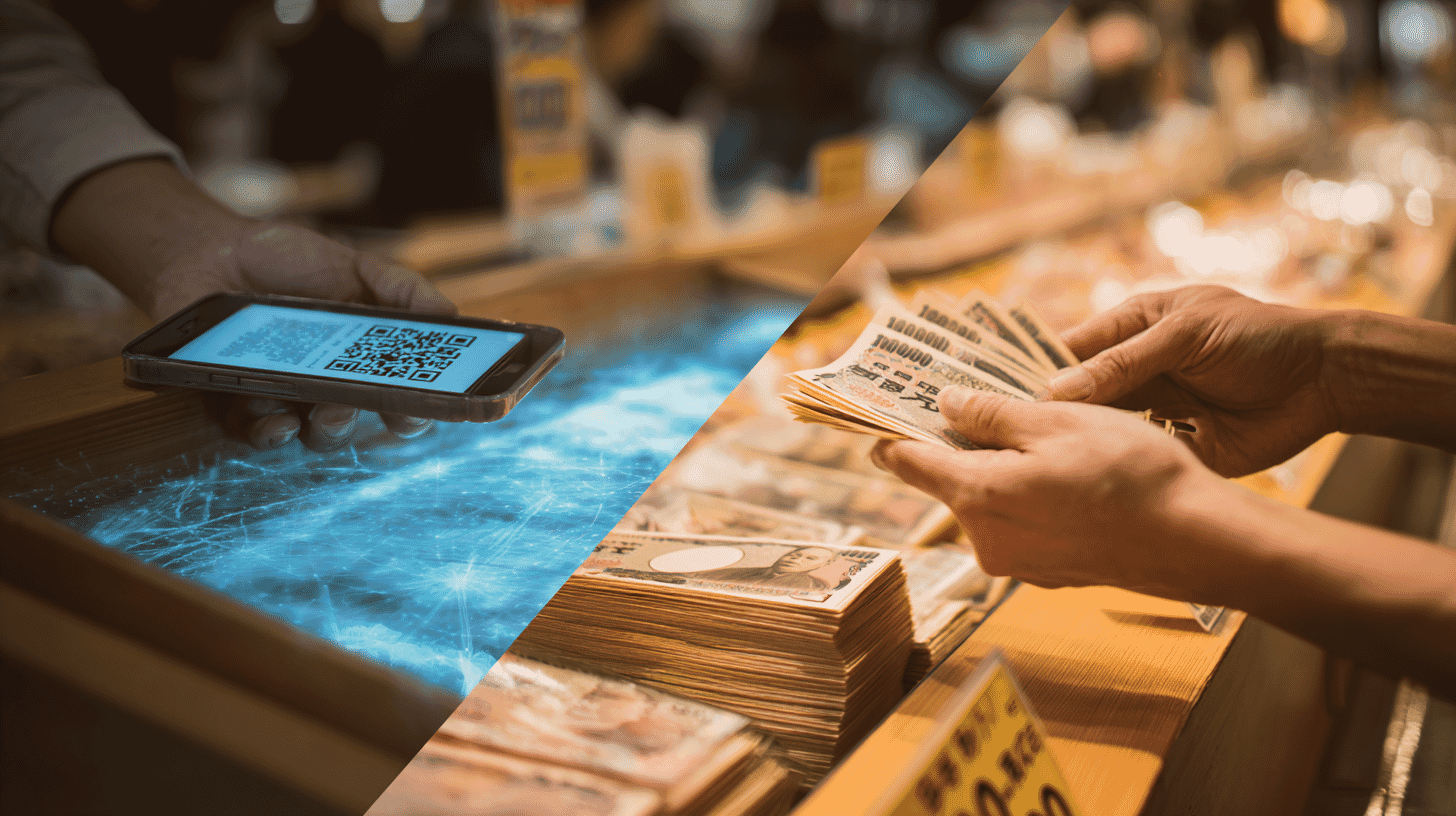
Japan's cashless payment ratio reached 58.0 percent in 2025 on the domestic measure, and the government is aiming for 65 percent by 2030. Against that current, some stores are switching back to cash only. A supermarket in Sendai dropped card payments to save about 20 million yen a year in fees and put the money into its prices. Here is what those fees cost, and why the reversal is happening here.
A Surprising Reversal in the Age of Digital Payments
In 2024, Japan achieved a cashless payment ratio of 42.8%, surpassing the government's target of 40% by 2025 a year ahead of schedule. The share kept climbing: figures released by the Ministry of Economy, Trade and Industry in March 2026 put 2025 at 58.0% (162.7 trillion yen) under a new domestic yardstick, or 46.3% under the older international one. The government now aims for 65% by 2030 and 80% eventually. With the proliferation of credit cards, QR code payments, and electronic money, the country has been steadily building an environment where consumers can shop with just their smartphones.
However, a peculiar counter-movement is emerging: an increasing number of stores are deliberately returning to "cash only" operations, a phenomenon rarely seen in developed nations worldwide.
Annual Fees of 20 Million Yen Straining Business Operations
Seisenkann Muranushi, a supermarket in Sendai City, Miyagi Prefecture, made a bold decision in April 2025 to abolish all cashless payments and accept only cash. While approximately 30% of their customers had been using cashless options, the store was paying around 20 million yen (approximately $130,000 USD) annually in transaction fees to payment service providers.
"When we thought about what we could do as a store to help customers cope with rising prices, we decided it was better to cut our expenses and pass those savings on to our customers," explained the store manager. By eliminating cashless payment fees, they've been able to offer remarkably low prices: carrots at around 200 yen per bag, daikon radishes at under 100 yen each, and a box of tangerines for about 1,000 yen. The strategy has reportedly led to increased sales.
The Cash-Only Movement Spreads to Restaurants and Services
G.G.C., a steak and hamburger restaurant in Takasaki City, Gunma Prefecture, also discontinued electronic money payments in September 2025, limiting transactions to credit cards and cash only. The savings from reduced fees allowed them to offer free rice upgrades (previously a paid option), resulting in approximately 150,000 yen in additional monthly profits.
The Aki-Takata City Museum of History and Folklore in Hiroshima Prefecture has also adopted a cash-only policy for admission fees. When they posted on social media that "While this is indeed the age of cashless payments, please understand it is not a given," some criticized them for being outdated. However, through careful communication with visitors, they've gained understanding for their decision.
The Reality of Cashless Payment Fees in Japan
Cashless payment fees in Japan vary by payment method and business size, but generally hover around 3% of the transaction amount.
Typical fee rates include:
- Credit card payments: approximately 3.0–3.25%
- QR code payments (PayPay, etc.): approximately 1.6–1.98%
- Electronic money payments: approximately 3.0–3.5%
Additional costs may include transfer fees for receiving sales proceeds and monthly terminal rental fees. For retail stores and restaurants operating on thin margins, these expenses represent a significant financial burden.
A Ministry of Economy, Trade and Industry survey found the average fee rate merchants said they could tolerate was 5.0% among those already accepting cashless payments and 6.0% among those that did not. More than 80 percent, however, said the rate they actually wanted was under 3%, and that gap against the prevailing low-3% rates is what drives the return to cash.
Global Comparison: Why Does Japan's Cash Culture Persist?
Comparing cashless payment ratios worldwide (figures from around 2021), South Korea leads at approximately 99%, followed by China at 83%, Australia at 68%, and the United Kingdom at 64%. On the international yardstick Japan stood at 46.3% in 2025, still low among developed nations.
South Korea implemented aggressive policies to promote credit card usage following the late 1990s Asian financial crisis. Measures included making a portion of card spending tax-deductible and mandating that businesses above a certain size accept card payments.
In China, counterfeit currency was a widespread social problem, and the highest denomination bill (100 yuan, approximately $14 USD) made cash transactions inconvenient. These factors contributed to the explosive adoption of smartphone-based QR code payments.
Japan, by contrast, enjoys extremely high trust in its currency, with counterfeit bills being exceptionally rare. The convenience of ATMs throughout the country and the famous safety that sees lost wallets returned intact also support the enduring cash culture.
Strong Cash Preferences Among Elderly Consumers
Street interviews conducted in Sugamo, Tokyo, a neighborhood known for its elderly population, revealed strong preferences for cash among older consumers.
"I feel more secure shopping with cash. With cashless payments, I tend to overspend," said a woman in her 70s. Another woman in her 80s explained, "If I drop my card, it would be terrible, so I try not to carry them around."
At a clothing store in Sugamo's shopping district, over 80% of customers choose to pay with cash. A store employee candidly shared, "Customers casually use their cards because they earn points, but we're thinking about the fees we have to pay for each transaction..."
A New Business Strategy for the Era of Rising Prices
As continuous inflation persists, retail stores and restaurants are exploring various cost-cutting measures. While the return to "cash only" may appear to go against the times, it delivers clear benefits through lower prices for customers.
However, challenges remain in serving customers who prefer cashless convenience, particularly the growing number of international tourists. With inbound visitors hitting a record 42.68 million in 2025, accommodating diverse payment methods is often essential.
How to balance cash and cashless operations, this has emerged as a new challenge for store management in an era of rising prices, and the debate is likely to continue.
What About Your Country?
What's the situation in your country, is cashless or cash payment more common? And what discussions are happening about transaction fees for merchants?









Global Discussion
15 comments