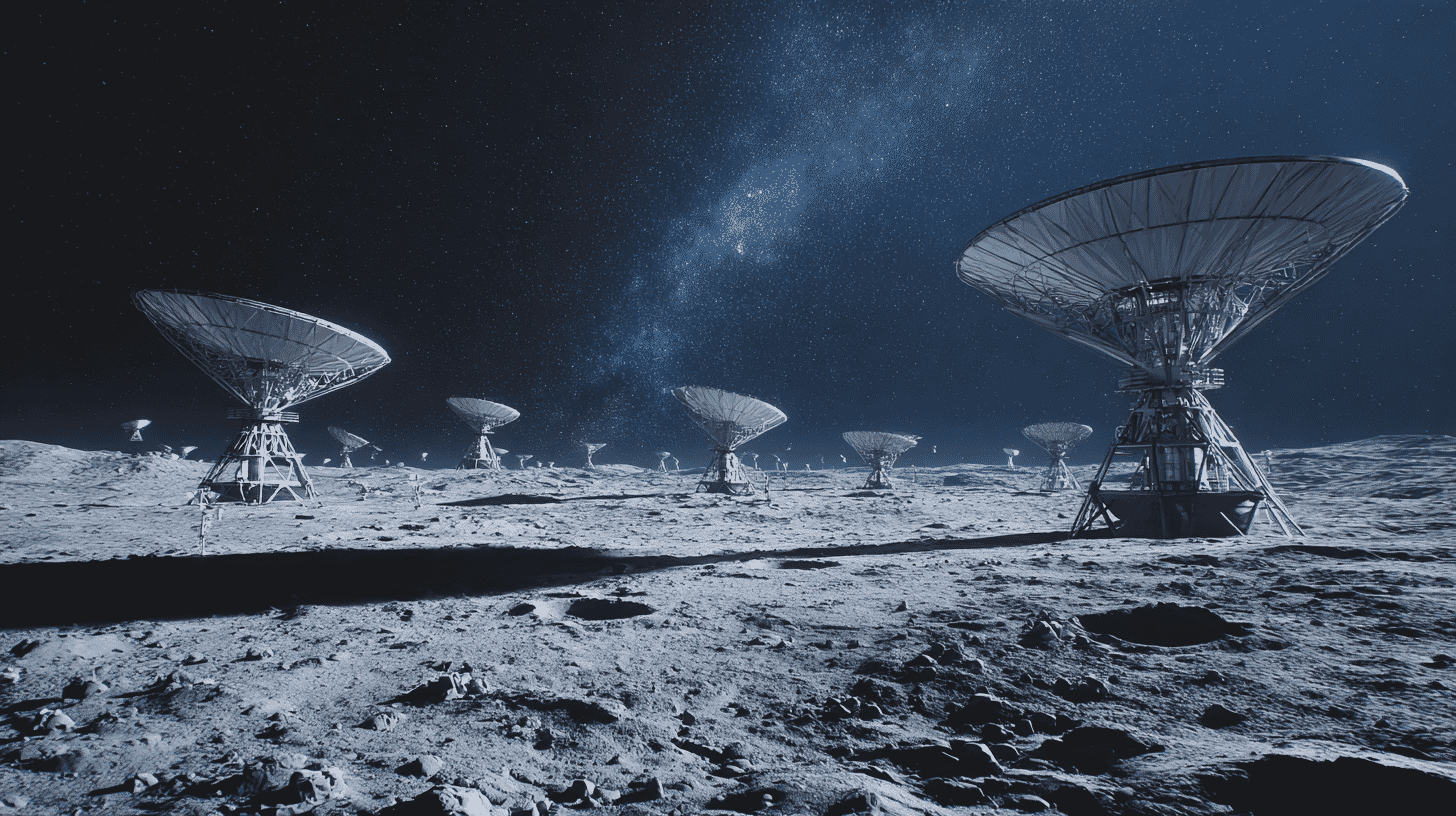
For about 100 million years after the Big Bang, the universe had no shining objects. The radio waves that neutral hydrogen emitted then have since been stretched to around 15 MHz, arriving as a signal of roughly 40 millikelvin in brightness temperature. That band is blocked by Earth's ionosphere, which is why Japan wants an observatory on the far side of the Moon.
Observing 13.8 Billion Years Ago from the Moon
Japan is advancing plans to construct a low-frequency radio telescope called "TSUKUYOMI" on the lunar surface. The project aims to launch a prototype in the 2020s and deploy more than 10 autonomous antennas on the Moon by the late 2030s.
The primary objective is to observe the "Cosmic Dark Ages", the period approximately 13.8 billion years ago. For about 100 million years after the Big Bang, before the first stars were born, the universe contained no stars or galaxies, only neutral hydrogen gas. By capturing traces of this era, scientists hope to reveal what the universe looked like at its very beginning.
Details of the TSUKUYOMI Project
Participating Institutions
The TSUKUYOMI project is led by JAXA's Institute of Space and Astronautical Science (ISAS), with participation from the National Astronomical Observatory of Japan (NAOJ), Tohoku University, Osaka Metropolitan University, Okayama University of Science, and Kumamoto University.
The project draws on Japan's expertise in radio astronomy, including operational experience with the ALMA telescope in Chile's Atacama Desert, lunar exploration technologies developed through the Kaguya and SLIM missions, and radio observation capabilities demonstrated by science satellites such as Arase and JUICE.
Scientific Objective: Detecting the 21-cm Line Global Signal
The project's primary scientific goal is detecting the "neutral hydrogen 21-cm line global signal" from the Cosmic Dark Ages.
About 380,000 years after the Big Bang, as the universe cooled, protons and electrons combined to form neutral hydrogen atoms. These atoms absorb or emit radio waves at a wavelength of 21 cm (frequency 1.42 GHz) against the cosmic microwave background radiation.
Due to the universe's expansion, signals from the Dark Ages are redshifted and now observed as low-frequency waves around 15 MHz. This signal is extremely faint, only about 40 millikelvin in brightness temperature.
The significance of this observation lies in obtaining pure cosmological information unaffected by star and galaxy formation. Scientists expect insights into the distribution of matter in the universe and the properties of dark matter that conventional methods cannot provide.
Technical Approach
TSUKUYOMI will employ short dipole antennas. The observation frequency range is 1-50 MHz, including bands that cannot reach Earth's surface due to ionospheric shielding.
The greatest observational challenge is that foreground radiation from our Milky Way galaxy is far stronger than the target signal. Precise calibration of frequency characteristics is key to success. The effect of the lunar surface on antenna beam patterns must also be considered.
The antennas will be mounted on poles to achieve sufficient height above the lunar surface, with deployment mechanisms for both the poles and antennas themselves. The system requires "lunar night survival" technology to endure extreme cold, plus heating, power generation, energy storage, and communication capabilities for continuous "all-night observation."
Why Lunar Observation is Necessary
Limitations of Earth-Based Observation
Low-frequency radio waves in the tens of MHz range are reflected by Earth's ionosphere, making ground-based observation extremely difficult. Additionally, Earth's environment is saturated with artificial radio waves from televisions, radios, and mobile phones, an unsuitable environment for detecting faint cosmic signals.
Furthermore, natural noise sources such as AKR (Auroral Kilometric Radiation) associated with aurora phenomena also interfere with precision observation near Earth.
Advantages of the Lunar Far Side
The far side of the Moon is a "radio quiet zone" where Earth is never visible. The Moon itself acts as a massive shield blocking artificial radio waves from Earth. This is said to be the most radio-quiet location in the entire solar system.
The Moon has no atmosphere or ionosphere, allowing direct reception of radio waves at all wavelengths. For catching the 21-cm line from the Dark Ages, there is no better place.
Development Roadmap
2020s: Prototype "LOPTA"
The first prototype, "LOPTA," is positioned as the TSUKUYOMI Prototype Antenna. Its purpose is technology demonstration for cosmic radio reception observation on the lunar surface. It will observe artificial radio waves from Earth, Milky Way radiation, and solar flare bursts to evaluate noise impacts in actual lunar conditions.
Early 2030s: Autonomous Antenna System Demonstration
The next phase aims to demonstrate an autonomous antenna system capable of surviving lunar nights and conducting all-night observations. This involves verifying systems integrating heating, power generation, energy storage, and communication functions.
Late 2030s: Full Observation Array Construction
The ultimate goal is deploying more than 10 autonomous antennas on the lunar surface to achieve observations as a lunar radio telescope and interferometer. Phased deployment offers advantages in leveraging various lunar exploration methods, infrastructure, and international cooperation.
Comparison with Global Lunar Radio Telescope Projects
United States: NASA LCRT Concept
NASA is advancing the "Lunar Crater Radio Telescope (LCRT)" concept. The idea involves stretching wire mesh inside a lunar crater to construct a radio telescope approximately 1 km in diameter, with construction performed by robots. Research continues under NASA's Innovative Advanced Concepts (NIAC) program.
China: 7,200 Antennas on the Far Side
China is actively pursuing lunar radio astronomy. The Queqiao relay satellite launched with Chang'e 4 in 2018 carries NCLE (Netherlands-China Low-Frequency Explorer), a low-frequency radio observation instrument jointly developed with the Netherlands.
Researchers at the China Academy of Space Technology and the Shanghai Astronomical Observatory have sketched an array of 7,200 butterfly-shaped antennas laid out in a 30-kilometer circle on the far side, to be finished by 2035. Chang'e 7 and 8 would place 16 test antennas first, with the rest following in stages. Riding along on Chang'e 8, now slated for 2029, is Africa2Moon, a South African-led demonstration in which three spheres carrying low-frequency antennas bounce across the surface into position. The eventual goal is a network of 55 antennas, one for each African nation.
International Radio Environment Protection Efforts
To protect the value of lunar radio observatories, the International Telecommunication Union (ITU) has established recommendations for radio environment protection in the Moon's Shielded Zone (SZM). Making all frequency bands below 2 GHz available for radio astronomy observation in the SZM is designated as the primary requirement.
Scientific Significance and Expected Outcomes
If it succeeds, TSUKUYOMI will let humanity "directly observe" the Cosmic Dark Ages for the first time, an era so far inferred only indirectly from the cosmic microwave background and distant galaxies.
Expected scientific outcomes include elucidation of matter distribution in the early universe, new insights into dark matter properties, and precision verification of cosmological models. Secondary scientific objectives include observation of stellar radiation from exoplanetary systems, planetary auroras, and characterization of the lunar radio environment.
Professor Tohru Yamada of JAXA's Institute of Space and Astronautical Science explains: "In terms of directly seeing the distribution of matter, the Dark Ages can be called the first page of cosmic history. A lunar observatory that can gaze upon the beginning of cosmic history from the far side or polar regions of the Moon, humanity's outpost toward the cosmos, is truly filled with romance."
What initiatives exist in your country regarding lunar exploration and space astronomy? What do you make of the idea of an observatory on the Moon?






Global Discussion
16 comments