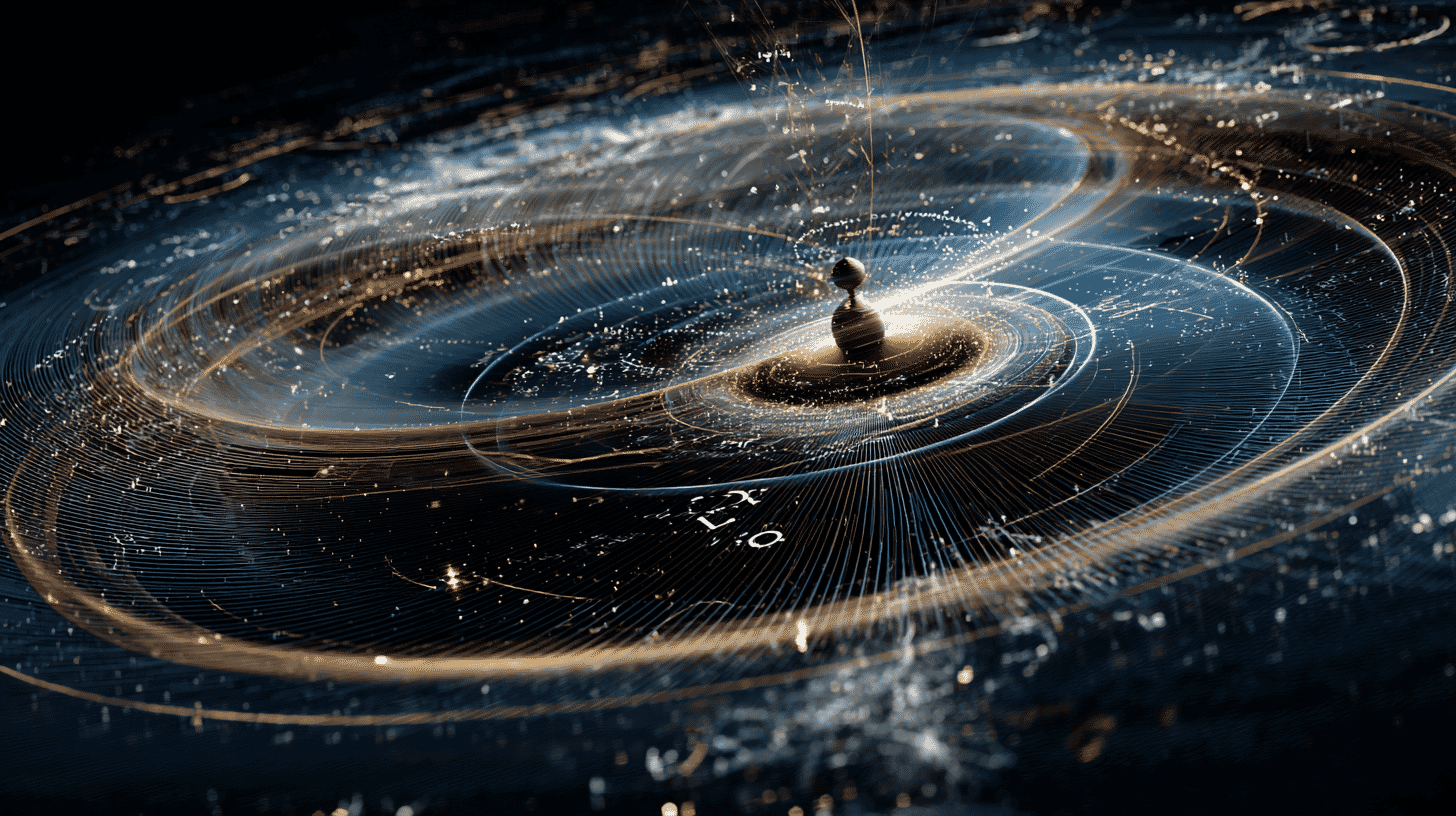
Quanta Magazine called 2025 a historic year for mathematics, and put the proof of the Kakeya conjecture in three dimensions among its three biggest advances.
The problem was published in 1917 by the Japanese mathematician Sōichi Kakeya. Deceptively simple to state, it went unsolved for more than a century. In February 2025, the three-dimensional case fell.
What is the Kakeya Problem? A Simple Question About Rotating a Pencil
The problem starts here. Place a pencil (a line segment of length 1) on your desk. How can you rotate this pencil to point in every direction while sweeping over as little area as possible?
The most intuitive answer is to spin the pencil around its center, tracing out a circle. However, with clever maneuvering, you can actually cover a much smaller area.
Kakeya himself initially suggested the Reuleaux triangle as a solution, but his colleagues soon discovered that rotation was possible within an even smaller equilateral triangle.
A Surprising Discovery: Rotation in Zero Area
In the 1920s, Russian mathematician Abram Besicovitch made a remarkable discovery that would reshape the problem entirely. He proved that "the area required to rotate a line segment of length 1 can be made arbitrarily small." Moreover, he demonstrated that "a set containing line segments in every direction can have zero area."
That shifted the focus from minimum area to dimension. A set can have zero area and still occupy space in intricate ways, and dimension is the tool that measures how intricately.
The dimensions referred to here are mathematically rigorous concepts known as "Hausdorff dimension" and "Minkowski dimension." Unlike integer dimensions, these can take fractional values like 2.5. Complex shapes like fractals often possess such intermediate dimensions.
The Kakeya Conjecture: Does the Dimension of the Set Equal the Dimension of the Space?
The modern "Kakeya conjecture" states:
In n-dimensional space, any set containing a unit line segment in every direction (a Kakeya set) must have dimension n.
In other words, a Kakeya set in 2D space must have dimension 2, and a Kakeya set in 3D space must have dimension 3.
The conjecture is trivially true for one dimension. Roy Davies proved the two-dimensional case in 1971. Three dimensions and above then stayed open for more than 50 years.
The Historic 2025 Proof
In February 2025, Hong Wang, an associate professor at New York University's Courant Institute of Mathematical Sciences, and Joshua Zahl, an associate professor at the University of British Columbia, finally proved the 3D Kakeya conjecture completely.
Fields Medalist Terence Tao praised the achievement, writing, "There has been some spectacular progress in geometric measure theory!" Eyal Lubetzky, chair of the Mathematics department at the Courant Institute, called it "one of the top mathematical achievements of the 21st century."
Quanta Magazine described this proof as a "once-in-a-century" result, emphasizing its historic significance.
The Key Idea: Multi-Scale Analysis
The method employed by Wang and Zahl is called "multi-scale analysis."
They conceptualized line segments (needles) as thin tubes of radius δ, then observed them progressively from microscopic to macroscopic scales, much like adjusting magnification on a microscope. They rigorously proved a property called "non-clustering," showing that multiple tubes cannot concentrate excessively in any particular location in space.
Central to the proof is a multi-scale, self-similar structure of Kakeya sets known as "stickiness," whose importance dates back to the groundbreaking 1999 work of Nets Katz, Izabella Łaba, and Terence Tao. Wang and Zahl themselves first proved, in 2022, that this special class of "sticky Kakeya sets" must have dimension 3, and in 2025 they reduced the general case to the sticky case, completing the proof.
Impact on Our Lives: Future Applications
This is pure mathematics, and nothing in your phone changes next quarter because of it. But because the conjecture sits under the foundations of harmonic analysis, there is room for it to matter downstream over a long horizon.
Contributions to Harmonic Analysis and Fourier Transforms
The Kakeya conjecture is intimately connected to a cluster of problems forming the foundation of harmonic analysis. The Fourier transform, a technique for expressing any signal as a sum of sine waves, underpins modern mobile phones and digital communications. This resolution is expected to drive advances in these theories.
Signal Processing and Communication Technology
Better models of how signals such as radio waves propagate and overlap in space could feed into next-generation wireless network design, and, more indirectly, into data compression algorithms.
Medical Imaging
Image reconstruction algorithms for MRI and CT scans are based on harmonic analysis techniques. The new mathematical methods emerging from this achievement may lead to more precise medical imaging technologies.
Future Prospects: The Challenge of Higher Dimensions
With the 3D proof complete, mathematicians now set their sights on four dimensions and beyond. The proof also opens pathways to the Kakeya maximal conjecture, the restriction conjecture, and the Bochner-Riesz conjecture, a hierarchy of challenging problems in harmonic analysis.
These conjectures form a layered structure, with the Kakeya conjecture as the foundation. Wang herself describes Fourier analysis as having a tower of conjectures with Kakeya at the bottom: disprove Kakeya and the whole tower falls. Proving it in three dimensions therefore adds weight to the others holding in three dimensions too. This proof makes climbing that tower a realistic possibility.
About Sōichi Kakeya
Sōichi Kakeya (1886–1947) was born in what is now Tsubo, Fukuyama City, Hiroshima Prefecture. After graduating from Tokyo Imperial University he was an associate professor at Tohoku Imperial University, then a professor at Tokyo Higher Normal School and at Tokyo University of Literature and Science, and became the first director of the Institute of Statistical Mathematics when it was founded in 1944. In 1928 he gave an invited lecture at the International Congress of Mathematicians in Bologna and received the Imperial Prize of the Japan Academy the same year.
An interesting anecdote about the problem's origin survives: When mathematician Kentaro Yano asked Kakeya how he conceived the problem, Kakeya reportedly answered that "samurai carried their spears even when entering the toilet. If they had to fight in such a confined space, they would need to wield the spear in the smallest possible area."
A question one Japanese mathematician asked 108 years ago was answered by mathematicians on the other side of the world. That is roughly what the discipline looks like from the inside.
Update: On July 23, 2026, at the opening ceremony of the International Congress of Mathematicians in Philadelphia, Hong Wang was awarded a 2026 Fields Medal. The International Mathematical Union's citation covers her work in harmonic analysis and geometric measure theory, including multiscale and decoupling techniques applied to the local smoothing conjecture for the planar wave equation, and major advances in Fourier restriction, Falconer distance sets, Furstenberg sets in the plane, and the Kakeya problem in three dimensions. The Kakeya work is one part of that. She is only the third woman to win the medal in its 90-year history. She was an associate professor at NYU's Courant Institute when the proof appeared; she is now a Silver Professor there and also a professor at France's Institut des Hautes Études Scientifiques.
Just as the Kakeya conjecture, born in Japan, led to a worldwide breakthrough, mathematical problems transcend national boundaries to connect researchers globally. What famous mathematical problems originated in your country? Are there any challenging problems still being studied today? Share your thoughts in the comments!
References
- https://gigazine.net/news/20251230-breakthroughs-in-mathematics-2025/
- https://www.quantamagazine.org/once-in-a-century-proof-settles-maths-kakeya-conjecture-20250314/
- https://www.nyu.edu/about/news-publications/news/2025/march/mathematicians-move-the-needle-on-decades-old-problem.html
- https://terrytao.wordpress.com/2025/02/25/the-three-dimensional-kakeya-conjecture-after-wang-and-zahl/
- https://arxiv.org/abs/2502.17655
- https://levtech.jp/media/article/column/detail_635/
- https://en.wikipedia.org/wiki/Kakeya_set








Global Discussion
15 comments