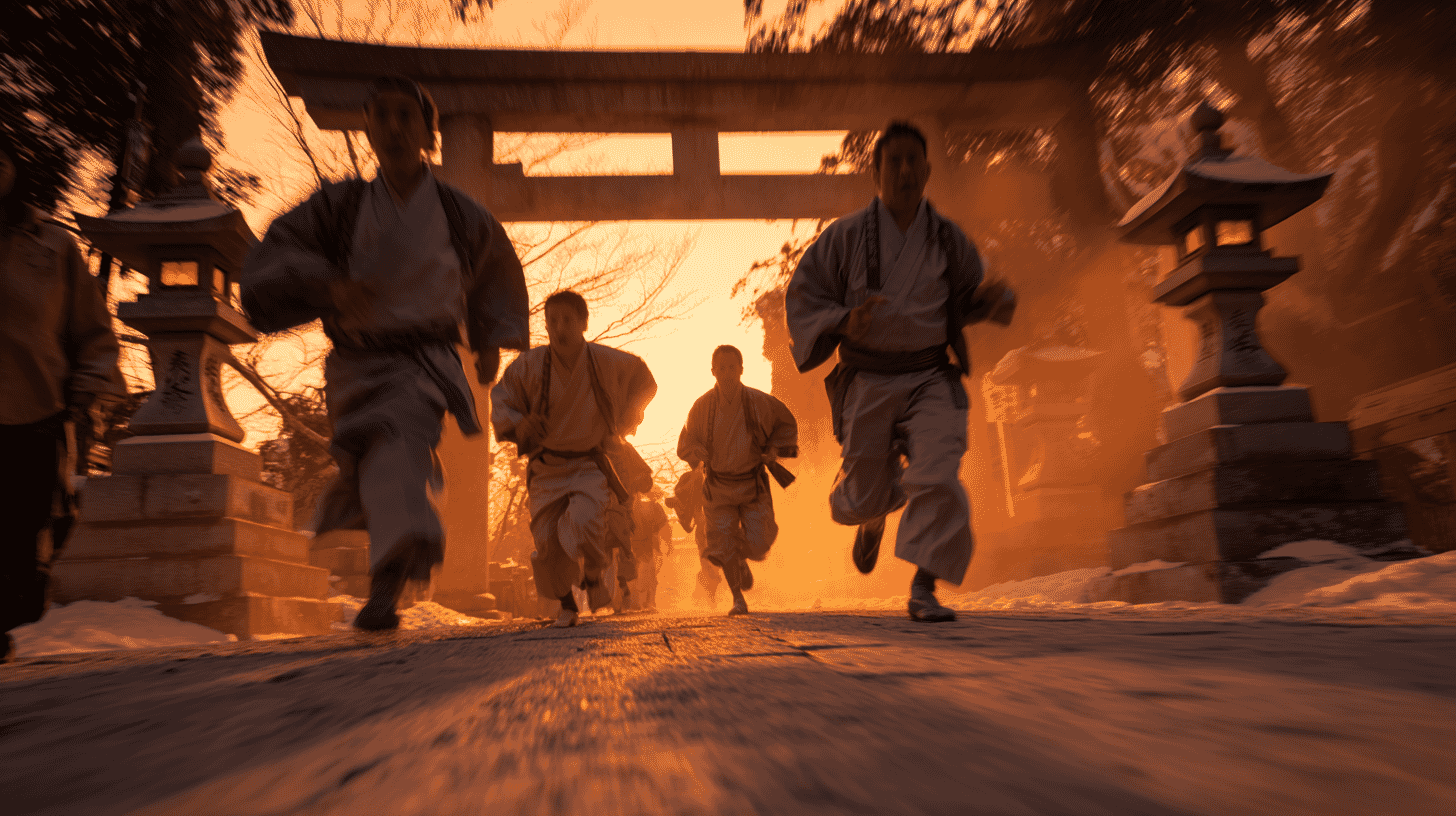
At six in the morning on January 10 each year, the main gate of Nishinomiya Shrine in Hyogo Prefecture swings open. A drumbeat gives the signal, and the crowd waiting outside sprints the roughly 230 meters to the main hall. Whoever reaches it first is named ichiban-fuku, the first lucky one, better known as the fukuotoko. The Kaimon Shinji Fukuotoko Erabi has run since the Edo period, and it remains one of the few events anywhere that is simultaneously a sprint and a religious rite.
Running at the Head Shrine of Ebisu
Nishinomiya Shrine is the head shrine of the Ebisu faith in Japan. Ebisu presides over commercial prosperity, good harvests, and good fortune, and the Toka Ebisu festival held from January 9 to 11 draws crowds on a scale few festivals in the Kansai region can match.
The race belongs to the rites of the main day, January 10. It is not a footrace with a shrine as backdrop; arriving first is understood as being recognized by the deity. That is why an event decided by finishing order gets described in the passive voice, as being chosen.
The Lottery for 108 Places
Anyone can take part, but a good starting position has to be won the night before. Late on January 9, a lottery is held in the shrine grounds, and the winners make up the 108 runners in the front row; in some years a second row of 108 is drawn as well. In recent years the field has run to around 5,000 people, so whether you draw one of those 108 slots largely determines your chances.
Losing the lottery does not disqualify you; you can still run from behind. Given the crush at the gate and the first bend, though, coming through from the back is not a realistic proposition.
A 230-Meter Course With Teeth
The distance sounds trivial. The route is not.
Past the gate the path swings right by about 130 degrees at a bend known as the tenbin curve. Runners arriving at full speed lose their footing there, and when one goes down the ones behind go with him. A large pileup at this bend happens nearly every year, and it is usually the footage that ends up on the national news. Beyond it comes a straight of roughly 100 meters known as the fukuotoko path.
Beyond it lies a stone-paved approach. On a winter morning the surface is cold and, if damp, slick. The last stretch is the straight in front of the main hall, where a finish counts only once a priest has been touched.
Speed Alone Does Not Win It
Past winners have included track athletes, but also firefighters, office workers, and students. People who consider themselves fast do not reliably win, and that is part of what makes the rite interesting.
What it demands is the judgment to dodge a falling runner in an instant, footwork that holds on wet stone, and enough composure not to panic in a crowd of thousands. Beyond that, which line opens up is something you cannot know until you are running. Participants absorb that residue of chance in their own phrasing: the deity decides.
The Winners of 2025 and 2026
In 2025 the gate opened at six on January 10 and roughly 5,000 people took part. The ichiban-fuku was Fumiya Ogishi, 17, a second-year student at Hyogo Prefectural Takarazuka High School and a member of its track club. His event is the javelin, but he runs 100 meters in the low 12s, and on his first attempt he came from the second row of the front group to reach the hall first. Second place went to Yuki Kwabena Komatsu, 21, a third-year at Ryukoku University, and third to Akihiro Yabuki, 22, a fourth-year at Doshisha University.
On January 10, 2026, the winner was Teppei Toyokawa, 22, a fourth-year at Doshisha University living in Kyoto's Kamigyo ward and originally from Kato in Hyogo. According to the Kobe Shimbun he fell once along the way and still finished first, which is about as neat a demonstration of what this rite rewards as one could ask for. Second place went to Ayumu Sawai, a third-year at Kobe International University, and third to Daiki Akamatsu, a fourth-year at Biwako Seikei Sport College. All three were university students.
What the Winner Receives
Three runners are recognized each year, first through third. The prizes scale with placing: a carved wooden image of Ebisu, a happi coat, a ceremonial fuku-zasa bamboo branch, a bale of rice, a cask of sake, Yebisu beer, and snow crab. That the size of the carving depends on your finishing position is very much in keeping with the spirit of the thing.
Winners are also invited to shrine events throughout the following year. Because television and newspapers carry the result nationwide, their names and faces circulate widely. The recognition is an honor and, for twelve months, a role to carry.
The fuku in fukuotoko means good fortune and otoko means man. Women increasingly take part, though the rite has kept the original name. The sight of thousands of people breaking into a run the moment a gate opens has drawn coverage from foreign outlets as well, making it one of the more striking items in Japan's new year calendar.
Does your country have unique traditions for grabbing good luck at the start of a new year? Tell us in the comments!
References
- https://nishinomiya-ebisu.com/
- https://www.kobe-np.co.jp/news/society/202601/0019897494.shtml - Kobe Shimbun on the 2026 race
- https://www.kobe-np.co.jp/news/society/202501/0018527202.shtml - Kobe Shimbun on the 2025 race
- https://www.japan-guide.com/e/e3556.html





Global Discussion
16 comments