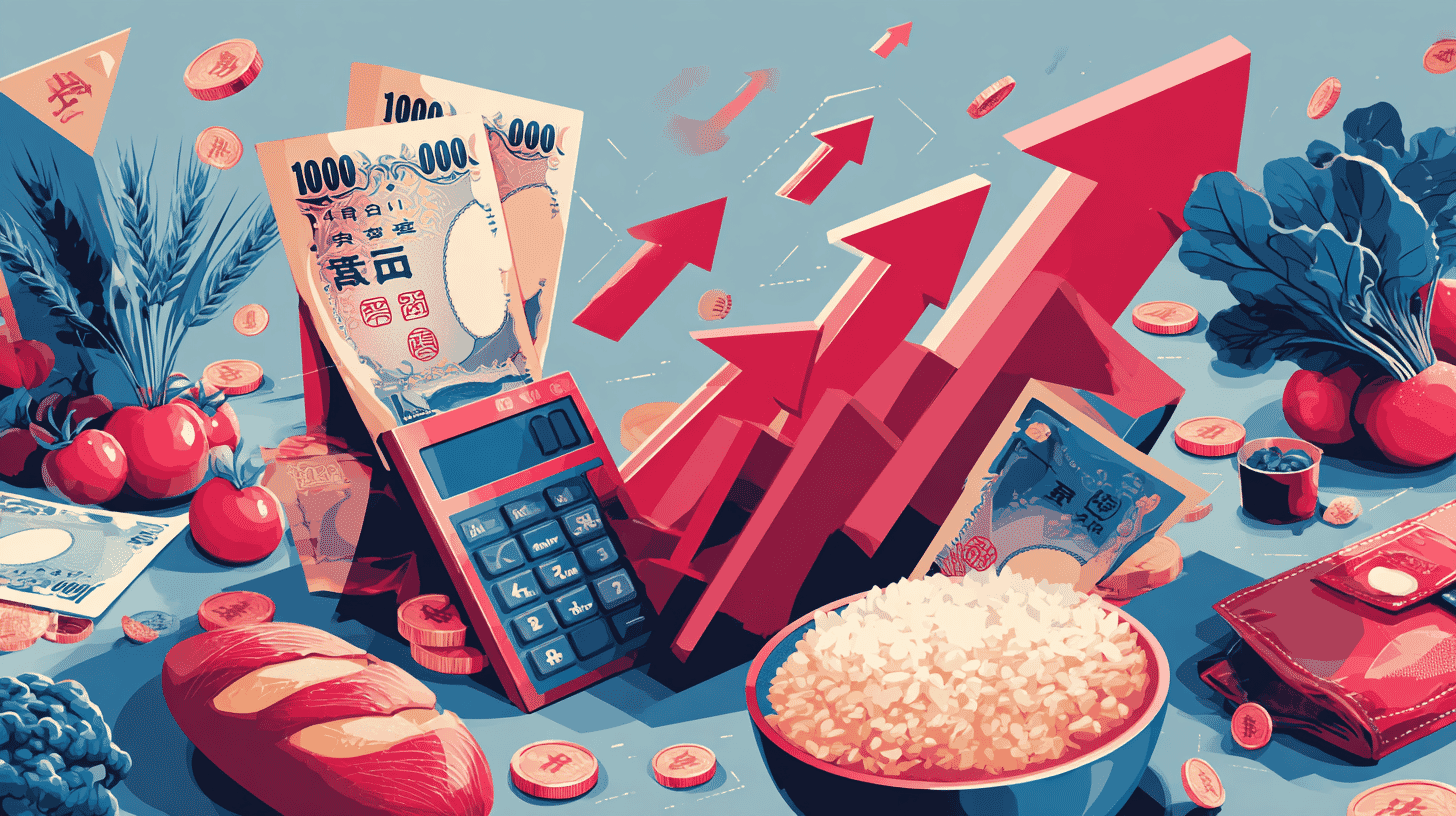
In the 2024 spring wage talks, Rengo's final tally put the average increase at 5.10%, the highest in 33 years. However, what most Japanese people are experiencing is financial hardship. Behind this contradiction lies inflation outpacing wage growth.
Over 90% of companies reported raising wages in a Ministry of Health, Labour and Welfare survey. Real wages still fell for four consecutive months through November 2024. In November, nominal cash earnings rose 3.0% year on year while consumer prices excluding imputed rent climbed 3.4%, leaving a 0.3% shortfall.
Soaring Food Prices Hit Households Hard
Food price inflation has been particularly severe. In December 2024, rice prices surged by a record 64.5% year-on-year due to summer supply shortages and increased production costs.
Chocolate and confectionery prices have also risen sharply as global cocoa bean prices soared on bad weather in producing countries such as Ghana. Combined with yen depreciation, everyday grocery prices have gone up across the board. Beverages, processed meats, and condiments, the items closest to household budgets, have been hit hardest.
Yen Depreciation and Logistics Costs Drive Inflation
Multiple factors are accelerating inflation. First, the weak yen. With the U.S.-Japan interest rate differential persisting, import costs have risen and are being passed on to final product prices.
Second, labor costs. Ironically, wage increases themselves have become a cost factor, prompting companies to transfer these expenses to sales prices. This is particularly evident in labor-intensive service and food manufacturing industries.
Third, rising logistics costs. The so-called "2024 Logistics Problem," stricter working hour regulations in the transportation sector, has increased shipping costs, which feed into product prices.
The Meaning of Continued Negative Real Wages
A Bank of Japan survey from September 2024 revealed that over 55% of respondents felt the economic situation had worsened, while only 6.9% felt it had improved. More than 50% reported their living standards becoming tighter.
Negative real wages mean the same amount of work buys less. That is what people mean when they say things have gotten harder.
The Outlook Into 2025
The Cabinet Office predicts consumer price inflation of around 2% for fiscal 2025. Wage increase rates, meanwhile, were expected to moderate somewhat following the 2024 surge.
Surveys of food manufacturers show an increasing number citing logistics and labor costs as reasons for price increases in early 2025. Logistics costs, in particular, are expected to drive further price transfers as the 2024 Problem's impact intensifies.
Will the Wage-Price Virtuous Cycle Materialize?
The government and Bank of Japan aim for a "virtuous cycle of wages and prices," but the current situation shows prices leading while wages lag behind. Without sustained wage increases exceeding the 2-3% inflation rate, turning real wages positive will be difficult.
How much will labor unions demand in the 2025 spring wage negotiations? Will corporate management come to view inflation-beating raises as a natural obligation? That shift in mindset will determine whether Japan's economy can enter a true virtuous cycle.
[Update] Over the next two years the numbers finally began to catch up with how people felt. Spring wage settlements topped 5% in both 2025 and 2026, with Rengo's final tally for 2026 at 5.01%, a third straight year above 5%. Real wages still fell 1.3% in 2025, a fourth consecutive annual decline: nominal cash earnings rose 2.3%, but not enough to beat price rises led by rice (2024 was down 0.2%). The labor ministry has used the all-items CPI in its real-wage calculation since the March 2025 data; on that basis the 2025 decline is a smaller 0.8%. The turn came in 2026. Real wages have been positive for six consecutive months since January, up 1.6% year on year in June. Nominal cash earnings rose 3.4% to ¥531,677, and five straight months of growth above 3% is the first such run since 1992, 34 years ago. Inflation on the measure used for the calculation slowed to 1.9%, which is what made the difference. Rice is at a turning point too. The wholesale price of the 2025 crop peaked at ¥37,058 per 60 kg of brown rice in October 2025 and stood at ¥32,486 in July 2026, still 21% above a year earlier, but supermarket prices in early August averaged ¥3,220 per 5 kg, 13.8% below the same period last year, and the new crop arriving from September is expected to push them lower (as of early September 2026).
Impact on People's Lives and Future Challenges
The price-wage gap cuts deepest for employees at small and medium enterprises, non-regular workers, and pensioners. Wage gains concentrated in large corporations take time to reach the rest of society.
And if consumers pull back on spending as prices rise, corporate profits weaken and the capacity to raise wages goes with them. The risk of the cycle turning vicious has not gone away.
For Japan to leave deflation behind for good, raises that beat inflation have to become the norm, not a one-off. Yet even with record wage gains on paper, the relief never quite reaches the checkout line. That gap between the statistics and the lived feeling is what most Japanese are wrestling with right now. In your country, are paychecks keeping up with prices?








Global Discussion
20 comments