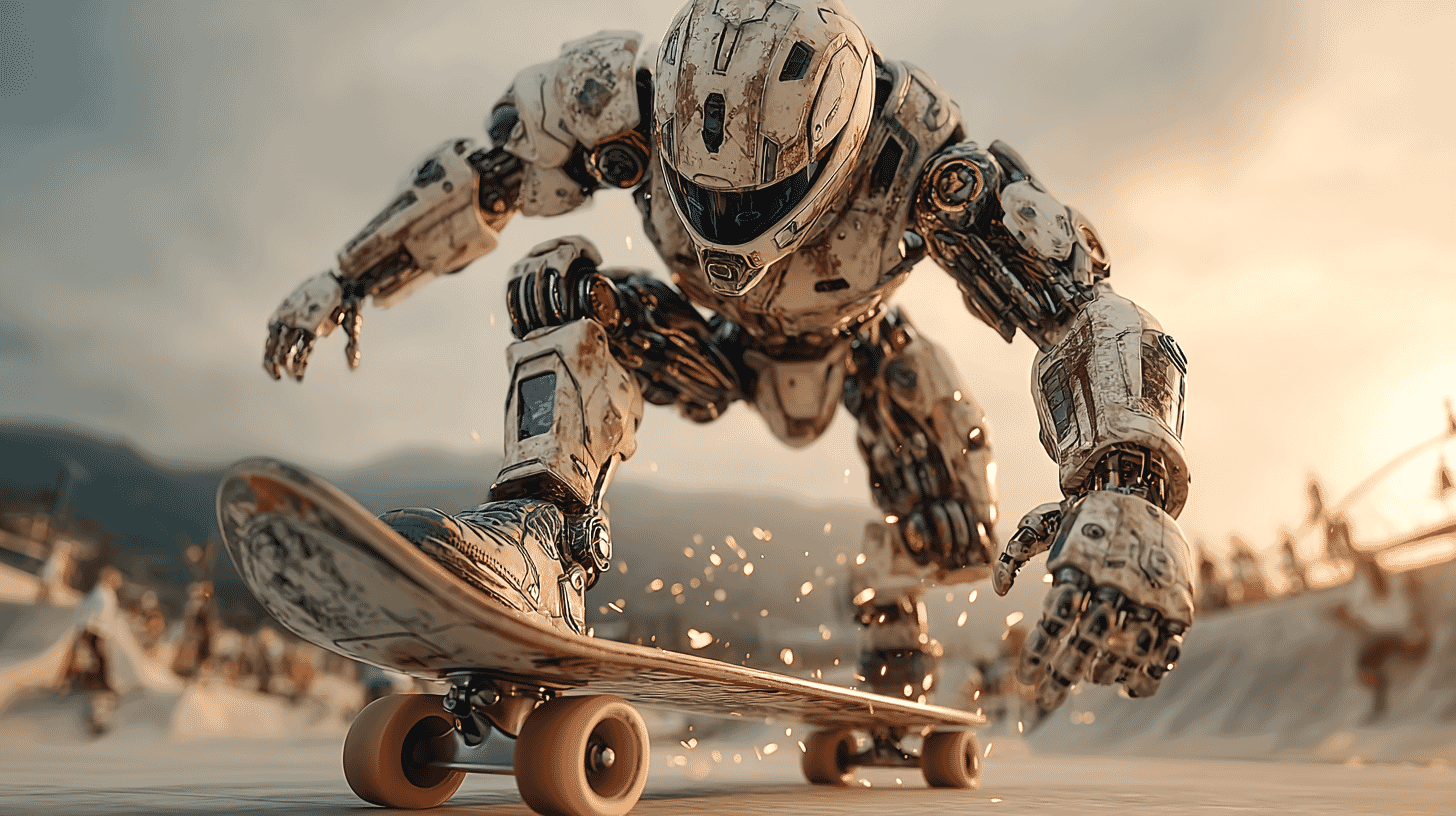
A collaborative research team from ATR (Advanced Telecommunications Research Institute International), Kyoto University, and the National Institute of Advanced Industrial Science and Technology (AIST) is developing a humanoid robot capable of freely riding a skateboard. On September 11, 2025, the team unveiled a robot (152 cm tall, about 40 kg) powered by ATR's "Cyborg AI" that performed slalom skateboarding, achieving human-level real-time motion performance. The work runs under a NEDO-commissioned program on next-generation AI that evolves alongside people, active since fiscal 2020 and led by Shin Ishii, professor at Kyoto University's Graduate School of Informatics and concurrently head of ATR's Brain Information Communication Research Laboratory Group. "Why a skateboard?" is a fair question, and the answer is that the task concentrates most of the problems standing between humanoid robots and practical use.
Why Skateboarding?
Skateboarding is one of the most challenging skills even for humans to master. It requires maintaining balance on an unstable board while controlling direction through weight shifts and responding instantaneously to changes in the road surface. If a robot can accomplish this complex task, it demonstrates breakthroughs in several key areas:
What it takes is dynamic balance control that holds posture under constantly changing conditions rather than static ones, predictive control that anticipates the next moment and acts ahead of it, whole-body coordination linking arms, legs, and torso, and real-time adaptation to changing surfaces. Every one of those is a requirement for a robot working outdoors, and a skateboard tests all of them at once.
The team built an experimental facility on ATR's grounds in Seika, Kyoto Prefecture, which they call the Robot Skate Park; NEDO and ATR announced it on March 12, 2024 as the world's first environment for human-AI co-evolution. There they record a human rider's brain waves, muscle activity, and motion capture data simultaneously, then train the robot on those signals through imitation learning. When the work was first shown publicly in 2024, control centered on shifting the center of gravity by raising and lowering the hips; the September 2025 demonstration extended that to whole-body motion using the upper body as well.
Global Humanoid Robot Development Landscape
Boston Dynamics "Atlas"
Boston Dynamics' "Atlas" has amazed the world with its advanced athletic abilities, performing parkour and backflips. In 2024, the company unveiled a fully electric new Atlas, aiming for practical applications in manufacturing and logistics.
Tesla "Optimus"
Tesla, led by Elon Musk, is pushing Optimus toward mass production. It ended Model S and X output at Fremont in early May 2026 and is converting that line for Optimus. On the April 2026 earnings call, Musk put the start of V3 production at late July or August while warning the ramp would be "quite slow." In January 2026 he had acknowledged that no Optimus units were yet doing useful work in Tesla's own factories. The gap between the stated goals and current progress is real.
Honda "ASIMO" Legacy
Honda's "ASIMO," introduced in 2000, made a global impact as a pioneer in bipedal walking robots. While the ASIMO project has concluded, its technology continues to influence next-generation mobility development.
Figure AI "Figure 03"
Startup Figure AI, reportedly valued at around $39 billion, ended its OpenAI partnership in February 2025 and switched to its own in-house AI model, "Helix." In October 2025 it unveiled its latest robot, "Figure 03," which is now being deployed on BMW's factory floor.
China's Rapid Advancement
In China, multiple companies including UBTECH and Unitree have entered humanoid robot development, rapidly advancing their technological capabilities with government support. They aim to capture market share with competitively priced products.
Japan's Strengths and the Significance of This Research
Japanese robotics technology has led the world in industrial robots. However, in the humanoid robot sector, the rise of American and Chinese players has been remarkable in recent years.
The ATR, Kyoto University, and AIST collaboration is not merely a "showpiece" but holds significant importance in several ways.
Deepening Fundamental Research
The fundamental research approach unique to universities and research institutions allows tackling root technical challenges without rushing toward commercial results.
Industry-Academia-Government Collaboration Model
The cooperation between different types of organizations, ATR (private research institute), Kyoto University (academic institution), and AIST (national research and development agency), enables a multifaceted approach.
Real-World Application Potential
Technologies developed through skateboarding directly translate to practical applications, such as robots navigating debris at disaster sites or construction robots moving across unstable scaffolding.
Technical Challenges
Developing a skateboard-riding robot presents several technical difficulties.
Sensor Technology
The robot must perceive its own posture, board tilt, and road conditions in real-time. High-precision IMUs (Inertial Measurement Units) and force sensors are key.
Control Algorithms
To handle unpredictable disturbances, hybrid approaches combining Model Predictive Control (MPC) and reinforcement learning with traditional PID control are required. In practice, the Cyborg AI predicts 500 possible next motions, completing what amounts to 28 hours of computation in a single second and continuously selecting the optimal move to keep the robot stable in real time.
Actuator Performance
Actuators capable of delivering large forces instantaneously while also enabling delicate control, similar to human muscles, are essential.
Future Outlook
NEDO and ATR say they will build on this result to develop applications in labour-intensive fields such as nursing care, assistance and rehabilitation, and individual transport and haulage. Ishii has spoken of eventually combining Cyborg AI with generative AI and brain-science-based AI to reach a robot that also understands the human mind. The skills learned on a skateboard could feed into fluid assistance in nursing and welfare, off-road mobility for disaster rescue, flexible task handling at construction and manufacturing sites, and applications in sports coaching and education.
The race to mass-produce is being led by American and Chinese firms. But the question of how to teach a machine to move like a person is not solved by unit counts, and that is the part ATR, Kyoto University, and AIST have taken on.
What is the state of humanoid robot development in your country, and what applications are people hoping for?
References
- https://www.kyoto-u.ac.jp/ja/research-news/2025-09-12 - Kyoto University announcement
- https://www.nedo.go.jp/news/press/AA5_101886.html - NEDO press release
- https://www.nikkei.com/article/DGXZQOUF044L40U5A900C2000000/ - Nikkei
- https://www.kyoto-np.co.jp/articles/-/1568693 - Kyoto Shimbun
- https://newswitch.jp/p/48008







Global Discussion
16 comments