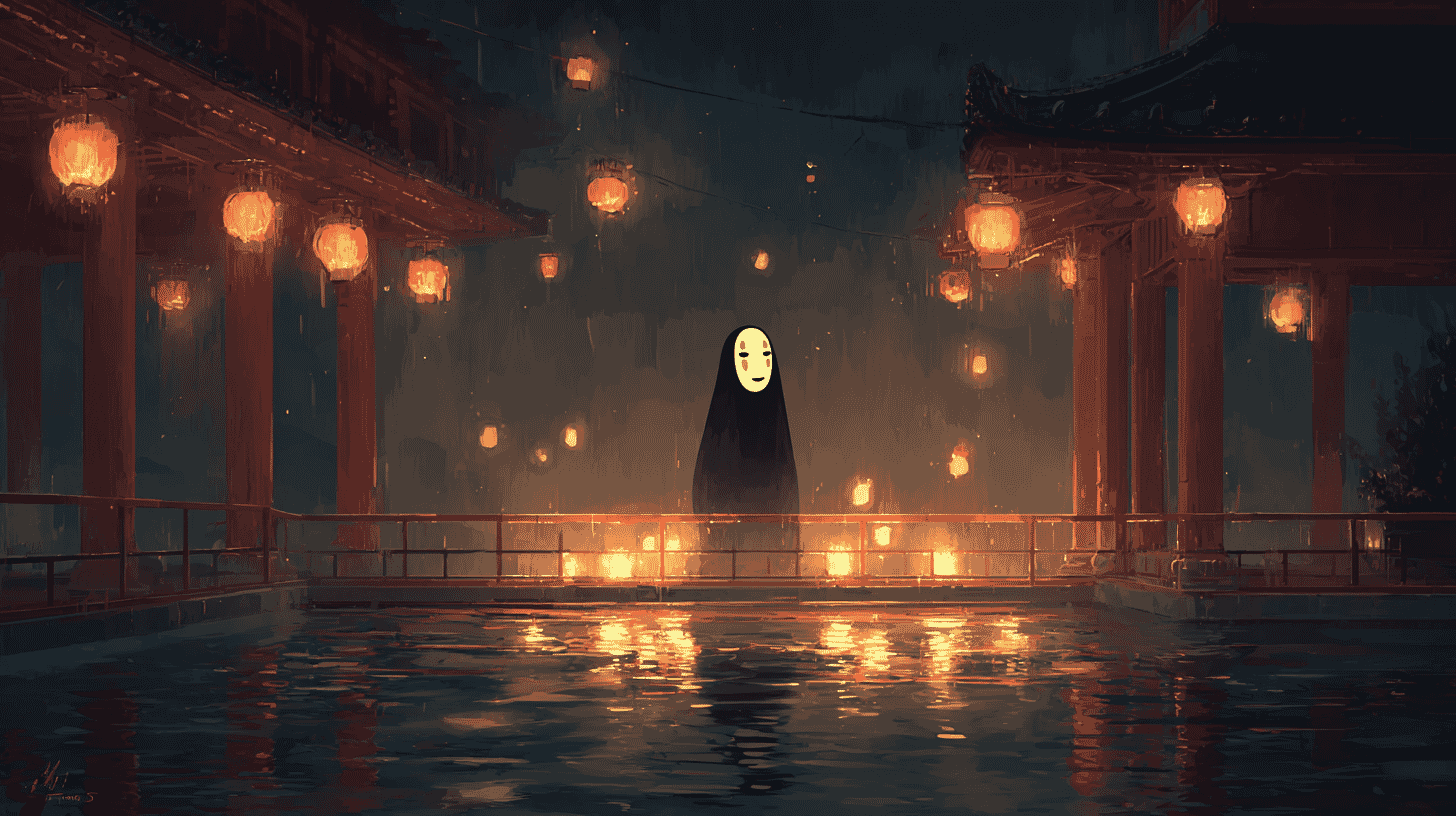
On January 2, 2026, Nippon TV aired Studio Ghibli's "Spirited Away" on its "Friday Road Show" slot. During the broadcast, the program's official X account posted a comment from director Hayao Miyazaki that spread quickly online. It answered a question fans have chewed over for years: what exactly is No-Face (Kaonashi in Japanese)?
What Miyazaki Said About No-Face
The line the account quoted reads:
"There are plenty of No-Faces around us. People who want to latch onto someone but have no self of their own, I think they're everywhere."
No-Face, on this reading, is neither monster nor villain but a being with no self of its own, taking shape from whatever it meets. Layered onto it is a familiar human figure: someone who badly wants to be accepted and connected, yet has no firm identity underneath.
The remark was not new in 2026. The same quote appeared on the show's official X account back in January 2017, and it has been recirculated at nearly every broadcast since.
A Character Nobody Planned
No-Face was never meant to carry the story. Production materials describe the character as having no assigned role at all, simply standing there in the background.
On screen, though, that blankness had an odd pull, and it caught Miyazaki's eye. When the story needed reworking midway through production, he improvised the sequence in which No-Face rampages through the bathhouse. The originally planned climax, defeating the witch Yubaba, was dropped, and the relationship between Chihiro and No-Face became the film's spine instead.
A Being That Keeps Changing
Early on, No-Face is quiet and half-transparent, capable only of "Ah... Ah..." Once inside the bathhouse it buys the staff's attention with handfuls of gold, swells enormous under the greed around it, and eats without stopping. Rejected by Chihiro and fed the bitter dumpling she received from the River Spirit, it vomits up everything it swallowed and shrinks back to its original form. It ends the film at Zeniba's cottage, helping with the work there and finally settling.
While it can only reach people through money, it spirals. Given a role, it calms down. The arc folds in a recognizable pattern: a self reshaped by its surroundings and by whoever happens to be nearby.
Why the Reading Lands in the Social Media Era
The explanation itself has circulated since the film's 2001 release, but the reception has shifted. Japanese viewers this time replied with comments like "I see," "that's deep," "there's probably a No-Face inside me too," and "I'd say about 70% of Japanese people are made of No-Face."
In an environment where it is easy to drift with other people's values and the mood of a timeline, No-Face is moving from "scary character" or "funny character" toward something closer to a mirror.
From Screen to Stage
Released in the summer of 2001, Spirited Away grossed 31.68 billion yen in Japan including its 2020 rerelease, roughly $200 million at recent exchange rates. It held the domestic box office record for two decades, until "Demon Slayer: Mugen Train" passed it in 2020. It won the Golden Bear at the 52nd Berlin International Film Festival in 2002 and the Academy Award for Best Animated Feature the following year.
In 2022, Toho marked its 90th anniversary by staging the film for the first time, adapted and directed by John Caird, with Kanna Hashimoto and Mone Kamishiraishi as Chihiro. The 2024 production added Rina Kawaei and Momoko Fukuchi to the rotation, toured five Japanese cities, and ran 135 performances at the London Coliseum for an audience of roughly 300,000. A Shanghai run followed in the summer of 2025, with Seoul scheduled from January 2026.
[Update, July 2026] The Seoul run at the Seoul Arts Center Opera House played all 94 performances to sold-out houses between January 7 and March 22, 2026. Since the 2022 Tokyo premiere the production has passed 491 performances and 900,000 tickets. A 2026-2028 world tour has also been announced, opening at Taipei's National Theater in December 2026, then playing five Japanese cities, Toronto and Los Angeles, and returning to London's West End in 2028, running through July that year. Toho expects the production to pass 500 performances and one million tickets during the Taipei run. For a staging performed in Japanese by a Japanese cast, the scale is without precedent in Japanese theatre.
How are people like No-Face, those who "want to latch onto someone but have no self of their own", talked about where you live? Does anyone come to mind? We'd like to hear it.
References
- https://news.yahoo.co.jp/articles/12aa3f3f2660c1f18d9d7011bc41f68e56b7085a
- https://www.oricon.co.jp/news/2428710/full/
- https://comicbook.com/anime/news/spirited-away-no-face-identity-miyazaki/
- https://www.slashfilm.com/1883300/no-face-spirited-away-explained/
- https://www.tohostage.com/spirited_away/







Global Discussion
15 comments