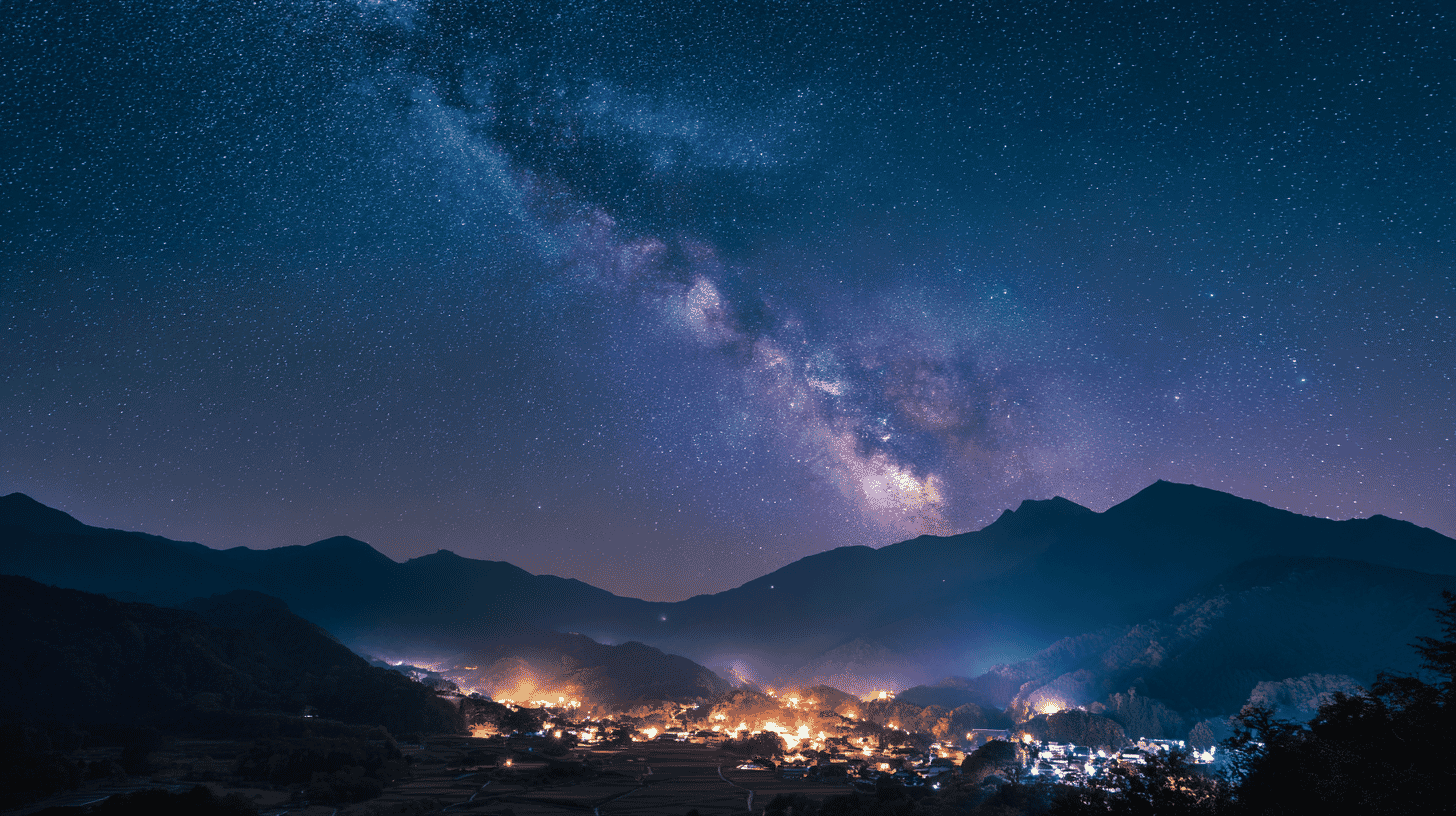
Achi, a village of about 5,800 people at the southern tip of Nagano Prefecture, has queues for its gondola even in midwinter. After a 2006 Ministry of the Environment survey ranked it first nationwide for stargazing, the village began running a ski resort gondola at night for star tours. Here is how it turned a resource that costs nothing into a tourism business, and where it sits in the wider world of astrotourism.
How a Village of 5,800 Draws 130,000 Visitors Annually
Tucked away in the southernmost tip of Nagano Prefecture, Achi Village is home to just 5,800 residents. Yet this quiet mountain community has become a magnet for stargazers seeking what has been officially recognized as Japan's finest starry sky. Even in winter temperatures dropping to minus 3°C (27°F), lines of nearly 100 people form at the gondola station, eager to witness the celestial spectacle above.
The village's rise to fame began in 2006 when Japan's Ministry of the Environment conducted a nationwide star-watching survey and ranked Achi Village first among locations most suitable for stellar observation. This recognition gave the village its now-famous branding: "Japan's No.1 Starry Sky."
The Heavenly Night Tour Experience
The flagship tourism product is the "Tengoku no Rakuen" (Heavenly Paradise) Night Tour, which launched in 2012. By March 2025, the tour and its related sea-of-clouds and winter events had welcomed over 1.2 million cumulative visitors, establishing itself as one of Japan's most popular stargazing experiences.
The tour takes place at Heavens Sonohara, a highland resort featuring a 2,500-meter gondola ride with a 600-meter elevation gain. Over approximately 15 minutes, visitors ascend to an observation area at 1,400 meters above sea level, far from any urban light pollution. At this altitude, the stars appear so close that you could almost reach out and touch them.
The tour's highlight is the "light-down time," when all venue lights are simultaneously extinguished, revealing a 360-degree canopy of stars. Expert guides provide astronomical commentary, and original visual content is projected, transforming simple stargazing into an immersive entertainment experience.
Braving the Cold for Beauty
In January 2026, visitors from Tokyo, Gifu, and beyond were spotted making the pilgrimage despite harsh winter conditions. One couple traveled three hours from Gifu via Nagoya by express bus. Another couple returned for a "revenge visit" after clouds had obscured their view the previous year.
Mountaintop temperatures regularly drop below minus 3°C, yet visitors eagerly spread out leisure sheets on the snowy ground, lying back to take in the stellar panorama. Many borrow insulated long coats and thermal mats from their accommodations. One romantic visitor came to gift his partner "Japan's most beautiful starry sky" for her birthday.
A Model for Rural Revitalization
Achi Village's success offers valuable lessons for rural communities worldwide facing population decline and economic stagnation. The village demonstrates how natural assets can be transformed into sustainable tourism without massive infrastructure investments.
In 2012, the village established the "Star Village Achi Promotion Council," bringing together diverse stakeholders including tourism operators, restaurants, farmers, and NPOs. A key insight drove the project: utilizing the ski resort's gondola during the off-season, combined with the realization that "the starry sky costs nothing."
By 2015, Achi Village had signed a tourism partnership agreement with JTB, Japan's largest travel agency. Tour attendance reached 130,000 a year in fiscal 2018, drawing businesses from different sectors into the effort and creating new jobs in the region.
Hot Springs: The Perfect Complement
Achi Village also boasts Hirugami Onsen, a popular hot spring resort. The alkaline sulfur springs (pH 9.7) are renowned as "beauty baths" for their silky, skin-smoothing properties.
Package deals combining the night tour with hot spring accommodation have proven particularly attractive. Visitors can warm their chilled bodies in the therapeutic waters while basking in the afterglow of their stargazing experience. Guests at partner hotels can also secure tour tickets earlier than the standard two-week advance booking period, a significant advantage for planners.
Astrotourism: A Global Phenomenon
Achi Village's success aligns with the global rise of astrotourism. According to DarkSky International, over 220 sites worldwide have been designated as International Dark Sky Places as of 2024. The northern lights tourism market alone was valued at approximately $834 million in 2023.
Destinations like Jasper National Park in Canada, Alqueva Dark Sky Reserve in Portugal, and Galloway Forest Park in Scotland have demonstrated significant economic benefits from dark sky tourism. Galloway reportedly generated £500,000 annually in its first decade after certification, while Chile's Antofagasta region saw 327% year-on-year growth through astrotourism initiatives.
Challenges and Solutions
Stargazing tourism naturally faces weather-related challenges. Cloudy or rainy conditions can disappoint visitors who've traveled specifically to see stars. Achi Village addresses this by offering indoor planetarium-style programs during inclement weather, ensuring guests can enjoy their visit regardless of conditions.
Growing popularity has also led to gondola congestion, particularly during peak evening hours. Visitors are advised to plan ample time and dress warmly, as the 1,400-meter summit is significantly colder than lower elevations.
Update: The tour continues as "Season 2026," running April 11, 2026 through March 22, 2027, its 15th season since the 2012 launch, with some dates excluded for gondola maintenance. 2026 also marks the village's 70th anniversary and the 30th of the Heavens Sonohara resort, and from August 1 to 9 the summit hosted STARRY NIGHT FES 2026, pairing the night sky with live music. (Added August 2026)
Share Your Stargazing Stories
Light pollution has made starry skies increasingly hard to see from urban areas in Japan and elsewhere. Achi Village shows how a community can rediscover the value of a dark sky and build a local economy around it.
Does your country or region have places known for their night skies? Tell us about astrotourism where you live, or about a stargazing night you still remember.
References
- https://news.yahoo.co.jp/articles/7937a556ed770febd0dc6bc311272152b7b889ca
- https://sva.jp/
- https://travel.rakuten.co.jp/mytrip/howto/starvillage-achi
- https://www.jtbbwt.com/government/case-study/solution/area-marketing/detail/id=1381
- https://prtimes.jp/main/html/rd/p/000000291.000018496.html
- https://darksky.org/about/success-stories/
- https://en.wikipedia.org/wiki/Astrotourism








Global Discussion
15 comments