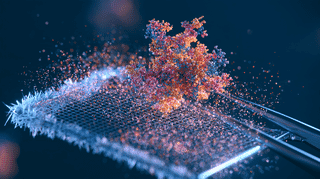
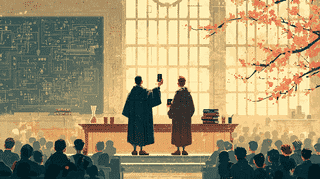
Cryo-electron microscopes flash-freeze proteins and build 3D models from millions of molecular images. What they see, what they do and what they cost, as a Kyoto university teaches undergraduates to use the data.
Thirty players throwing together need about 64,201 rounds to leave one winner. The widely quoted 63,917 counts only the wait until the first non-tie, and just 4.61 throws settle anything.
Japan's Neko Kentei cat exam has drawn roughly 40,000 takers since 2017. Three levels of 100 questions each, part of every fee funds stray-cat neutering, and your cat is officially allowed on camera.
Toho University stroked infants on the head, back and belly. Only the back calmed them, at about 10.5 cm/s. In mouse pups raised without a mother, the response never appeared at all.
In 2004, a University of Tokyo brain scientist said humans are born wired for grammar. In 2022, ChatGPT learned language without any such wiring. The half-century debate Chomsky started is wide open again.
It began with a particle mistaken for a bacterium in an English cooling tower. Two decades later, giant virus research in Japan has reached a startling question: where did the cell nucleus that defines us come from? A look at Furtivovirus, found in a Kamakura river.
Japan is rewriting the national curriculum that governs every classroom, with new tech subjects, flexible class hours, and slimmer content arriving from 2030. How does it compare to Finland, Singapore, and the US?
Japan's Coast Guard has released free Minecraft world data recreating Japan's surrounding seafloor, including the 10,920m Challenger Deep in the Mariana Trench. Released for Marine Safety Day on May 12, 2026, the world is available for both Java and Bedrock editions.
Students at Daigo Junior High in Fushimi-ku, Kyoto have collected aluminum cans from their homes since 1994 and turned them into cash for the Kansai Guide Dogs for the Blind Association. Over 30 years the donations have reached 6,188,582 yen (about $39,400), enough to train two guide dogs. We unpack the school culture and the funding structure that make a 30-year relay possible.
In the afterword of Jujutsu Kaisen Modulo Volume 3, Gege Akutami revealed that the story of the Simurians' canal was deeply inspired by Tetsu Nakamura, a Japanese doctor who built a 25.5km irrigation canal in Afghanistan. Known in Afghanistan as 'Kaka Murad' (Uncle Murad), here is who he was, both from Japan's perspective and from how Afghans remember him.
Kenichi Sugino, who designed the Game Boy Color, Advance, DS and 3DS over 37 years at Nintendo, and Goro Abe, who directed all 12 WarioWare titles, have joined Osaka Electro-Communication University as professors. We explore Japan's distinctive game education model, how it compares to DigiPen and USC, and the wave of generational change at Nintendo.