
🦠 In 1992, a particle scooped from the water of an English cooling tower was filed away in a freezer as a bacterium. It would take eleven years for anyone to realize it was a virus, and one so large it broke the definition of what a virus could be. That moment opened a hunt that has now reached a small river in Kamakura, Japan, where a new species was found hiding behind another virus. What these "giant viruses" are quietly forcing scientists to ask is a much bigger question: where did our own cells come from?
The microbe that turned out not to be one
The story starts with a misidentification. While investigating a pneumonia outbreak in Bradford, England, researchers pulled an amoeba from a contaminated cooling tower and found round particles living inside it. The particles stained the way bacteria do and were big enough to see under an ordinary light microscope, so the team logged them as a gram-positive bacterium, nicknamed it "Bradfordcoccus," and froze the sample.
It sat there for over a decade. When French microbiologists Bernard La Scola and Didier Raoult finally took a closer look in the early 2000s, the "bacterium" refused to behave like one. Standard bacterial gene tests came back empty. Under an electron microscope, the truth appeared: this was a virus, larger than some bacteria, with a genome of roughly 1.2 million base pairs and around a thousand genes. In 2003 they published it in Science and named it mimivirus, for "mimicking microbe."
For context, the coronavirus behind COVID-19 encodes about thirty proteins. Influenza gets by on eight genes. A virus with a thousand was not supposed to exist. The discovery did something rare in biology: it made researchers go back and question a word they thought they understood.
How big is big, and why does it matter?
There is no strict scientific cutoff for the term "giant virus," but the rough rule is a particle larger than 0.25 micrometers, visible under a light microscope, which ordinary viruses are not. The current heavyweight, the urn-shaped pandoravirus, stretches to 1.2 micrometers with close to 2,000 genes, rivaling a small living cell. Others read like a designer's sketchbook: the elongated pithovirus, the spherical mollivirus, the rocket-shaped tupanvirus trailing a long tail.
What unsettles biologists is not the size itself but what comes with it. Ordinary viruses are minimalists; they hijack a host cell's machinery to copy themselves and carry almost no extra equipment. Mimivirus, by contrast, carries genes for tasks viruses are not supposed to handle on their own, and more than half of its genes have no known function at all. A virus is usually defined as something that cannot live on its own, but a creature with a thousand genes, doing chemistry that looks almost cellular, sits awkwardly on the line between "virus" and "alive." Most of these giants infect amoebae, single-celled organisms, which is why so many discoveries come from pond water, soil, and cooling towers rather than from sick patients.
A Japanese hypothesis about where we came from
This is where the story turns toward Japan, and toward a question that sounds almost too grand for pond water.
Every organism with a cell nucleus, every plant, animal and fungus, including us, is a eukaryote. The nucleus is the membrane-wrapped vault that holds our DNA, and where it came from is one of the unsolved riddles of evolution. In 2001, Masaharu Takemura, now a professor at Tokyo University of Science, proposed an answer that many found provocative: that the nucleus itself may have descended from a large DNA virus. The "viral factories" that some big viruses build inside an infected cell, sealing off their genetic work from the rest of the cell, look uncannily like a nucleus doing its job.
It remains a hypothesis, and not everyone in the field is convinced. But Takemura spent the years that followed looking for evidence in the water around him. In 2016 his team reported tokyovirus, one of the first giant viruses isolated in Japan. In 2019 came medusavirus, pulled from a hot spring in Hokkaido, carrying a complete set of histone genes, the proteins eukaryotes use to fold and pack their DNA, which had never been seen all together in a virus before. In December 2025, working with a single-celled amoeba called Vermamoeba, the group described ushikuvirus from Lake Ushiku, a marsh in Ibaraki, a relative of medusavirus that swells its host to nearly twice its size and builds its viral factory out in the cell's cytoplasm.
Each new virus was a slightly different way of dealing with the host's nucleus.
The virus that was hiding
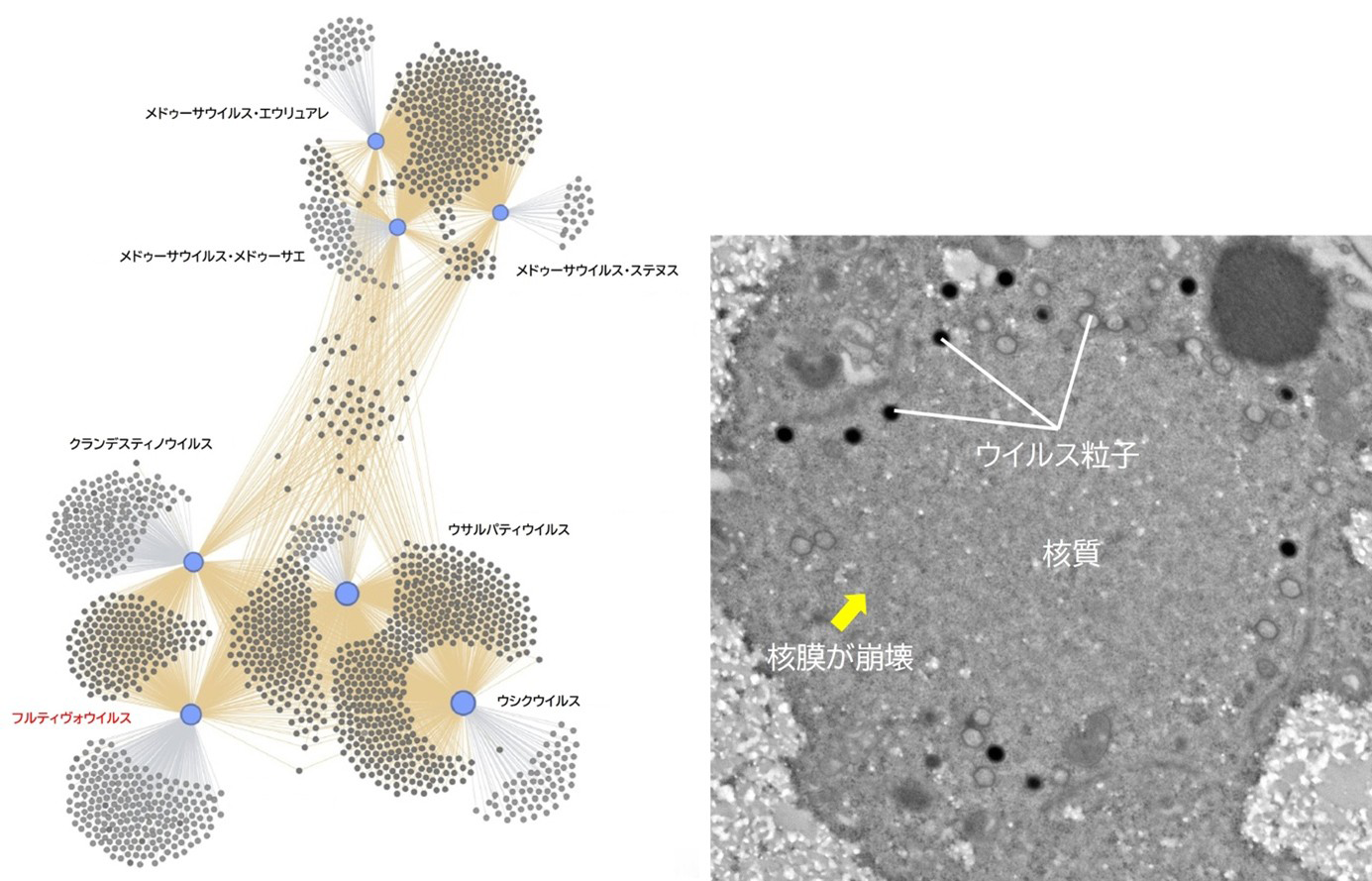
The newest chapter arrived from a river called Inasegawa, in the seaside city of Kamakura. In a freshwater sample, Takemura's group, with doctoral student Jiwan Bae leading the work, was screening for viruses infecting Vermamoeba when they noticed something that should not have been there. Behind the infection of one virus, faustovirus, a second virus had quietly slipped in and was multiplying in its shadow. They named it furtivovirus, from the Latin furtivus, "stealthy."
Source: Tokyo University of Science
Its genome runs to 560,176 base pairs across 656 predicted genes, and it turned out to be a close cousin of clandestinovirus, found in France in 2021. The striking part came from the electron microscope. As furtivovirus infects a cell, it tears down the membrane of the host's nucleus, then assembles and packages its new particles inside the nuclear space itself. That is a third distinct method: medusavirus replicates within the intact nucleus, ushikuvirus breaks the membrane and works in the cytoplasm, and furtivovirus breaks the membrane and works inside the nuclear material. Three viruses, three different relationships with the same structure.
That difference is the point. Comparing the three lets researchers sketch how a virus's relationship with the nucleus might have evolved step by step. On the strength of the genetic analysis, the team proposed that furtivovirus and three relatives form a new family, Manesviridae, and that it is the sister group of Mamonoviridae, the family medusavirus belongs to. They went further, arguing the two families should be united under a new higher-level order, its name still to be decided, rather than filed under the existing pandoravirus group. The work was published in May 2026 in the Journal of Virology.
What a virus in a river can tell us about ourselves
It is easy to read a headline about a new virus and brace for bad news. Furtivovirus is not that. It infects amoebae, not people, and the reason it matters has nothing to do with disease.
Giant viruses keep prying open the boxes biology had neatly closed. They blur the boundary between the living and the not-quite-living. They turn out to be heavy lifters in the ocean, infecting blooms of plankton, triggering die-offs that reset the ecosystem, and helping carry carbon down into the deep sea. And if Takemura's hypothesis holds, still an if, they may carry a clue to the oldest question of all: how the cell nucleus, the thing that makes us the kind of life we are, came to exist. The freshly described furtivovirus, with its own peculiar way of invading the nucleus, hands that hypothesis one more piece to test.
The striking thing is where all this keeps coming from. Not a deep-sea trench or a far-off jungle, but a cooling tower, a hot spring, a marsh, a river you could walk past on a weekend in Kamakura. The next rewrite of the textbook may be sitting in a puddle. What does the water near you hold that no one has thought to look at yet?
References
- https://www.tus.ac.jp/today/archive/20260526_4546.html
- https://www.ims.riken.jp/poster_virus/eco/mimi/
- https://journals.asm.org/doi/10.1128/jvi.02031-25
- https://www.tus.ac.jp/today/archive/20251219_9539.html
- https://wired.jp/article/ushikuvirus-giant-virus-discovery-japan/
- https://www.nature.com/scitable/topicpage/discovery-of-the-giant-mimivirus-14402410/







Global Discussion
4 comments