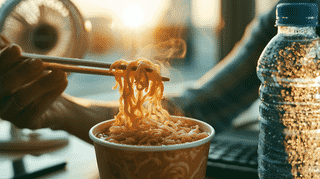
A Ukrainian soldier scored Japanese snacks and cup noodles out of 10. His zine was reprinted in at least seven times the quantity expected. Who sent the box, and what instant noodles already meant in Ukraine.
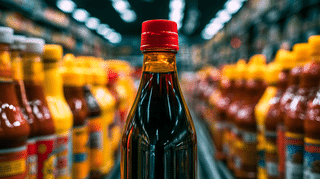
Kikkoman's third US soy sauce plant has opened in Jefferson, Wisconsin, a $560 million investment. Fifty-five years after a village voted 54 to 14 on the first one, North America now supplies two-thirds of group profit.
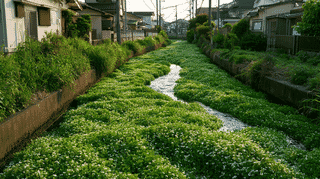
In spring 2026 a meter-tall mat of watercress smothered a suburban river in Matsuyama. Japan calls it a priority-control invasive species, yet farms ship 362 tons a year. How New Zealand, Australia and the US see it.
Warming seas pushed a pufferfish north across the Tsugaru Strait, and the hybrids do not fit Japan's 1983 table of edible species and parts. How the rulebook caught up, and why the Mediterranean has the same gap.
SUSHI BUS puts a working conveyor-belt sushi lane on the upper deck of an open-top double-decker and sends it around Tokyo from October 2026. Seventy minutes, all you can eat, 20 seats.
Kewpie sets up an Indian sales company in September 2026. In the US, egg yolk is what legally makes mayonnaise mayonnaise. In India, egg is what earns the non-vegetarian mark. Same ingredient, opposite verdicts.
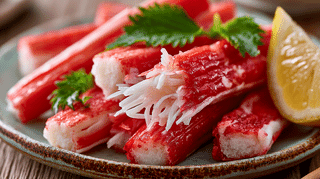
The crab stick in your salad or sushi roll traces back to a small town on Japan's Noto Peninsula, where it was invented as one of the country's great postwar food breakthroughs. The global surimi market is worth several billion dollars, roughly half of it crab sticks. Riding a wave of fish-eating and high-protein diets, kanikama is spreading fast, so why is Japan's surimi know-how so hard to imitate, and how is it sold abroad?
Nissin launched the first-ever cold-water-only Cup Noodle on July 20. Its patented Cold Rehydrate technology turns fridge-chilled water into chewy noodles in 5 minutes. Here's how Japan, birthplace of instant ramen, keeps reinventing it.
The 1910 Asakusa shop credited with inventing soy-sauce ramen and spreading the '-ken' naming culture is back. As ramen overtakes sushi with global tourists, the founder's great-great-grandson revives a legend.
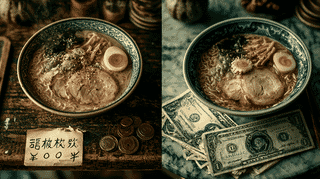
Japan saw a record 36 ramen shop bankruptcies in the first half of 2026. While the world pays $18 a bowl, shops in ramen's homeland collapse against a cultural price ceiling of 1,000 yen (about $6). Here is the structural squeeze behind the paradox.
Foreign visitors spent ¥2.07 trillion (~$12.9B) on food in Japan in 2025, 21.9% of all inbound spending. What 42 million tourists eat, the dietary-diversity gap, and how to plan a gourmet trip.