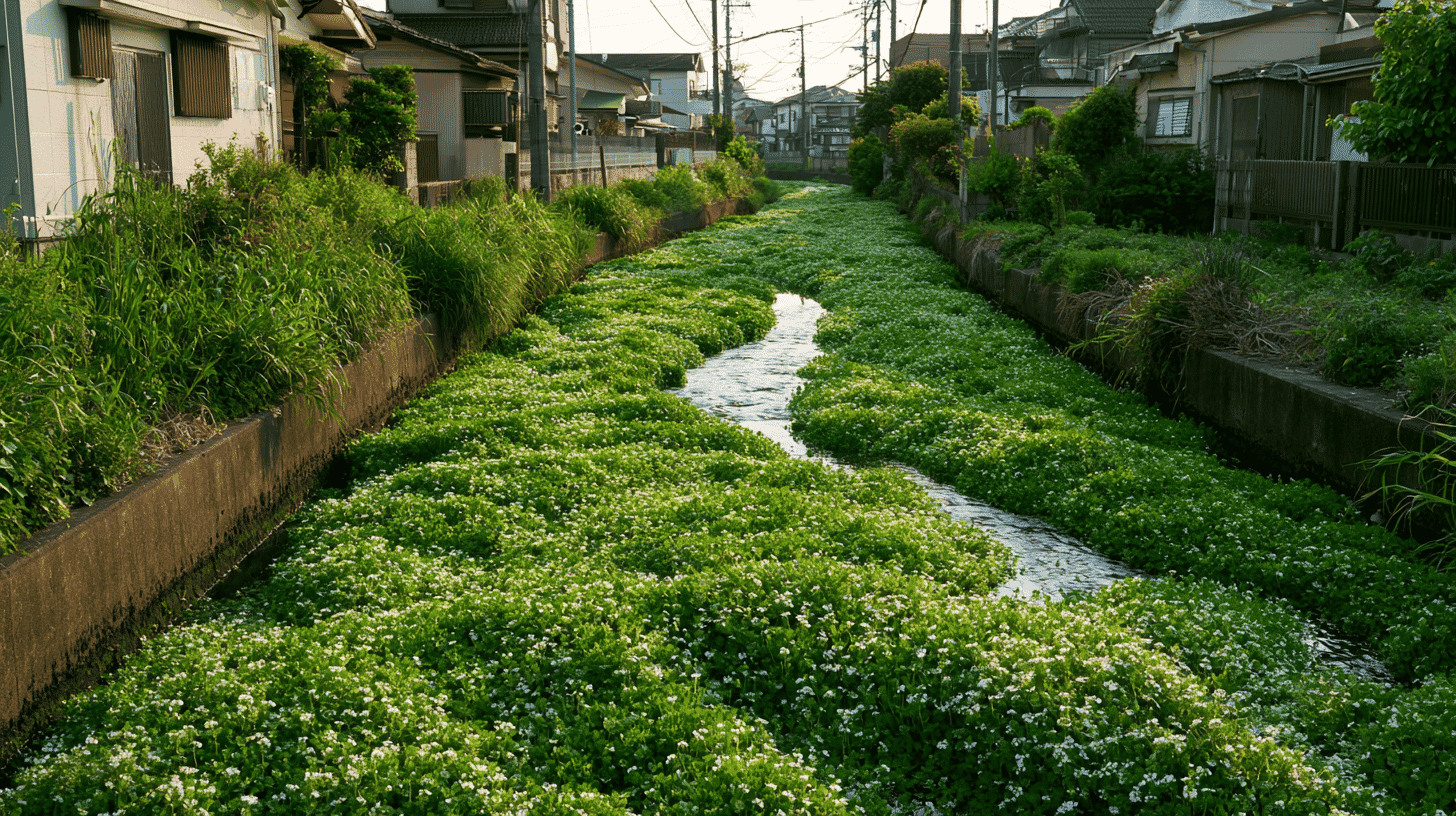
🥬 The sprig of watercress next to your steak has a second life in Japan. In the spring of 2026 it smothered a small river in a residential part of Matsuyama, on the island of Shikoku, so thickly that the water disappeared. The Japanese government classifies watercress as a "priority control" invasive species and says removal is a high priority. A vegetable on the supermarket shelf, a pest in the creek. Japan is not the only country living with that contradiction.
A green carpet over a suburban river
The river is the Yoshifuji, which winds through quiet housing in Matsuyama. When a reporter from the Mainichi Shimbun visited in April 2026, the stretch near a municipal elementary school was so overgrown that the surface was barely visible. The tallest plants stood about a meter high. The reporter snapped off a stem and chewed it: the familiar peppery bite. Watercress, no question.
A man who has lived beside the river for years told the Mainichi that the plant had only started growing this thick in the past decade or so. As far as residents could tell, all they could do was wait for heavy rain to flush it downstream.

Source: Wikimedia Commons / Zcebeci (CC BY-SA 4.0)
The Yoshifuji was not alone. The Mainichi found watercress choking the Miyauchi River in Yawatahama, the Ikata Okawa in Ikata, and irrigation channels in Uwajima, all in Ehime Prefecture. A September 2 report in the Japan Agricultural News traced wild watercress in the prefecture back to the 1930s. Two escape routes are suspected: plants washing out of cultivation, and birds carrying seed. Nobody has been able to pin down which.
The plant does have a season. According to the Japan Agricultural News, the Yoshifuji watercress died back before the rainy season, and when its reporter searched Matsuyama, Yawatahama and Ikata in late August, there was none to be found. It surges in spring, vanishes in summer, and comes back the following year. Hiromitsu Matsui, professor emeritus at Matsuyama Shinonome Junior College, says it could well return across Ehime from next year.
An edible immigrant from the Meiji era
Watercress, Nasturtium officinale, is a perennial in the mustard family, native to Europe and Central Asia. Its Japanese name, oranda-garashi, literally means "Dutch mustard," and according to a field guide from Osaka Prefecture's environmental research institute, it got that name simply because it came from overseas. According to the invasive species database run by Japan's National Institute for Environmental Studies (NIES), it entered the country in 1870 or 1871, right after the Meiji Restoration, and the listed pathway is "introduced for food and medicinal use."
It was, in other words, invited in for dinner.
That was not its only job. The Japan Agricultural News, citing the Ministry of the Environment, reports that watercress was also introduced for water purification. In an NIES research interview, hydroponic treatment beds using watercress and similar crops are described as achieving more than ten times the cleaning effect of reed beds in some cases. The plant's appetite for nitrogen and phosphorus made it a useful tool for anyone trying to scrub polluted water.
That appetite is now working against the river. Yoshiharu Fujii, professor emeritus at Tokyo University of Agriculture and Technology, told TV Asahi that the Yoshifuji watercress probably grew so large on phosphorus and nitrogen from household wastewater. The Japan Agricultural News quotes Matsui making the same point about runoff from homes and fertilized fields. The dirtier and richer the water, the happier the watercress.
Why the government wants it gone
In March 2015, the Ministry of the Environment and the Ministry of Agriculture, Forestry and Fisheries published Japan's List of Invasive Alien Species Threatening Ecosystems. It covers 429 species, 229 animals and 200 plants, sorted by what kind of response each one needs. Watercress landed in the "priority control" tier, which the ministries define as species expected to cause serious damage, where countermeasures by every relevant party are highly necessary.
Asked by the Japan Agricultural News, the ministry's invasive species office said removal is a high priority. The stated concern is agricultural: if watercress takes over an irrigation channel it can block the flow and damage farming. At the same time, the ministry admitted it does not have detailed distribution data and simply regards the plant as present nationwide.
Matsui laid out the ecological damage for the Mainichi in two parts. First, watercress roots trap silt, so the riverbed fills in and the current slows. Second, a dense mat cuts off light to the water below, which hits native aquatic life hard. The Japan Agricultural News adds two more worries: it crowds out native water plants and gets in the way of fish trying to move up and down the river.
Ehime is not an outlier. The Japan Agricultural News reports that the city of Noda in Chiba Prefecture believes watercress is growing in colonies near the channels of the Tone and Edo rivers. Kagawa Prefecture has confirmed it in reservoirs, rivers and channels across the prefecture, has a specimen record from 1965 in what is now the city of Mitoyo, and has put watercress on its own invasive species list because of the risk to native plants.
Hard to kill, and nobody's top priority
What makes watercress so stubborn is its ability to regenerate. A broken stem puts out roots and becomes a new plant. Fujii told TV Asahi that tearing it out from the top or yanking it carelessly can spread it rather than remove it. If you are going to pull it, pull it out by the roots. Matsui gives the same advice.
On the ground, though, the sense of urgency is muted. The river and erosion control section of Ehime's Chuyo regional office, which manages the Yoshifuji, told the Mainichi that it had just finished dredging sediment for flood control the previous fiscal year. Grass such as watercress sometimes comes out with the sediment, but unlike trees, which snag floating debris, the office does not consider it a particular problem for river management. The Japan Agricultural News reports that the agriculture ministry's rural environment office has issued no call for control either.
So the national government says removal is highly necessary, the prefecture says it is not really a problem, and the farm ministry says nothing at all. Nobody owns the problem.
And all the while, watercress is being farmed in the open. According to the agriculture ministry's survey of regional specialty vegetables, the 2022 crop covered 29 hectares nationwide and yielded 373 tons, of which 362 tons were shipped. Yamanashi Prefecture alone produced 245 tons, roughly two thirds of the total, followed by Okinawa with 32 tons and Oita with 17. Matsui told the Japan Agricultural News that with basic containment such as netting across outflow channels, there is no problem growing it.
Growing it for food and stopping it from going wild are not in conflict. The trouble lives in the careless space between the two.
New Zealand, Australia and the United States
New Zealand has lived with the same plant, and the same tension, for far longer. The New Zealand Plant Conservation Network records watercress as naturalized in 1852, with "culinary herb" as the reason it was brought in. Te Ara, the country's official encyclopedia, notes that watercress, brought in by early settlers for the table, turned into a pest along Christchurch's Avon River and nearby streams, and that when provincial councils passed the first weed legislation in the 1850s, watercress was named alongside gorse and thistles.
The two-faced relationship is still very much alive there. In 2020, the New Zealand Herald reported that Greater Wellington Regional Council had sprayed herbicide on watercress growing in a roadside drain near Masterton, to the anger of locals. The drain was a favorite picking spot for watercress destined for "boil-up," a traditional dish. To the council it was a weed in a waterway. To the neighbors it was food. The same argument now playing out in Matsuyama has been running in the opposite hemisphere for generations.
Australia is split. The Weeds of Melbourne project cites a report that watercress had "completely naturalised" on Perth's Swan River by 1843. Yet a 2017 assessment of wetland weeds by Victoria's Arthur Rylah Institute concluded that after more than a century in the state, watercress appears to be an innocuous weed with no documented impacts.
In the United States, the US Geological Survey's nonindigenous aquatic species database lists watercress as established and naturalized across North America as far north as Alaska. It flags the plant as a potential noxious weed and notes that in the arid West it can alter stream function and block waterways. A US Fish and Wildlife Service risk screening cites Department of Agriculture data placing it in 47 of the 48 contiguous states, every one except North Dakota. The same agency, however, rated the overall risk as "uncertain," because there is so little evidence of harm since the mid-twentieth century.
One plant, three verdicts: an active control target, a harmless naturalized herb, or a shrug. Within that range, Japan's "priority control" label sits toward the strict end.
When food goes feral
The lesson of watercress is that "edible" and "safe to introduce" are different questions. Food plants are moved deliberately, repeatedly and over wide areas by people who want more of them. They are grown in wet fields and along waterways that connect directly to natural habitat. The more valuable a plant is on the plate, the more chances it gets to escape.
Nor is the wild stuff a free lunch. Fujii warned TV Asahi that wild watercress can carry parasites and should be cooked thoroughly. A plant fattened on household wastewater has, by definition, been growing in household wastewater.
The realistic path is the one Matsui sketched: grow it, but do not let it out. Net the channel between the field and the river. Keep leftover stems out of the drain. If you find a wild patch, dig it out by the roots in early spring before it takes off. None of it makes headlines. Most work on invasive species never does.
Now picture your own dinner table. How many of the vegetables and herbs on it were growing in your country before people brought them there? And how many of those, if you walked down to the nearest creek or drainage ditch, would you find being treated as weeds?
References
- https://news.yahoo.co.jp/articles/bf3465718704d8cf3a913c35b3b4a55b8c2d0ed8
- https://mainichi.jp/articles/20260410/k00/00m/040/095000c
- https://news.tv-asahi.co.jp/news_society/articles/900188333.html
- https://www.nies.go.jp/biodiversity/invasive/DB/detail/80110.html
- https://www.nies.go.jp/kanko/kankyogi/07/04-09.html
- https://www.knsk-osaka.jp/zukan/zukan_database/mizukusa_gairai/4350b31dd019ea9/4250bd56619da78.html
- https://www.maff.go.jp/j/press/kanbo/kankyo/pdf/150326-01.pdf
- https://www.e-stat.go.jp/stat-search/files?page=1&layout=datalist&toukei=00500501&tstat=000001018175&cycle=7&year=20220&month=0&tclass1=000001033588&tclass2=000001218846
- https://www.nzpcn.org.nz/flora/species/nasturtium-officinale/
- https://teara.govt.nz/en/1966/water-plants/page-5
- https://teara.govt.nz/en/weeds-of-agriculture/print
- https://www.nzherald.co.nz/nz/watercress-spot-sprayed/ALTCINTLNACTDA4CJ2RPHXAMHA/
- https://weedsofmelbourne.org/watercress-nasturtium-officinale
- https://ari.vic.gov.au/__data/assets/pdf_file/0027/69912/Knowledge-document-of-the-impact-of-priority-wetland-weeds-Part-2-16-June-2017.pdf
- https://nas.er.usgs.gov/queries/factsheet.aspx?SpeciesID=229
- https://www.fws.gov/media/ecological-risk-screening-summary-watercress-nasturtium-officinale-uncertain-risk








Global Discussion
4 comments