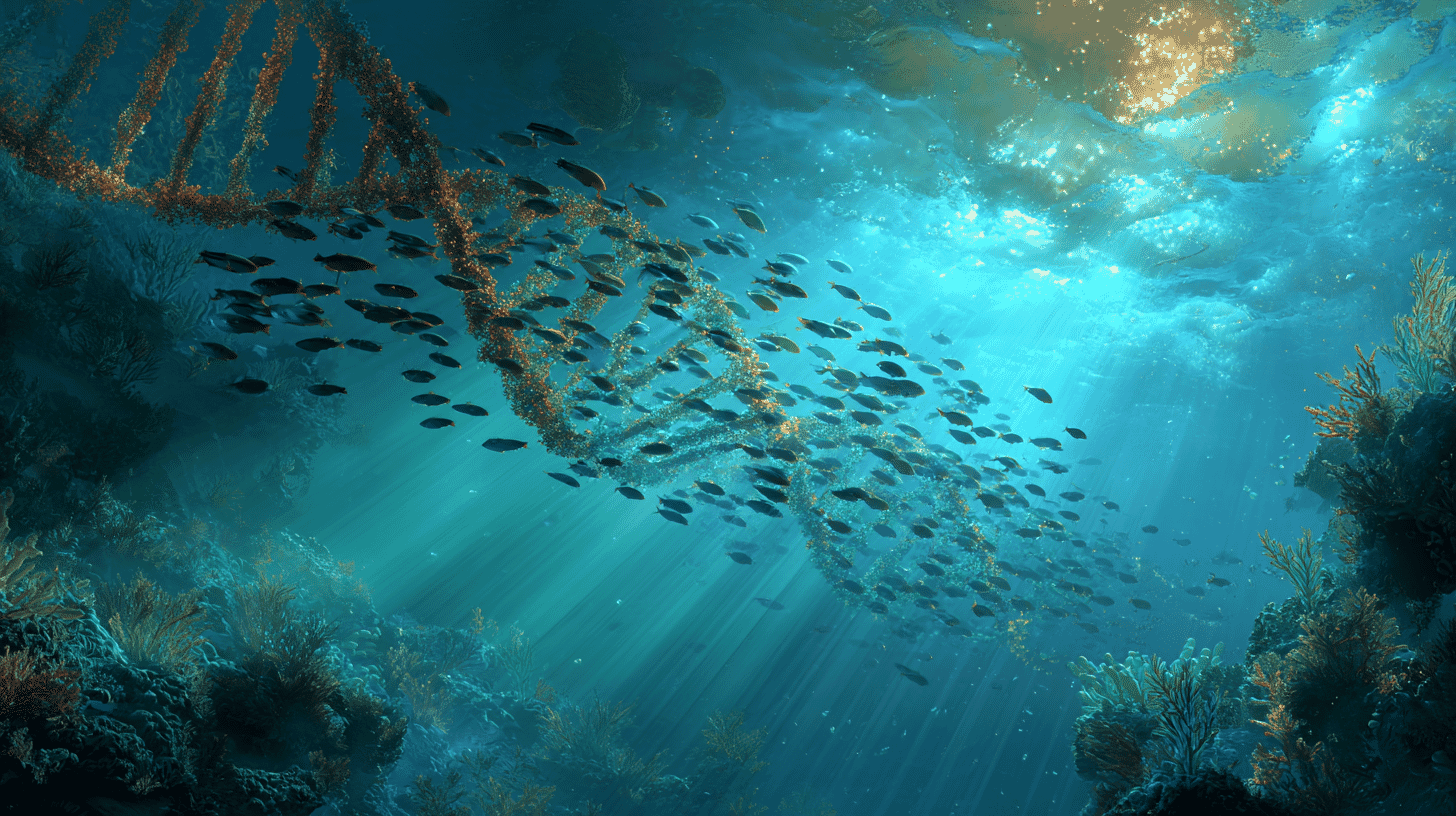
The fish on your plate may no longer belong to the group it was classified in for over a century. Japan's largest fish taxonomy group, Perciformes, has been dismantled by DNA analysis. Invisible nanoplastics are killing fish larvae through the food chain. And shortfin mako sharks "warm up" before diving deep, a behavior never seen in fish before. Here's how Japan's latest marine research is rewriting everything we thought we knew about fish.
Japan's Waters: A Marine Biodiversity Powerhouse
Japan's Exclusive Economic Zone (EEZ) covers approximately 4.47 million km². While this represents less than 1% of the world's ocean volume, roughly 34,000 marine species have been confirmed within these waters, about 15% of all known marine life on Earth. Some 3,700 species of saltwater fish alone inhabit Japan's seas, representing approximately a quarter of the world's estimated 15,000 marine fish species.
The reason for this extraordinary diversity lies in geography. The Japanese archipelago spans from subtropical to subarctic climate zones, and sits at the convergence of four tectonic plates. Deep ocean trenches, expansive continental shelves, and complex seafloor topography create a mosaic of habitats found in few other places on the planet. Researchers estimate that an additional 120,000 species may still await discovery.
And from these rich waters, a wave of surprising findings is emerging.
The Great Perciformes Breakup: Fish Taxonomy Turned Upside Down
For decades, the order Perciformes was the largest group in all of vertebrate taxonomy, containing about 10,000 species and accounting for roughly 40% of all bony fishes. Virtually every "fish-shaped fish" you can imagine belonged to this group, from gobies and hairtails to wrasses and sillagos.
Then came the revolution in molecular phylogenetics, the science of using DNA to trace evolutionary relationships. As researchers began comparing the genomes of thousands of species, they discovered that many fish placed together based on physical appearance were, in fact, only distantly related. Perciformes, it turned out, had been functioning as a kind of "taxonomic wastebasket", a catch-all for species that didn't obviously belong elsewhere.
The result has been a dramatic dismantling. Grunts and stripeys moved to Centrarchiformes. Groupers and scorpionfish were reassigned to a restructured Perciformes (now informally called the "Perch order"). New orders such as Labriformes (wrasses), Gobiiformes (gobies), Carangiformes (jacks), and Scombriformes (mackerels) were established.
The biggest shock? The Japanese sea bass (suzuki), the very fish that gave Perciformes its Japanese name "Suzuki-moku", was itself removed from the group. DNA analysis revealed that suzuki is more closely related to tiny deep-sea fish in the family Acropomatidae (lanternbellies), placing it in the order Acropomatiformes. A one-meter predator sharing a branch with centimeter-long fish nobody has heard of, that's the kind of surprise molecular biology delivers.
For years, Perciformes was mocked as a "wastebasket taxon," a place to put fish that had no clear shared features for want of anywhere better. DNA technology exposed this and forced a fundamental rethink of a classification that had been misled by appearances.
The Ichthyological Society of Japan continues to announce reclassifications. In 2025 alone, a new species of stingray was described from Ariake Bay, and 16 species of anthias had their genus assignments changed. The family tree of fish is still very much a work in progress.
Nanoplastics: The Invisible Killer in the Food Chain
While taxonomic reshuffling is an academic matter, another line of research touches something far more urgent: fish survival.
In December 2025, a research team led by Associate Professor Mitsuharu Yagi at Nagasaki University published alarming findings in Science of the Total Environment. Their experiments showed that nanoplastics, particles smaller than 1 micrometer (one-thousandth of a millimeter), dramatically reduced the survival rate of red sea bream (madai) larvae.
What made this study particularly significant was its focus on exposure pathways. When larvae absorbed nanoplastics directly from the water, the effects were concerning. But when the larvae consumed rotifers (tiny zooplankton) that had already accumulated nanoplastics in their bodies, the lethal effects were far worse. The food chain was amplifying plastic pollution.
Even surviving larvae showed elevated antioxidant enzyme levels and activated inflammatory genes, clear signs of severe physiological stress at the cellular level.
The research group noted that across hundreds of sampling expeditions using university research vessels, they have never once failed to find microplastics in their nets. Japan's surrounding waters, fed by the Kuroshio Current and the Tsushima Warm Current, collect plastic debris from across East Asia. Some areas have recorded microplastic concentrations 27 times the global average.
Mako Sharks Warm Up Before Diving: A World First
Another remarkable discovery comes from a collaboration between the Okinawa Churashima Foundation, the Graduate University for Advanced Studies (SOKENDAI), and international partners. The study focused on shortfin mako sharks (Isurus oxyrinchus) and their thermoregulation behavior.
Certain fish, including tunas, marlins, and some sharks, possess "regional endothermy," the ability to maintain body temperatures above ambient water temperature. This was long assumed to be an adaptation for cold-water hunting. But for shortfin makos, which prefer warmer seas, the advantage was unclear.
By attaching data loggers to wild makos off southeastern Taiwan, the team found that body temperature dropped slowly in cold deep water but rose rapidly at the warm surface, at more than 10 times the rate of cooling. This allows makos to extend hunting time in the prey-rich deep while efficiently reheating near the surface.
The true surprise was this: some individuals actively raised their body temperature above the surrounding water temperature before initiating a deep dive. This "pre-dive warm-up" had never been documented in any fish species. It suggests a level of behavioral flexibility and anticipatory decision-making that challenges our assumptions about fish cognition.
Environmental DNA: Reading the Ocean in a Cup of Water
Supporting these discoveries is a revolution in survey technology. Environmental DNA (eDNA) metabarcoding allows researchers to identify fish species from traces of DNA, shed through scales, mucus, and waste, floating in seawater.
A team led by Associate Professor Reiji Masuda at Kyoto University demonstrated that a single day of eDNA sampling could detect roughly 80% of fish species in a given area, far outperforming traditional methods like dive surveys that require multiple trained experts over several days.
At the Okinawa Institute of Science and Technology (OIST), researchers working with the Churashima Foundation developed an eDNA system capable of detecting 83 out of 85 known genera of reef-building corals in Japanese waters. The survey requires, quite literally, a cup of seawater.
This technology promises to transform marine conservation and fisheries management by making comprehensive biodiversity surveys faster, cheaper, and less invasive than ever before.
Evolutionary Dead Ends and New Species: The Mysteries Continue
In June 2025, a joint team from Science Tokyo (formerly Tokyo Institute of Technology) and Sophia University published a groundbreaking study in Molecular Ecology. By comparing the genomes of 240 fish species, they discovered that fish which evolved parental egg-guarding strategies had lost the genes responsible for producing tough egg membranes. Without those genes, these species cannot revert to non-guarding reproductive strategies, they are trapped in an "evolutionary dead end," confirmed at the molecular level for the first time.
Meanwhile, new species continue to emerge. In 2025, the Ariake stingray (Hemitrygon ariakensis) was formally described as a new species from Japan's Ariake Bay. ROV surveys off Okinawa uncovered two goby species never before recorded in Japan, revealing their living coloration for the first time. And a mullet long known as "Anpin-bora" was shown through molecular analysis to actually comprise two distinct species, with the name "Takitsubo-menada" proposed for the newly recognized one.
These discoveries underscore that even in one of the world's most studied marine environments, we have barely scratched the surface.
Even the fish we eat every day still hold secrets. That familiar creature on your plate is far more mysterious than it appears.
What new discoveries or unusual research on fish are there in your country?
References
- https://tsurinews.jp/fish_labo/
- https://www.fish-isj.jp/
- https://churaumi.okinawa/research/marine_organisms/
- https://www.isct.ac.jp/ja/news/y89gj0lh34jp
- https://www.nagasaki-u.ac.jp/ja/science/science426.html
- https://www.kyoto-u.ac.jp/ja/research-news/2017-01-13-1
- https://www.env.go.jp/nature/biodic/kaiyo-hozen/guideline/05-2.html




Global Discussion
15 comments