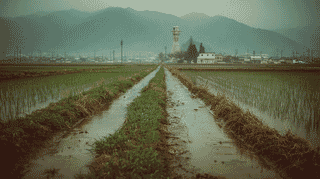
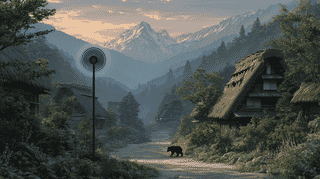
Extinct in Japan's wild in 1971, the Oriental stork now numbers 728, and only 49 were released. Most hatched in the wild, fed by low-pesticide paddies that cost farmers work and yield. Now they nest on power poles.
The Tsugaru Strait separates Japan's brown bears from its black bears. According to a genetic study of 327 frogs, the only amphibian known to live naturally on both sides crossed it 1 to 2.5 million years ago.
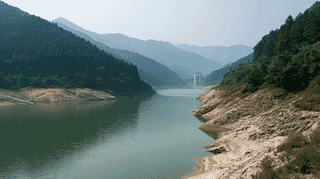
About 10,400 wakasagi, a cold-water smelt never native to Haizuka Dam, died amid heat and drought in Hiroshima. Nobody knows who brought them, and Japan's invasive species law does not cover fish moved within Japan.
Genji fireflies flash about every 4 seconds in eastern Japan and every 2 in the west. A survey of 164 populations found western and Kyushu lineages in over 70% of Tokyo's, most likely brought in by people.
In spring 2026 a meter-tall mat of watercress smothered a suburban river in Matsuyama. Japan calls it a priority-control invasive species, yet farms ship 362 tons a year. How New Zealand, Australia and the US see it.
Japan's Environment Ministry dropped a plan in August 2026 to list every cat as invasive. On Amami Oshima, 727 forest cats were caught over seven years, 723 were rehomed, and no euthanasia was recorded.
Researchers landing on Nishinoshima must first wade into the sea, gear and all, so no seed comes ashore. Two 2026 studies show why: seabirds, not people, brought the plants.
Takasaki pays 300 yen per beetle. Kawashima paid 100 yen and closed two and a half months early after handing out 7 million yen for 70,000 insects. Taiwan ran almost the same scheme, and cancelled it.
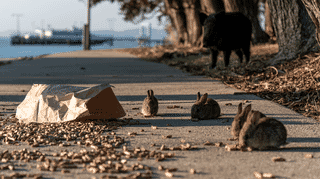
A wild boar was seen hunting a live rabbit on Japan's Rabbit Island in March 2024. Researchers say unregulated tourist feeding has swollen the rabbit population, and that leftovers and carcasses draw boars in.
Japan's largest native slug reaches nearly 20cm, never shows up in city gardens, and carries both sexes in one body. How it compares to North America's banana slug and Europe's Arion slugs, and why forests need it.
Modern wild boars still carry traces of domestic pigs brought from the Asian mainland over 2,000 years ago. Nagoya University read that story off 93 jawbones from Shimane's Nishikawazu site: escaped pigs going feral and breeding with native boars. The same thing is happening today from Texas to Brazil.
Declared extinct in 1949, Japan's short-tailed albatross has rebounded to roughly 11,000 birds on the volcanic island of Torishima. We trace how decoys and recorded calls lured the seabird to safer colonies, and how the method echoes Project Puffin in Maine.
Hokkaido culls a record 157,525 deer a year, yet 730,000 remain. Inside the wolf extinction, forest and alpine damage, 5,460 car crashes, and the venison-vs-wolf debate over Japan's missing apex predator.
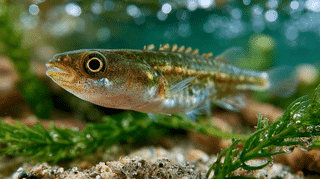
It has its own asteroid and is a prefectural symbol, yet for over 60 years the Musashi stickleback officially didn't exist. How an ice-age survivor near Tokyo finally became a named species, Pungitius nakamurai.
In the American South, kudzu is a notorious invasive weed. In Japan, its flower yields tectorigenin, a supplement compound. A RIKEN team has now decoded how the flower makes it and brewed it in yeast, with no kudzu required.
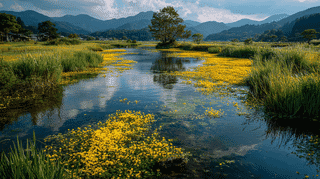
A paddy field in central Japan was swallowed by bright yellow flowers. Water primrose, a South American invader, regrows from the tiniest stem fragment. We look at why farmers cannot kill it, how the same plant is wrecking waterways in France, Britain and the US, and why eradication may be impossible.
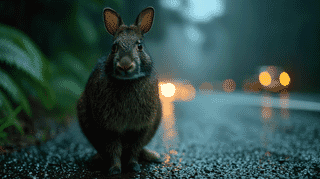
Roadkill of the Amami black rabbit, a 'living fossil' found only on two southern Japanese islands, hit a record 185 in 2025. The grim milestone is a side effect of Japan's celebrated invasive-species eradication programs, including a 24-year mongoose campaign declared complete in 2024.
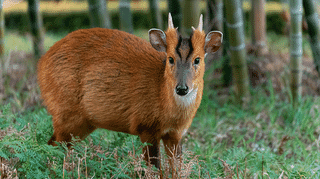
A Reeves's muntjac was sighted in Sakai, Ibaraki Prefecture in late April, the first confirmed sighting in two years and five months. Under Ibaraki's first-of-its-kind ¥2,000 bounty program for citizen-submitted photos, this should have been the first qualifying case. Why is Japan offering cash for sightings of a cute, dog-sized deer? We unpack the agricultural damage, the SFTS tick-borne disease angle, the unsettling lessons from Britain, and what happens if the front line in Ibaraki fails.
In April 2026, all six Tohoku prefectures issued their earliest-ever bear alerts. A fatal attack in Iwate, Aomori's first urban emergency hunting in Hachinohe. Meanwhile, Shirakawa-go deployed 10 'Bear Sonic' units emitting a chalkboard-scratching sound. In Toyama, sightings dropped to zero for a year after installation. Can this Japanese acoustic technology save the day?