
🐛 Catch one beetle, hand in the corpse, collect 300 yen. When the city of Takasaki opened its counter on August 3, residents brought in 1,170 dead beetles before the first day was out. A week earlier the mayor had said in public that he doubted many people would bother.
The 300-yen beetle
Takasaki, in Gunma Prefecture north of Tokyo, now pays residents 300 yen (about $1.90) for every adult red-necked longhorn beetle they kill within the city and carry to a municipal office. The payment arrives as "Takasaki Tsuka," a digital local currency that cannot be turned into cash and expires at the end of the fiscal year. The window runs August 3 to 31, backed by a one-million-yen budget of about $6,400, or roughly 3,333 beetles. The city reckons this is the highest per-insect rate any Japanese municipality has put on the table.
Day one produced 67 claims and 1,170 beetles, a payout of 351,000 yen. By the end of day two the tally was 91 claims, 1,431 beetles, 429,300 yen (about $2,700). The largest single claim was 284 beetles, worth 85,200 yen (about $540). Many claimants were primary school children on summer break, brought along by a parent or grandparent.
At his July 28 press conference, Mayor Kenji Tomioka had been relaxed about the whole thing. It is a "creepy bug," he said, so he did not expect a flood of applications. He also promised to top up the budget if it ran dry. As of August 6 the city's own page still listed the scheme as open. At that pace, he is going to need the second promise.
The fine print is oddly specific. If the corpse is mangled, the city counts one red thorax as one beetle. And if you sit on your haul too long, the red darkens to black, staff can no longer confirm the species, and you get nothing.
What exactly is being hunted
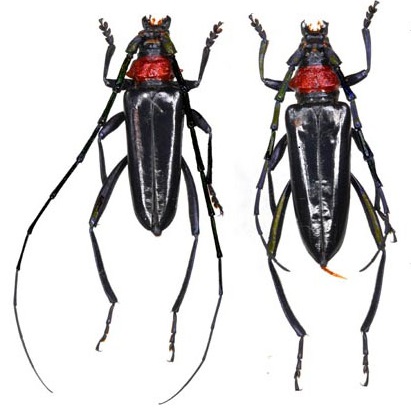
Source: Ibaraki Prefecture
The red-necked longhorn beetle, Aromia bungii, is 2.5 to 4 centimetres of glossy black with a vivid red band behind the head. It is native to China, Korea, Taiwan and Vietnam, and turned up in Japan for the first time in Aichi Prefecture in 2012. In January 2018 it was designated an Invasive Alien Species.
The adults are only the visible half of the problem. The damage is done underneath the bark, where larvae spend one to three years chewing through the trunks of cherry, plum, peach and apricot trees. By the time a tree looks sick, its interior is already gone. Japan's agriculture ministry counted the beetle in 20 prefectures as of July 2026. Takasaki surveys its own parks and schoolyards every May and June, and that count, which covers city-owned land only, went from 73 damaged trees in fiscal 2024 to 533 in fiscal 2025 and 1,120 in fiscal 2026.
On July 31 the agriculture and environment ministries set up a joint national task force, headed by both ministers. Agriculture Minister Norikazu Suzuki said the beetle raises concerns for "our country's culture and agriculture."
Readers in Europe have a stake in this too. The same beetle has established breeding populations in Germany and Italy, according to the UK's Forest Research, which urges vigilance in Britain, where so far only individual insects have been intercepted in wooden pallets.
Japan's wanted list
Kawashima, a town in Saitama, paid 100 yen (about 64 cents) in actual cash to any resident of the prefecture, and, crucially, accepted beetles killed anywhere in Saitama rather than only inside town limits. Oyama in Tochigi issues a receipt per corpse and trades ten receipts for a 500-yen gift card. Payouts are capped at 5,000 yen per resident per year, and pest-control professionals and anyone behind on municipal taxes are excluded. Ibaraki Prefecture runs a scheme called Kamikiri Mikke-tai, roughly "the beetle-spotters". It covers two invasive longhorns and pays a 500-yen prepaid card per ten insects. Bring fewer than ten and you get a canvas bag or a tin badge instead. Children from primary school up can take part. In its 2025 season, according to the Ibaraki Shimbun, 328 participants turned in 7,797 beetles.
Osaka Prefecture skipped money altogether. Its summer campaign runs June 1 to August 28. Residents sign up as a cherry-tree defence squad and compete on catch count. The top twenty win a guided tour of Tennoji Zoo, Cerezo Osaka football merchandise, or Amazon vouchers.
One rule holds everywhere: because the beetle is a designated invasive species, carrying a live one is illegal. You kill it where you find it, then bring it in.
How 150,000 yen became 7 million
It opened on June 1 with a budget of roughly 150,000 yen, about $950, or 1,500 beetles, and was scheduled to run until the end of September. Mayor Takashi Fujima said afterwards that he had wanted people to notice the problem, and thought a bounty would do it.
By mid-June the budget was already gone. Speaking to TV Asahi in late June, town official Atsushi Tomono said the original ceiling had been 1,500 beetles and that more than 5,000 had already come through the door. The town drew on reserve funds, passed a 3.5-million-yen supplementary budget, and on July 10 an extraordinary session of the town assembly approved more, letting the counter reopen on the 13th. On July 16 the running total hit seven million yen, 70,000 beetles, about $44,500, and the programme closed two and a half months early. One person turned up with more than 1,800 beetles in a single visit.
Kawashima's final tally, published broken down by where each insect was killed, shows why. Of the 70,000 beetles, only 5,753 came from Kawashima itself. The largest single source was Konosu with 17,451, followed by Kumagaya with 10,438, both further north. Across 859 claims, a town of its size ended up paying for a prefecture's problem.
Taiwan tried this. So did Minnesota, in 1877.
Insect bounties are not a Japanese invention, and where they have been tried before, two problems keep recurring: the budget, and whether the insects actually decline.
Taiwan ran nearly the same experiment against the lychee stink bug, Tessaratoma papillosa, whose defensive spray burns human skin and whose feeding wrecks lychee and longan harvests. Rather than paying for adults, the central government subsidised local buybacks of egg clusters at NT$5 each, roughly 16 US cents for a leaf carrying at least fourteen eggs.
Changhua County shows what that does to a budget. In 2020 it bought about 132,000 clusters and paid out roughly NT$660,000. For 2021 it set aside NT$792,000 expecting a similar volume, then took in 439,601 clusters and paid NT$2,198,005, about $68,000 and more than triple the previous year, according to the Liberty Times. The biggest single earner, a woman in Fenyuan Township, collected NT$207,705, about $6,400. Local media called her and others like her egg-picking masters.
From 2022 the central agency stopped funding the buybacks. In later reporting by the United Daily News, a Changhua agriculture official argued that halving the price would have been wiser than scrapping the scheme, and put the county's haul of roughly 440,000 clusters at about 6.16 million insects stopped before hatching.
Go back further and the same policy shows up in the American Midwest. Facing the Rocky Mountain locust, the Minnesota legislature set aside $100,000 for bounties in 1877, the Star Tribune has recounted. It paid 50 cents for a gallon of eggs and a dollar for a bushel of insects caught before May 25, with township officials appointed as measurers. The paper's verdict on the whole effort is blunt: none of it did much good.
Does paying for bugs actually work?
Takasaki's environment division says the logic is simple: kill adults before they lay, and you remove next year's larvae from the trees. They set the rate at 300 yen specifically to get residents moving fast. Whether that shows up as fewer damaged trees will take a while to see: the city counts its trees each May and June, so the first survey that could reflect this summer's hunt is the one taken in 2027.
The uncomfortable part is the arithmetic. Seventy thousand beetles cost one town seven million yen, and that town is a single dot inside a twenty-prefecture problem. What separates a workable scheme from a runaway one is design detail rather than headline price: Oyama's annual per-person cap, Ibaraki's exclusion of contractors, Osaka's refusal to pay cash at all. Kawashima had none of those brakes, which is precisely why it hit its ceiling in six weeks.
Taiwan's experience points at the real trap. A bounty popular enough to remove millions of insects is a bounty expensive enough to get cancelled, and when it is cancelled the control strategy loses a limb it had come to rely on. Whether 300 yen a beetle is real pest control or an awareness campaign that happens to cost money is something Japan will work out over the next few summers.
Japan has, for now, put a price tag on an insect's head. Does your country pay people to kill anything, and if it does, did the money hold out?
References
- https://www.city.takasaki.gunma.jp/page/93338.html
- https://www.town.kawajima.saitama.jp/item/15489.htm
- https://news.yahoo.co.jp/articles/8c7573b599bf48b7799cd1f9adff829b75f18729
- https://www.jomo-news.co.jp/articles/-/995368
- https://news.yahoo.co.jp/articles/a0539f579f8d38df47806dea97a6d434f570a06d
- https://news.yahoo.co.jp/articles/a58600517955fcb09d8c2e1688883b279b930859
- https://news.yahoo.co.jp/articles/376f0228de0207e007281cc50794f50d48c3aaf3
- https://www.city.oyama.tochigi.jp/kurashi/gomi-seikatsu/kankyohozen/page001193.html
- https://www.pref.ibaraki.jp/seikatsukankyo/kansei/tayosei/kamikirimikketai.html
- https://www.pref.osaka.lg.jp/o120030/midorikikaku/kankyo/kubiakanatsunojin.html
- https://www.maff.go.jp/j/syouan/syokubo/keneki/k_kokunai/kubiaka/kubiaka.html
- https://news.ltn.com.tw/news/life/breakingnews/3698828
- https://udn.com/news/story/7325/6299793
- https://www.startribune.com/grasshoppers-swarmed-in-1870s-leaving-minnesota-farmers-destitute/600175326
- https://www.forestresearch.gov.uk/tools-and-resources/fthr/pest-and-disease-resources/red-necked-longhorn-beetle-aromia-bungii/
- https://ibarakinews.jp/news/newsdetail.php?f_jun=1780233832739000








Global Discussion
4 comments