Purupuru Maker, a free browser tool that wobbles only the parts of an image you paint, has gone viral in Japan and abroad. Meet the solo developer behind it and Japan's culture of gloriously pointless web toys.
Kushiro Airport in Hokkaido is the first in Japan to fully deploy WOLF-GUARD, a self-driving version of the famous Monster Wolf robot. In trials, the Monster Wolf cut small-animal intrusions by about 60 percent. Here's how the red-eyed, howling patroller works, and how it compares with the falcons, border collies and radar used at airports abroad.
Why does osteosarcoma cluster in the knees of growing teenagers? A University of Tokyo team, working from an accidental clue in aging research, has pieced together how the cancer starts: an accelerator gene (c-Myc), a brake gene (p53), and a signal from the bone's growth plate. It could reshape drug discovery for a rare cancer.
A century-old Japanese packaging company will launch a flexible CIGS solar cell in early 2027, betting that proven, long-life thin-film tech can beat still-maturing perovskite to Japan's weak roofs and walls. The contrarian logic, and the catches.
Researchers at Showa and Kansai Medical Universities grew mesothelial-like cells from human iPS cells to repair the peritoneum, the membrane that wears out and ends peritoneal dialysis. A look at the mouse proof-of-concept and why Japan's PD rate is so unusually low.
NYK Line, Japan's largest shipping company, is working with Mitsubishi Heavy Industries to catch reusable rocket boosters on a ship at sea. The idea began in an in-house training program, became the first shipping-company project selected for JAXA's Space Strategy Fund, and now faces a question NYK's own engineers raise: will anyone launch often enough to make it pay?
Bridgestone's airless AirFree tire is now in permanent service on an autonomous shuttle in Higashiomi, Shiga, a national first. How its puncture-proof resin-spoke design works, why driverless and MaaS fleets need it, how it contrasts with Michelin's Uptis strategy, and whether it's really Moon-bound.
Japan's iPS cell therapy already treated fresh spinal injuries. Now a Keio University team is preparing a trial for the far harder chronic phase, where more than 100,000 patients have long been told regeneration simply isn't possible.
Researchers at the Institute of Science Tokyo have created a surface electrene: a crystal whose outermost layer is a sheet of loose electrons, with a work function lower than cesium. It survives open air because nitrogen caps it, then leaves as ammonia. Here is what it means for green fertilizer, and how it compares with the electrochemical routes pursued in China, Europe and the US.
Altermagnetism, the third type of magnet that stunned physics in 2024, had one flaw: no one could steer it. A Tokyo-KEK team aligned its domains in MnTe with a tiny millitesla field and watched them flip with polarized neutrons, with a stray field 10,000 times smaller than a ferromagnet's.
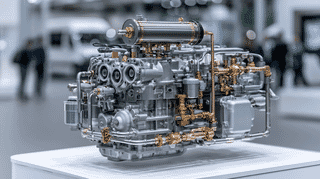
Toyota, Shinshu University and 11 partners are building a self-driving lab where robots run experiments and AI picks what to try next. Here is how Japan's closed-loop materials push compares with Berkeley's A-Lab and China's robot chemist.