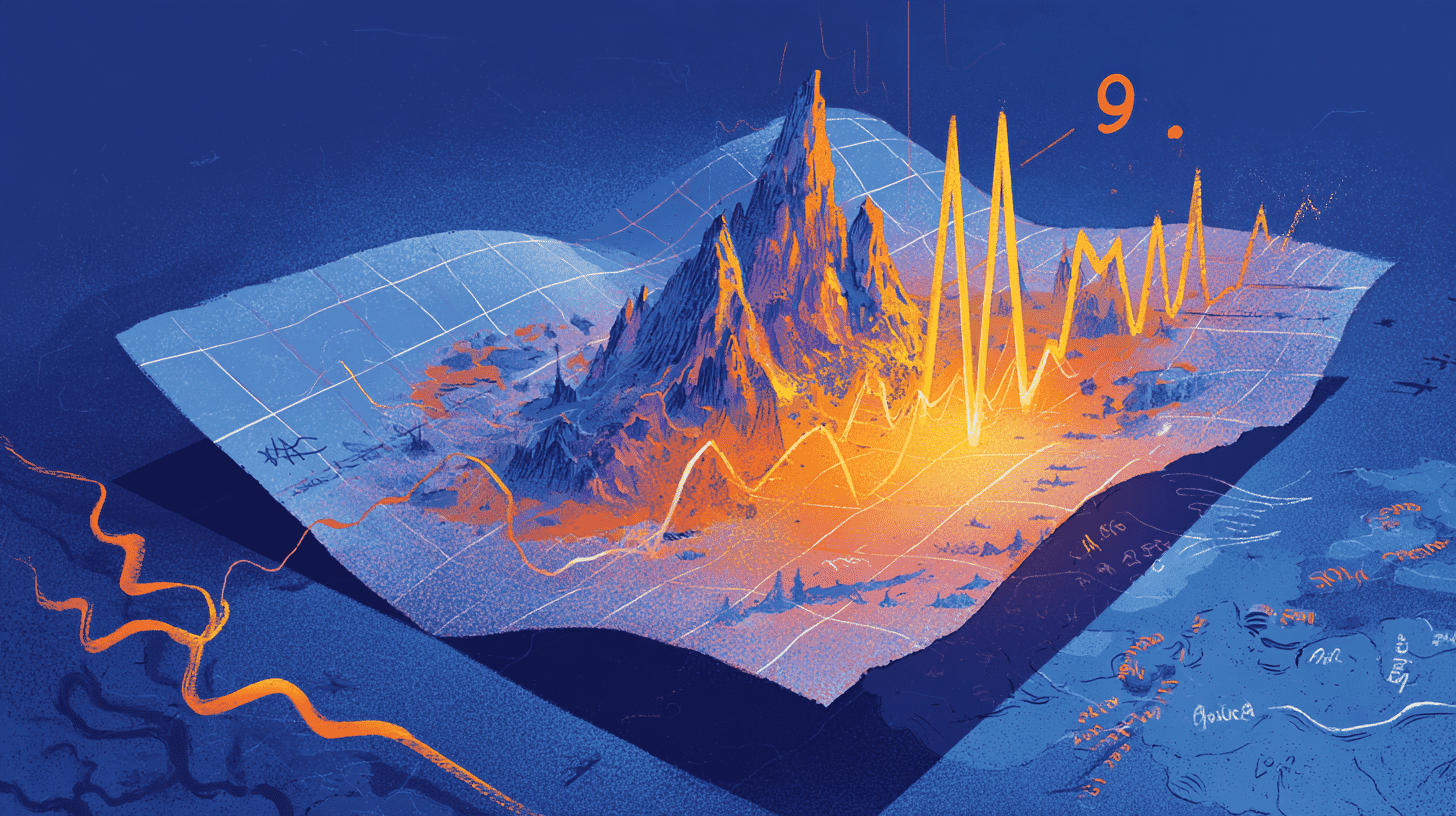
🌍 At 12:40 p.m. on October 16, 2026, phones and loudspeakers across much of Japan announced a magnitude 9.9 earthquake in the Kuril Islands. That would have been the biggest earthquake ever recorded on Earth. What actually reached Japan was intensity 1, in Hakodate, and the warning was withdrawn about 8 minutes later.
No tsunami warning followed, and by evening Japanese social media was treating the whole thing as a joke.
What happened at 12:40
The real quake was a magnitude 6.9 (preliminary), near Russia's Kamchatka Peninsula, about 160 km deep. The Japan Meteorological Agency (JMA) detected the seismic waves at 12:38:10. For the first 14 updates the system behaved like a normal early warning system working with a few seconds of data: magnitude estimates between 6.2 and 7.6, bouncing around as more stations reported in.
Then 9.9 first appeared in update 15, 73.5 seconds after detection, and never left. The warning went out with update 17, 112.5 seconds after detection, covering a huge area from Hokkaido to the Chubu region of central Japan.
The forecast called for intensity 5-lower to 7 in northern Nemuro, at Hokkaido's eastern tip, with 7 being the top of Japan's intensity scale, and intensity 1 to 4 for Tokyo's 23 wards, more than 2,000 km from where the quake actually was.
The ground in Tokyo did nothing. JMA withdrew the alert at 12:48, which AdverTimes reports was the first cancellation of a warning-level alert (lower-level forecasts had been cancelled before). At a 2 p.m. briefing JMA apologized and ruled out a cyberattack.
Just how big is a magnitude 9.9?
Magnitude is not a ruler, it's a logarithm. JMA's rule of thumb: each step of 1 in magnitude means about 32 times the energy. Run the numbers and the fake quake was:
- about 30,000 times the real quake (M6.9)
- about 22 times the 2011 Tohoku earthquake (M9.0), the one behind the great tsunami
- about 4 times the 1960 Chile earthquake (M9.5), the largest ever recorded
The system was announcing a new world record, by a wide margin, with the calm of a vending machine.
A lot of people in Japan didn't buy it. A popular Togetter thread collected posts from people whose first reaction was "bug." One noted that 9.9 looked like a suspicious boundary value. Others did the Chile math in their heads.
Not everyone found that charming. Several commenters called it plain normalcy bias, pointing out that the same reflex would also wave away a real giant. And a real M8.8 did strike near Kamchatka in July 2025.
Why the system thought the world was ending
JMA published two follow-up reports on the same day. Stripped of jargon, three things went wrong:
- A magnitude formula built for domestic quakes was applied to one very far from Japan.
- Magnitude and shaking forecast were computed from two different hypocenters. They are supposed to be the same point.
- Seismometers far from the hypocenter were used to compute magnitude.
Early magnitude estimates come from how hard stations are shaking and how far they are from the quake. JMA's map shows the system calculating magnitude from a point far out in the Pacific, east of Kamchatka. From that distance, the shaking at Japan's sensors could only fit a monster, which is the most likely route to 9.9 (JMA's reports show the map but don't spell out this step). The system then took that monster's size and plugged it into a different location, the Kurils, to forecast shaking in Japan. It's like hearing a firecracker, deciding it was an explosion 1,000 km away, and then announcing a huge blast next door.
The embarrassing part is that this had happened before. On July 30, 2020, an M5.8 near Torishima was estimated as M7.3, with a warning issued for Tohoku, Kanto, Koshin, Hokuriku, Tokai and the Izu Islands. No shaking of intensity 1 or more was observed anywhere. JMA's fix back then was a function that excludes stations more than 700 km from the hypocenter.
On October 16, JMA found that the function was not working properly. Engineers applied an emergency fix at about 9:30 p.m. the same day, and confirmed that after the fix, the same quake no longer triggers a warning.
The punchline: a lot of phones stayed quiet
While half of Japan was jumping out of chairs, Docomo customers did not receive the alert at all. NTT Docomo apologized the same day: its emergency Area Mail never went out in Hokkaido, Tohoku, Kanto, Koshin, Hokuriku, Tokai and the Izu Islands, due to a system malfunction at the carrier. Docomo sends these when intensity 5-lower or stronger is forecast, which this time it certainly was.
The fake earthquake, in other words, found a real bug. Many Japanese commenters said a false alarm was a far better day to find out than the real thing.
Many also complained the cancellation came with the same alarm sound, so people who had just relaxed got blasted again. One user reported a Starbucks bursting into laughter at the cancellation.
Does anyone else have this?
Yes. Japan started nationwide public warnings in 2007.
Mexico's SASMEX began in 1991 with 12 stations on the Guerrero coast. Its coastal sensors can buy Mexico City a minute, sometimes longer, before shaking from big Pacific-coast quakes arrives. By 2026, the alert reached the streets through 28,287 loudspeakers in Mexico City. On the US West Coast, ShakeAlert reached California in 2019, Oregon in March 2021 and Washington in May 2021, covering more than 50 million people. Taiwan has run public alerts since 2014 and South Korea since 2015. And Google pushes alerts to Android phones in many countries, using the phones themselves as seismometers.
Other systems have had bad days too:
- Brazil, February 2025: Google's Android alerts warned of up to M5.5 around 2 a.m. There was no quake, and Google switched the system off there.
- Israel, October 26, 2024: an explosion in southern Lebanon was mistaken for a quake, and alerts went to 284 communities.
- Turkey, February 2023: the opposite failure. In the M7.8, Google estimated 4.5 to 4.9 and sent its top alert to only 469 people, when up to 10 million should have received it.
Plenty of Japanese commenters drew the same lesson: a system that screams about a quake that never comes is annoying, but one that stays calm during a real M7.8 is far worse.
Fail, or practice swing?
The phrase that kept coming up online was "not a swing and a miss, but a practice swing." It frames a false alarm as rehearsal: you ducked, you checked the exits, you found out your phone carrier was broken.
The opposite worry is an old one: every false alarm teaches people that the alarm can be ignored. JMA says it will keep investigating and take further steps.
Does your country have quake alerts? If your phone suddenly said "magnitude 9.9," would you dive under the table, or suspect a bug first?
References
- https://www.jma.go.jp/jma/press/2610/16b/202610161400.html
- https://www.jma.go.jp/jma/press/2610/16c/202610161730.html
- https://www.jma.go.jp/jma/press/2610/16d/202610162240.html
- https://www.data.jma.go.jp/eew/data/nc/pub_hist/2026/10/20261016123810/content/content_out.html
- https://www.jma.go.jp/jma/press/2007/30a/kaisetsu202007301130.pdf
- https://www.data.jma.go.jp/nagoya/shosai/info/mini-jishin/magunitude.html
- https://www.advertimes.com/20261016/article560875/
- https://bnonews.com/index.php/2026/10/japan-mistakenly-issues-warning-for-magnitude-9-9-earthquake/
- https://www.jma.go.jp/jma/en/2011_Earthquake/2011_Earthquake.html
- https://www.docomo.ne.jp/info/notice/page/261016_00_m.html
- https://togetter.com/li/2758891
- https://b.hatena.ne.jp/entry/s/news.web.nhk/newsweb/na/nd-20261016de60368
- https://www.scientificamerican.com/article/how-big-was-chile-earthquake-1960/
- https://www.aljazeera.com/amp/video/newsfeed/2025/7/30/tsunami-alert-after-massive-earthquake-east-of-russia
- https://www.usgs.gov/programs/earthquake-hazards/science/earthquake-early-warning-around-world
- https://www.usgs.gov/news/entire-us-west-coast-now-has-access-shakealert-earthquake-early-warning
- https://politica.expansion.mx/cdmx/2026/09/18/por-que-alerta-sismica-tardo-30-anos-en-llegar-a-calles
- https://en.wikipedia.org/wiki/Earthquake_early_warning_system
- https://9to5google.com/2025/02/14/google-android-earthquake-alerts-false-alarm-brazil/
- https://www.jpost.com/breaking-news/article-826136
- https://the-decoder.com/google-waited-over-two-years-to-admit-its-earthquake-alerts-failed-in-turkeys-2023-quakes/







Global Discussion
5 comments