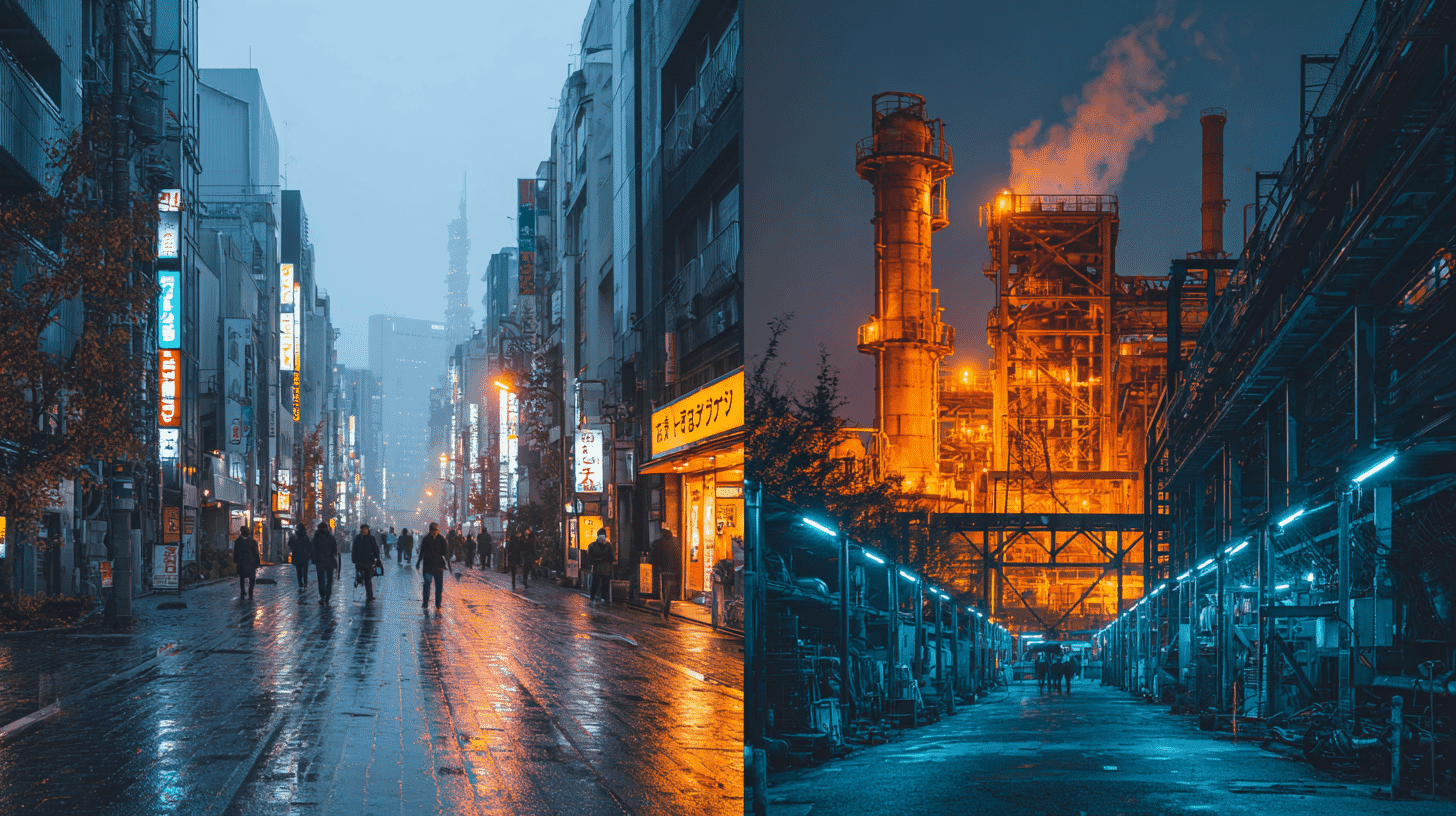
Almost no public trash cans, yet streets stay spotless. Tourists marvel at Japan's cleanliness. But the latest data from Japan's Ministry of the Environment tells a different story: a recycling rate of just 19.3% in FY2024, far behind Germany's ~67% and South Korea's ~60%. Why does "the clean country" rank at the bottom of the developed world in recycling? The answer lies in 991 incinerators.
38.11 Million Tons: Equivalent to 102 Tokyo Domes
According to the Ministry of the Environment's annual "Municipal Solid Waste Generation and Treatment" survey released in April, Japan generated 38.11 million tons of municipal waste in FY2024 (April 2024–March 2025). That's down 2.2% from the previous year, and equivalent to filling the Tokyo Dome 102 times. About 70% (26.37 million tons) came from households, and the remaining 11.75 million tons from businesses.
Per capita daily waste generation stood at 839 grams, down 1.5% year-on-year. Compared to a decade ago (2015), Japanese households now produce 100 grams less waste per person per day. Total waste has fallen 13.7% over the same period. On paper, Japan is steadily reducing its waste footprint.
The problem is what happens next. When you look at how that waste gets processed, Japan occupies a strikingly unusual position among developed economies.
A 19.3% Recycling Rate: Among the Lowest in the OECD
Of the 38.11 million tons generated, 4.26 million tons were reprocessed after intermediate treatment (incineration, crushing, sorting). Combined with directly-collected recyclables and community collection, total recycled volume reached 7.38 million tons, down 3.4% year-on-year. The final recycling rate: 19.3%, a 0.2-point drop from the previous year.
Set this against international benchmarks and Japan's position becomes stark:
- Germany: ~67% (European Environment Agency, 2022), world leader
- South Korea: ~60% domestic waste; ~98% for food waste alone
- EU average: ~48.6% (2022)
- United States: ~32% (EPA, 2018)
- Japan: 19.3% (FY2024)
Academic literature and OECD reports consistently describe Japan as "one of the lowest recyclers among industrialized nations." The gap with Germany is nearly fourfold.
A 79% Incineration Rate: The World's Biggest Burner
So where does the waste actually go? The answer: incinerators.
As of the end of FY2024, Japan operates 991 waste incineration facilities. More than 90% of municipal waste undergoes intermediate treatment, and incineration accounts for roughly 79% of that pipeline. Compare this to the OECD average of around 20% and the U.S. figure of about 12%, and Japan's dependence on burning becomes extraordinary.
Only about 8% (3.06 million tons) ends up in landfills, the opposite of the U.S. and many European countries, where landfilling still dominates. There's a geographic reason: about 73% of Japan's land is mountainous, and the population is concentrated in narrow coastal plains. Landfill sites are physically scarce. Final disposal sites serving Tokyo and Osaka have been flagged as approaching capacity for more than a decade.
The "Thermal Recycling" Trick: A Uniquely Japanese Accounting Method
Here's where international readers often get confused. You may have seen claims that Japan recycles 84% of its plastic, one of the highest rates in the world. So why is the overall rate just 19.3%?
The answer is a term called "thermal recycling."
Thermal recycling means burning plastic to recover energy. In Japan, this is counted as a form of recycling. Under this generous definition, plastic "recycling" reaches 84%. But if you restrict the measure to material recycling, where plastic actually becomes new plastic, the rate drops to around 24%.
EU and UN statistics treat incineration with energy recovery as "energy recovery," not recycling. In other words, Japan and Europe are using different rulers. Environmental NGOs and academics have long criticized Japan's reliance on thermal recycling as a form of statistical sleight of hand that undermines genuine material circulation.
That said, Japan's incineration technology itself is world-class. Of the 991 facilities, about 710 (70%) use the waste heat, and 415 (40%) have electricity-generating equipment. In FY2024, waste-to-energy plants generated 10,448 gigawatt-hours of electricity, equivalent to the annual consumption of roughly 2.67 million households. Dioxin control and exhaust filtering are sophisticated enough that incinerators can be sited directly adjacent to residential neighborhoods, something almost unthinkable in the U.S. or Europe.
¥2.45 Trillion Price Tag: A Burden for a Shrinking Population
Japan's total waste management expenditure in FY2024 was ¥2.45 trillion (about $15.5 billion), up 6.9% year-on-year. That breaks down into ¥556 billion for facility construction and upgrades, and ¥1.78 trillion for day-to-day operations and maintenance.
The cost pressure stems from an aging infrastructure wave. Most of Japan's incinerators were built between the 1990s and early 2000s and are reaching end-of-life. Replacements run into the tens of billions of yen per facility.
Meanwhile, Japan is losing incinerators: the national count dropped by 13 from the previous year. Over the next 10–20 years, Japan faces a paradox, maintaining nationwide processing capacity while the number of facilities falls, funded by a population that's shrinking and aging. Smaller municipalities are increasingly unable to keep their own incinerators running and are being forced to pool resources regionally.
April 2026: Japan's Big Circular Economy Pivot
To tackle these structural problems, Japan enacted a revised Act on the Promotion of Effective Utilization of Resources, which took effect on April 1, 2026.
Two pillars stand out. First, the law requires manufacturers of designated products to submit plans and regular reports on their use of recycled materials, with specific utilization quotas. Second, a new design certification system rewards products engineered for material recycling: on February 10, 2026, the government issued its first round of certifications, 41 products across four categories (PET beverage bottles, stationery, household cosmetic containers, and household cleaning-product containers).
For decades, Japanese manufacturers optimized packaging for ease of incineration because "thermal recycling would take care of it." The new law explicitly reverses that logic: design for material recycling, not for burning.
There's external pressure too. Starting July 2026, the EU enforces stricter circular economy rules, including bans on destroying unsold clothing and expanded recycled-content mandates. Japanese exporters will have to meet European standards regardless of what Japan's domestic statistics say. The "we hit 84% via thermal recycling" argument simply won't fly abroad anymore.
The Real Meaning of "Clean Japan": Technology That Makes Garbage Disappear
Tourists visiting Japan routinely marvel that streets stay pristine despite the near-total absence of public trash cans. People carry their convenience-store waste home, sort it meticulously, and put it out on designated collection days. This "take it home" ethic underpins the country's visible cleanliness.
But the numbers tell a different story underneath: Japan isn't a country that produces less waste, it's a country that burns waste quickly and makes it disappear. Much of what households dutifully sort ultimately ends up in an incinerator, gets turned into electricity, and becomes ash sent to landfill. The process is high-tech and sanitary, but the share of material that truly re-enters the economy remains among the lowest in the developed world.
Japan leads the world in "urban mining", recovering rare metals from discarded electronics. But in basic municipal-waste material recycling, it clearly lags. The 2026 legal overhaul is the starting line of a 15-year effort to close that gap.
Japan's Waste Picture in Numbers (FY2024)
- Total waste generated: 38.11 million tons (−2.2% YoY; 102 Tokyo Domes)
- Per capita daily waste: 839 grams
- Recycling rate: 19.3% (−0.2 points YoY)
- Final landfill disposal: 3.06 million tons
- Incineration share: ~79% (highest in OECD)
- Incineration facilities nationwide: 991
- Electricity generated from waste incineration: 10,448 GWh (~2.67 million households)
- Total waste management expenditure: ¥2.45 trillion (~$15.5 billion), up 6.9% YoY
Japan's challenge may be less about technology and more about measurement and culture. The country operates world-class incinerators, and its citizens sort waste with remarkable discipline, yet its material-recycling numbers remain far behind Europe and Korea. Sometimes looking clean and being circular aren't the same thing.
Where does your country's waste actually end up, recycled, landfilled, burned, or exported? We'd love to hear how the rules and realities compare where you live.
References
- https://news.yahoo.co.jp/articles/74960adc6d87bc38cff9078c2be87a7f7077fac0
- https://www.nippon.com/ja/japan-data/h02758/
- https://www.meti.go.jp/press/2025/02/20260210002/20260210002.html
- https://www.umweltbundesamt.de/en/data/environmental-indicators/indicator-recycling-municipal-waste
- https://www.epa.gov/facts-and-figures-about-materials-waste-and-recycling/national-overview-facts-and-figures-materials






Global Discussion
14 comments