Cars built in America will be able to pass Japan's strict vehicle inspections "as is." Japan's unique safety standards, long called a "non-tariff barrier," are changing significantly under the Japan-US trade agreement. Behind it lies an unexpected safety-standards controversy that began with President Trump's "bowling ball test" remark.
## MLIT Creates a "Special Approval" System: What Changes
On February 16, 2026, Japan's Ministry of Land, Infrastructure, Transport and Tourism (MLIT) amended the safety regulations for road vehicles and put a new approval system for US-made passenger cars into effect the same day.
The core of the system is simple. Passenger cars made in US factories that meet US safety standards (FMVSS, Federal Motor Vehicle Safety Standards) can be registered in Japan through a mainly document-based process, even if they do not fully comply with Japan's safety standards. In other words, the additional Japan-specific tests previously required are, in principle, no longer needed.
Specifically, vehicles that receive "special approval" from the transport minister are subject to the following measures.
A red star-shaped sticker about 5 cm in diameter must be affixed to the rear of the vehicle. The remarks field of the vehicle inspection certificate will state "Certified US Vehicle" and the date of conformity. Even if specifications differ from Japanese standards, vehicles will be accepted if safety can be confirmed on paper; vehicles whose safety cannot be confirmed cannot be imported. MLIT plans to ask manufacturers to take voluntary measures where necessary.
The biggest beneficiary is expected to be Toyota. The company plans to introduce three US-built models, the Camry, Highlander and Tundra, to the Japanese market in stages from 2026, and showed the Camry and Highlander at Fuji Speedway in November 2025. They are, in effect, "reverse imports." The system is not limited to US brands; it also covers vehicles made at Japanese automakers' US plants.
## A Reform Born of Japan-US Trade Friction
This special approval system did not appear out of nowhere. Behind it lie the Japan-US tariff negotiations that intensified in 2025.
In April 2025, President Trump imposed large additional tariffs on many countries, including a 25% additional tariff on cars and car parts from Japan. Japan's side, led by Ryosei Akazawa, then minister for economic revitalization (now minister of economy, trade and industry), held repeated talks with the US and reached a framework agreement on July 22 of that year.
The main points of the agreement were as follows.
- Tariffs on cars and car parts: cut from 25% to 15% (including the existing 2.5%)
- Reciprocal tariff on Japan: set at 15%
- Japanese investment in the US: about $550 billion (about ¥84 trillion)
- Additional purchases of US energy and agricultural products
The agreement also included a clause to "accept US-made and US-certified passenger cars in Japan without additional testing." The new special approval system implements that agreement at the level of law.
## What Was Trump's "Bowling Ball Test" Remark?
There is one episode you can't skip when discussing this issue. In an April 2025 social media post, President Trump listed eight "non-tariff barriers" of various countries. He criticized Japan's automobile safety standards as "protectionist technical standards" and cited "Japan's bowling ball test" as an example.
In fact, the remark had a history. In 2018, during his first administration, Trump claimed in a speech that "Japan drops a bowling ball from 20 feet above the hood of a car, and if it dents, the car fails. Only a tank could pass." The White House press secretary at the time had to explain that he had been "joking."
Of course, no such test exists in Japan. What Trump apparently confused it with is the "pedestrian head protection test," in which a dummy modeled on a human head (a hemispherical impactor) is struck against the hood to evaluate how well it absorbs the impact on a pedestrian's head when hit. It is an important safety standard for Japan's traffic environment, where about half of pedestrian traffic deaths result from head injuries.
In the United States, by contrast, where roads are wider and the risk of contact with pedestrians is lower than in Japan, there is no equivalent test standard. This difference had been treated as a "non-tariff barrier."
## Japan vs. the US: Why Do Safety Standards Differ?
The differences between Japanese and US automobile safety standards are not just regulatory; they reflect each country's traffic environment and social structure.
In Japan, roads are narrow and pedestrians and cyclists share space with cars, so "pedestrian protection" standards are especially emphasized. Japan's type-approval system is also based on 43 international standards developed at the United Nations, with mutual recognition arrangements with the EU and others.
The US, by contrast, has a safety-standard system premised on a vast road network. There are federal safety standards (FMVSS), but no pre-production review system like Japan's. Self-certification by manufacturers is the norm, with problems handled after the fact through recalls.
The special approval system can be seen as an attempt to bridge this fundamental difference through a "political agreement." While stating that "we must avoid threatening safety on Japan's roads," MLIT found a practical compromise: waiving additional tests if safety can be confirmed on paper.
## What Cars Will Actually Arrive?
For now, the stars are Toyota's US-built cars. Let's look at the three models due to arrive in stages from 2026.
**Camry**: A best-selling sedan in the US too. It has long been sold in Japan, but this will be the first "reverse-imported" version from a US plant.
**Highlander**: A large three-row SUV. Popular in the US starting at about $35,000 (about ¥5.3 million), it remains to be seen how well it will fit Japan's narrow roads. The Ministry of Economy, Trade and Industry has already introduced two as official vehicles, and on February 16, the day the system took effect, economy minister Akazawa showed up for official duties in one.
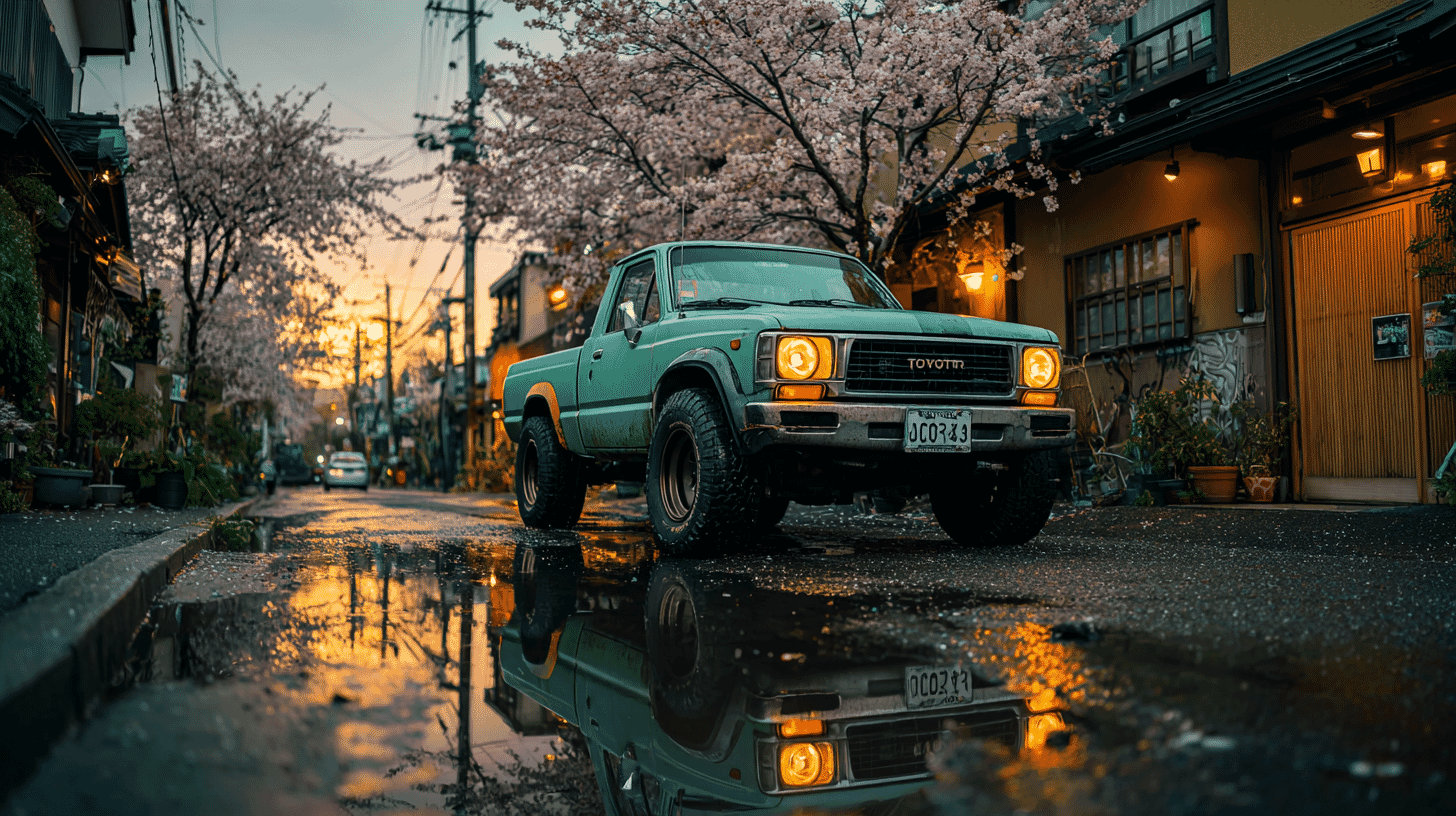
**Tundra**: A full-size pickup truck. At more than 5.8 meters long, it won't fit in most ordinary Japanese parking spaces, but demand is expected from outdoor enthusiasts and fans of American cars.
US automakers such as Ford may also look to enter the Japanese market on their own. Ford withdrew from Japan in 2016, but the lower barriers under the special approval system could open the way for a return.
## Concerns and Challenges Ahead
While some welcome the new system, several concerns have also been raised.
First is safety. Lighting colors and specifications differ between Japan and the US. Some US cars have red rear turn signals, while Japanese standards require amber. Some worry these differences could cause confusion on real roads.
Next is how repair shops will respond. If vehicles with unfamiliar specifications are brought in for inspection, shops might refuse them. The star sticker is aimed at exactly this problem, making certified vehicles instantly recognizable to encourage acceptance.
The weak yen is another factor. Since these vehicles are made in the US and imported, their price appeal is limited in the current exchange-rate environment.
And there is a fundamental question: concern about effectively relaxing Japan's pedestrian protection standards. MLIT says it will not allow imports of vehicles whose safety cannot be confirmed, but the long-term impact on Japan's road safety needs to be watched.
## Update: The Legal Basis for Tariffs Changed, but 15% on Cars Remained
Four days after the system took effect, the premise of the Japan-US agreement itself was shaken. On February 20, 2026, the US Supreme Court ruled 6-3 that the International Emergency Economic Powers Act (IEEPA) does not give the president the power to impose tariffs. Reciprocal tariffs and fentanyl-related tariffs based on IEEPA lost their legal basis all at once.
The part affecting Japanese cars, however, survived. Tariffs on cars and car parts are based on Section 232 of the Trade Expansion Act and were outside the scope of the ruling, so the 15% rate remains. Hours after the ruling, President Trump declared a uniform 10% surcharge under Section 122 of the Trade Act, and the next day, February 21, said he would raise it to 15%. Section 122 measures are limited to a maximum of 150 days and expired on July 24, 2026, after which they were replaced by measures under Section 301 of the Trade Act.
In other words, the laws the US uses to impose tariffs changed rapidly, but neither the 15% on cars nor the approval system for US-made passenger cars that Japan accepted in return has moved.
---
In Japan, the vehicle inspection system (shaken) is not just an inspection but a social mechanism rooted in protecting road safety, and opinions among Japanese people are divided over creating a "special exception" to its standards.
How does your country handle safety standards for foreign cars?
### References
* https://trafficnews.jp/post/636095
* https://car.watch.impress.co.jp/docs/news/2080616.html
* https://www.mlit.go.jp/report/press/jidosha10_hh_000338.html
* https://www.kantei.go.jp/jp/103/statement/2025/0723bura2.html
* https://www.jiji.com/jc/article?k=2025042800902&g=eco
 01 Pick
Business & Economy
01 Pick
Business & Economy




Global Discussion
15 comments