Astellas and Kyowa Kirin are the first Japanese drugmakers to sign most-favored-nation pricing deals with Washington. A September 29 tariff deadline explains the timing, and Japanese prices sit inside the U.S. formula.
The Switch 2 hit $499.99 in the US on September 1. Japan raised its price three months earlier, and Famitsu's numbers show a rush to 712,000 units in May, then 100,166 in June, with July still under April.
Medicines available in the US and Europe that Japanese patients cannot get. We unpack Japan's drug loss problem: the count falling from 86 to 78, a new fiscal-2026 budget, and the fresh risk posed by Trump's drug-pricing executive order.
In May 2026 Toyota canceled the Lexus LF-ZC, its next-gen EV—but it killed the car, not the tech. Why investment in gigacasting and solid-state batteries continues, compared with Tesla's own gigacasting retreat.
On May 29, 2026, Mitsubishi unveiled a mid-to-long-term vision reviving the Pajero after seven years and turning it into a series. With a ~1 trillion yen ($6.3B) investment, a hybrid pivot, and Nissan-built US vehicles to dodge tariffs, the comeback rides a global wave of heritage-SUV revivals.
Subaru cut its FY2026 operating profit forecast by 900 billion yen to just 40 billion yen, a 90% year-on-year plunge announced May 11. Beyond US tariffs, a North American cold wave, Middle East shipping disruptions, and EV asset impairment from Trump's environmental rollback all hit at once. Why does Subaru—with 80% North America sales reliance—suffer most among Japanese automakers?
JBIC and Japan's three megabanks signed $2.221 billion in loans for the first three projects of a $550 billion US investment ceiling, the price Tokyo paid to bring Trump's tariffs down to 15%. The deal, the dollar-funding crunch, and what changed when the Supreme Court ruled IEEPA tariffs unlawful in February 2026.
Japan's MAFF and U.S. Wheat Associates held the first meeting under their Memorandum of Cooperation on April 22 to stabilize wheat supply. With only 15% self-sufficiency and 40% of imports from the US, this article unpacks the food diplomacy at stake amid climate and logistics risks.
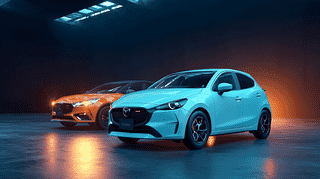
Mazda will end domestic production of its signature compact car Mazda2 (formerly Demio) at the end of August 2026. We explore the 30-year legacy of the car that saved Mazda from bankruptcy in the 1990s, and what this means for Japan's shrinking compact car market.
Japan's gasoline has hit record highs, dialysis tubing is running out, and bathtubs can't be shipped. With 95% of crude oil coming from the Middle East, pivoting to the world's largest oil producer, America, seems like a perfect Win-Win. But refinery design, tanker size, the Panama Canal bottleneck, and an ironic naphtha yield problem all stand in the way. Here's why the obvious solution isn't simple.
Japan pulled rare earth mud from 6,000m down in February 2026, but the 'Rare Metal King' Shigeo Nakamura says don't commercialize it. His counterintuitive argument: Minami-Torishima's 16 million tons is worth more as a silent deterrent co-held with the US than as a commercial mine. We unpack Nakamura's career, his 'don't mine, but keep the capacity' thesis, and how it compares to the US SPR, Project Vault, and Chinese stockpile strategy.
At the G7 finance ministers' expanded meeting on April 17, 2026 in Washington, members aligned on strengthening critical mineral supply chains. Japan committed $20M each to the Asian and Inter-American Development Banks, marking a pivot to the resource-country funding phase. From the Japan-EU BRT proposal to the Kananaskis CMAP, C$6.4B (~US$4.6B) in unlocked projects, and now MDB funding, progress is real. But China still processes 90% of rare earths. A sober assessment of whether 'slow but steady' is actually fast enough.
Japan's Foreign Minister Toshimitsu Motegi publicly criticized the White House at an April 17 Diet session over its use of Nintendo's Wii Sports footage in an Iran strike propaganda video. As Nintendo already sues the US over tariffs, here's how Japanese IP ended up at the center of a diplomatic spat, and how Reddit is reacting.
In spring 2026, Japan and the United States began building a three-layered rare earth alliance: Treasury Secretary Bessent's May visit, Mitsubishi Materials' stake in US recycler ReElement, and Proterial's breakthrough heavy-rare-earth-free magnet. Here is what this quiet realignment means for the global critical minerals map.
Japan's Economy Minister Akazawa called BOJ policy to boost the yen 'one option' to curb Iran-driven inflation. With USD/JPY near 160 and a 60% chance of a BOJ rate hike on April 28, we explain why a cabinet minister weighing in on forex policy is so unusual.
TDK will manufacture TMR sensors for Apple in the U.S. for the first time as part of Apple's expanded American Manufacturing Program, with $400 million invested through 2030. We examine how Trump-era reshoring pressure is reshaping supply chains for Japanese component makers including Murata and Taiyo Yuden.
Former BOJ Governor Haruhiko Kuroda has proposed a 'coalition of the willing' among Japan, the EU, and Southeast Asian nations to preserve free trade amid WTO dysfunction and Trump-era tariffs. His proposal calls for expanding frameworks like the CPTPP and strengthening economic security cooperation.
Trump tariffs triggered a massive production shift by Toyota, Honda, Nissan, and Subaru from Japan to the US. With $35 billion in annual tariff costs industry-wide, we explore each maker's strategy, the impact on 5.5 million Japanese jobs, and how this echoes the 1980s trade wars.
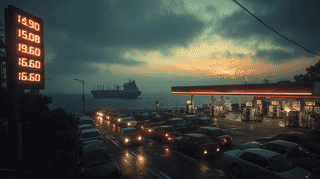
Japan's gasoline hits a record ¥190.8/L ($1.27/L) as the Hormuz Strait blockade chokes off 90%+ of crude imports. With the last Middle East tanker arriving March 22, government subsidies restarting, and Alaska crude on the table at the US-Japan summit, Japan faces its gravest energy crisis in decades.
Japan's government has asked Japan Display Inc. (JDI) to run a $13 billion advanced display factory in the US — part of a $550 billion investment deal to ease Trump tariffs. We break down the defense angle, China dependency risks, and what it means for a company that's been on life support for years.