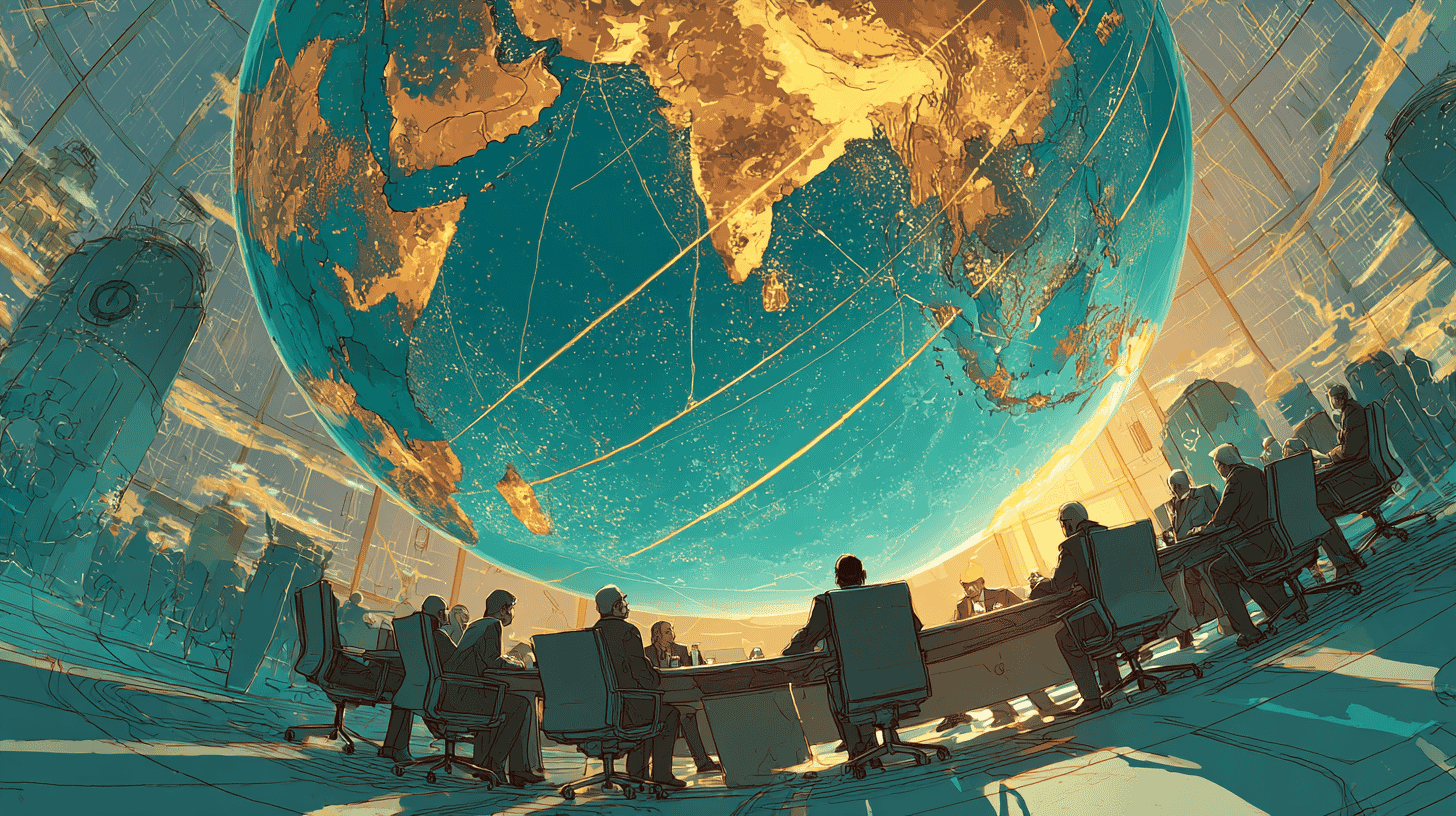
"Steady progress, but too slow." That's the most honest one-line verdict on the G7 finance ministers' expanded meeting held in Washington on April 17, 2026. As co-chair, Japan announced $20 million contributions each to the Asian Development Bank (ADB) and the Inter-American Development Bank (IDB), $40 million total. The number looks small. But it signals that the Western "de-risking from China" strategy has entered a new phase.
What was decided: the Washington meeting
The expanded G7 finance ministers' meeting convened in Washington on April 17, 2026. France, this year's G7 presidency holder, and Japan served as co-chairs, with the World Bank's president also co-chairing in an unusually inclusive format.
Beyond G7 members, Australia was invited, along with Argentina, Brazil, India, and Indonesia, major "Global South" resource-producing countries. That mix reflects the new focus.
The central question was how to build critical mineral supply chains with emerging economies. Finance Minister Satsuki Katayama told reporters that Japan "has been exposed to China's weaponization of critical minerals," and announced the funding commitment to ADB and IDB. According to finance ministry officials traveling with her, each contribution will total $20 million.
Channeling money through multilateral development banks is a step beyond the previous "G7-only solidarity" framework. Resources are in Latin America, Africa, and Southeast Asia. Flow non-Chinese capital there, build refining and processing capacity, that's the new logic.
How we got here: the "progress" part
The de-risking conversation started moving concretely in summer 2025. Lined up chronologically, the pace is genuinely steady.
June 2025: G7 Kananaskis Summit (Canada). G7 leaders adopted the Critical Minerals Action Plan (CMAP) and launched the Canada-led Critical Minerals Production Alliance. At this stage, it was still policy framing.
July 2025. The Japan-EU Business Round Table (BRT) formally proposed rare earth supply chain cooperation under the "Competitiveness Alliance." Private-sector momentum began.
October 31, 2025: G7 Energy and Environment Ministers' Meeting (Toronto). Under the Critical Minerals Production Alliance, 26 initial projects and C$6.4 billion (~US$4.6 billion) in partnerships were announced. Canada led, with nine allied countries participating. Concrete deal lists for rare earths, graphite, and scandium emerged.
January 12, 2026. First in-person G7 finance ministers' meeting on critical minerals, held in Washington. US Treasury Secretary Bessent chaired. Australia, India, South Korea, and Mexico joined the expanded session.
February 4, 2026. A ministerial meeting of 55 countries in Washington reached agreement on a "price floor" mechanism among Japan, the US, EU, and Mexico. This was the first concrete pricing tool to counter Chinese underselling.
April 17, 2026 (this meeting). The finance ministers' expanded meeting addressed resource-country engagement, with Japan announcing its MDB contributions.
Laid out this way, things really are moving month by month. Multi-venue G7 meetings, a price floor agreement, C$6.4 billion in project origination, and now MDB capital mobilization, the evidence of serious commitment is accumulating.
Bloomberg's forecast shows a "positive shift"
The shift is starting to show up in market forecasts too. A March 2026 Bloomberg Intelligence report projects that rising neodymium-praseodymium (NdPr) supply from the US and Australia will cut China's global market share from 90% in 2024 to 69% by 2030.
NdPr is the primary material for permanent magnets, essential for EV motors, defense systems, and industrial robotics. Non-Chinese producers like MP Materials (US) and Lynas Rare Earths (Australia) are scaling up. The annual global NdPr market value is forecast to reach $10 billion by 2030.
"Steady progress" is not a lie.
But it's slow: the reality in comparison
The problem is the pace.
First, China still controls roughly 90% of global rare earth processing, and that structural fact hasn't changed. Mining ore is possible in many countries, but the capacity to process it into oxides, metals, and magnets is concentrated in China. Digging up rocks isn't de-risking.
Heavy rare earths like dysprosium and terbium remain nearly 100% dependent on China. The 2030 forecast of 69% applies to NdPr (light rare earths) only. For heavy rare earths, the ones most tied to defense applications, alternative supply chains barely exist.
Next, the scale gap. Japan's MDB contribution totals $40 million. Meanwhile, the Australia-US critical minerals pipeline agreement reached in October 2025 was $8.5 billion. The US Commerce Department's January 2026 financing line for USA Rare Earth was $1.3 billion. The C$6.4 billion mobilized under the G7 alliance isn't small, but it's orders of magnitude below China's accumulated investment over 30+ years, starting in the 1980s, in the tens of billions of dollars.
Then there's the time-horizon wall. Mining development takes an average of 15 years from planning to production start. Processing plants take 5-10 years including environmental review and technical learning. China began building its current position when Deng Xiaoping declared in 1992 that "the Middle East has oil; China has rare earths." The G7 only started moving seriously in summer 2025.
Among economic security analysts, the goal of "halving Chinese dependence by 2030" is widely seen as highly ambitious. Honestly, whether it's achievable in time is uncertain.
Why it's slow: structural reasons
The key insight: this isn't slow because of a lack of will. Multiple structural constraints are at work.
Price competitiveness. China has supplied cheap rare earths to world markets on the back of low wages and lax environmental rules. For the West to compete at the same cost level requires subsidies, tariffs, price floors, or some other "market-distorting" intervention. The February 2026 price floor agreement was the first concrete attempt to clear this hurdle.
Environmental review thresholds. Japan, the EU, and the US all require environmental assessments that take years. Sweden's Kiruna region hosts over 1 million tonnes of rare earth deposits, but mining permits alone take years. The Chinese playbook of "tolerate pollution to move fast" cannot be replicated by democracies, politically or ethically.
Resource countries' own calculus. Producer countries in Africa, Latin America, and Southeast Asia don't uniformly want to distance themselves from China. China is strong in long-term contracts that trade infrastructure for mining concessions. From a resource country's perspective, rejecting a Chinese offer just because G7 MDB financing exists is not easy. That's exactly why Japan building a funding channel to resource countries matters, but the current dollar amount is still at the "message" level.
The one-year presidency cycle. The G7 rotates its presidency annually. Canada led in 2025, France leads in 2026. Maintaining continuity on action plans and alliances means surviving these annual handoffs. Japan stepping in as co-chair is partly about reinforcing that continuity.
"Steady" may not be enough
The $40 million Japan committed has limited financial weight. But the idea of the West funding resource countries, with Japan leading the pivot, is new and matters. Each phase has been worked through: proposals (summer 2025), project origination (autumn), market rules (winter), and now resource-country engagement (spring 2026).
Whether that's fast enough is another question. Can the G7 dismantle in 5-10 years a position China built over 30? No one knows. What's clear is that steady may not be enough, and each G7 member needs to step up another gear.
Japan tends to greet international-cooperation news with a vague "that's good" and rarely debates scale or urgency. How does your country evaluate China dependence risk? And how is it trying to de-risk?
References
- G7 Critical Minerals Supply Chain Strengthening Agreed (Kyodo/Yahoo News)
- Japan's MDB Contributions for Rare Earth Security (Nikkei)
- G7 Finance Ministers Meeting on Rare Earths - January 2026 (Nikkei)
- Canada Unlocks 26 New Investments Under Critical Minerals Production Alliance (Government of Canada)
- World Scrambles for Rare Earths to Erode China's Dominance (Bloomberg Intelligence)
- China Continues to Dominate Rare Earths (Mining Technology)
- Related: Will the Rare Earth 'Western Trade Bloc' Work?
- Related: Japan-US Rare Earth Alliance: Three Pillars







Global Discussion
14 comments