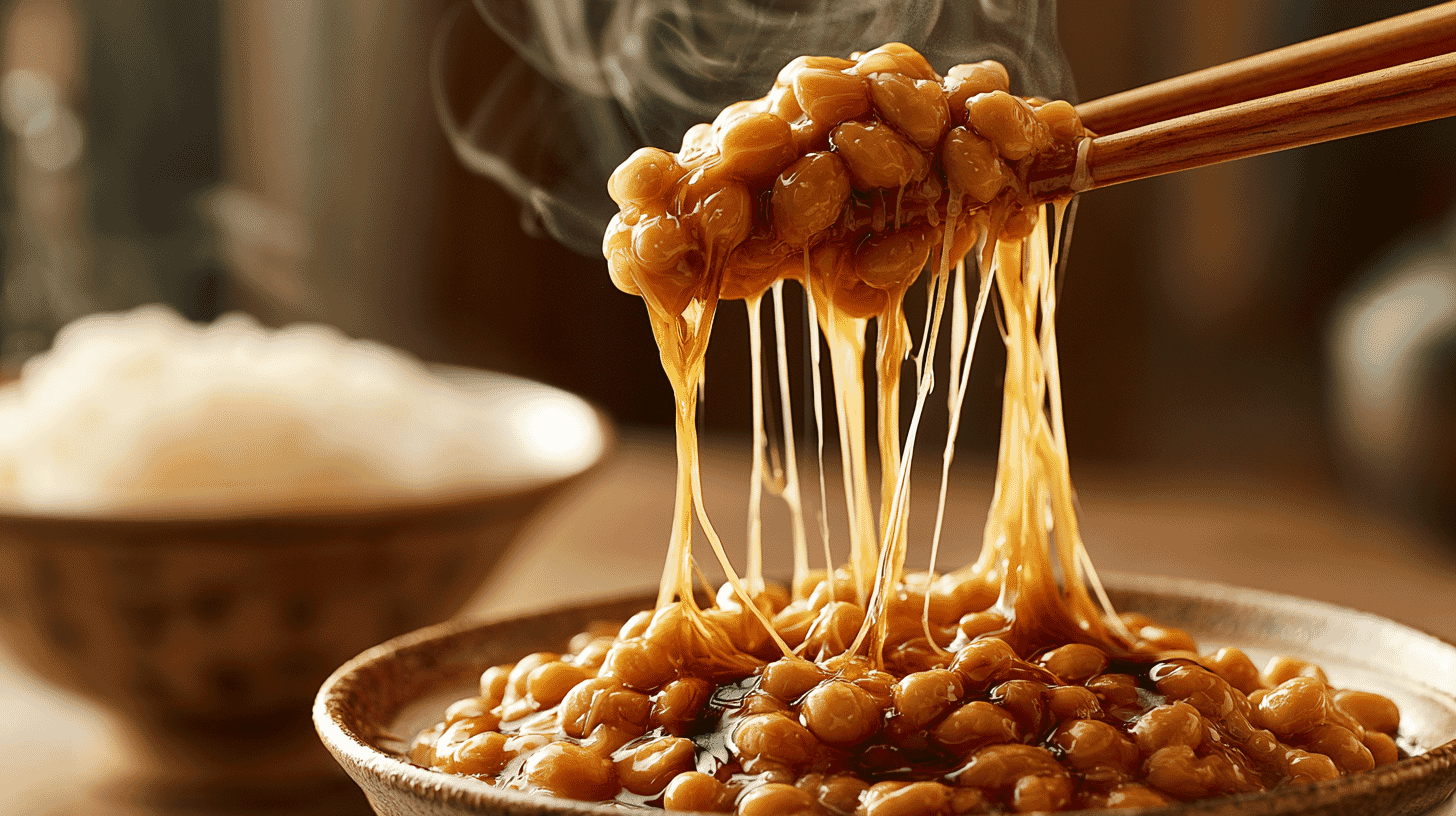
🫘 At a supermarket in Beijing, an entire aisle is stacked with Japanese natto, those famously sticky fermented soybeans most foreigners once said they could never eat. The label is in Japanese. The packs come in fours, not threes. And 80% of the weekend sales come from one Japanese region: Hokkaido.
One factory in the snowy city of Ebetsu has grown its exports 60-fold in eight years, almost entirely on Chinese demand. Meanwhile, back in Japan, one of the country's biggest natto makers paused four products, because tensions in the Middle East quietly disrupted its supply of packaging plastic.
This is the strange story of how Japan's most divisive breakfast food became a global commodity, told through one Hokkaido factory, one Beijing supermarket shelf, and one disappearing bottle of plum-flavored sauce.
A Hokkaido Factory's 60x Export Boom
In Ebetsu, a city outside Sapporo, Hokkaido Hamanasu Foods is having the kind of decade most regional food makers only dream about. When the company first started exporting natto in 2017, the entire year's overseas sales came to roughly 5 million yen. In 2025 that number cleared 300 million yen, a sixtyfold increase in eight years. Around 70% of it goes to a single market: China.
The company is not alone. According to the Hokkaido Regional Agricultural Administration Office, natto exported from the prefecture reached 640 million yen in 2025, five times the level when records began seven years earlier, with China taking roughly 90% of it. Nationally, JETRO's Tatsuya Furuki puts 2025 natto exports at 3.2 billion yen, up 48% year on year. Hamanasu Foods opened a new Ebetsu plant in 2023 that roughly doubled capacity, from about 40,000 packs a day to about 85,000, a bet placed well before these numbers arrived.
Speaking to Hokkaido Broadcasting Co. (HBC News), the company's senior managing director Tomohiko Funato gave a quick tour of the factory floor. Soybeans, pressure-steamed until they are soft and pale, get sprayed with natto starter culture, a strain of Bacillus subtilis var. natto, and packed by machine. They then spend about a day in a fermentation room kept at 40°C, where the bacteria break down proteins and produce the sticky polyglutamic acid threads, the funky aroma and the umami that defines natto.
What happens next is the interesting part. The finished packs go into a freezer kept at minus 30°C. Natto bacteria are tough, Funato explained: the cold does not kill them, they simply go dormant. Once thawed, the natto tastes the same as fresh, and freezing extends the shelf life far enough to survive a sea voyage, customs clearance and Beijing's distribution chain without losing its edge.
Beijing's Natto Aisle: Why "Four Packs" Beats Three
Walk into the right supermarket in Beijing and you will see something Japanese visitors find quietly surreal: a wall of Japanese-language natto packaging, in a country where natto was nearly unknown a decade ago.
According to HBC's report from the scene, weekend sales at one Beijing supermarket's natto section run 7,000 to 8,000 yuan, around 180,000 yen, or roughly 300 to 400 individual packs. Hokkaido products account for around 80% of those sales.
The packaging is the giveaway that this is a market built on careful localization. In Japan, natto typically sells in sets of three small cups. But Hamanasu Foods' export version comes in sets of four. "Even numbers are considered lucky in China," Funato said. "Three-pack versions exist, but four-packs are far more popular." The labels stay in Japanese. As Funato puts it, everything is printed in Japanese specifically to make clear that the product was made in Japan. The script itself is the quality signal.
This is the kind of cultural detail that never shows up in trade statistics, and the kind a regional food maker only learns on the ground.
Why China Suddenly Wants Natto
The strangeness of the boom is hard to overstate. Until very recently, Chinese cuisine had essentially no fermented soybean tradition resembling natto. The closest analogue, douchi, is a salted, drier black bean fermentation used as a seasoning, culturally a world away from the sticky breakfast bowl most Japanese eat.
So what changed? Tatsuya Furuki, deputy director at JETRO's (Japan External Trade Organization) Agricultural and Food Market Development Division, told HBC the catalyst was a slow build of small triggers. Japanese natto was originally sold in China for Japanese expats. Chinese consumers saw it on shelves and tried it, and then health-focused coverage on Chinese television and social media spread the curiosity faster.
A staff member at the Beijing supermarket told HBC's reporter that natto is, generally speaking, all benefit and no drawback, easy for people to accept, and very popular right now for health reasons.
That phrase, for health reasons, is doing a lot of work in this market. Chinese consumers reach for natto the way a New Yorker reaches for kombucha or kimchi: not because it tastes great, but because they have been told it is good for them.
The science, fortunately, mostly backs them up. Natto is one of the few common food sources of vitamin K2 in its highly bioavailable MK-7 form, which research has linked to bone and cardiovascular health. It contains an enzyme called nattokinase, identified by Japanese researcher Hiroyuki Sumi in 1980, which has shown clot-dissolving activity in laboratory studies. The evidence for direct cardiovascular benefits from eating natto remains less conclusive than supplement marketing implies. The Bacillus subtilis strain itself appears to survive stomach acid and reach the gut, where it may support the resident microbiome.
That's a far more solid health story than most "superfoods." It's also, crucially, a story that translates easily across languages.
The Plum Vinegar Sauce That Disappeared
Here's where the global picture turns ironic.

Source: Mizkan official site
While Chinese consumers fill their carts with Japanese natto, one of Japan's largest natto makers, Mizkan, just stopped selling a corner of its lineup at home.
On May 1, 2026, the company announced it was suspending sales of four natto products, effective the same day, with no resumption date set. They are Kin-no-tsubu Plum-flavored Black Vinegar Sauce 3-pack, its Hokkaido variant, Kume Natto Hokkaido Natto Mini 3, and Nattouichi Push-and-Squeeze Extra-Small Grain 3-pack. The reason, in the company's own statement, was that the worsening situation in the Middle East had driven up prices and created supply uncertainty for naphtha, the petrochemical feedstock behind the plastic trays and films Japanese natto depends on.
Mizkan also raised prices on all 19 of its natto products, the suspended ones included, by 6% to 20% from June 1 shipments. Its flagship Kin-no-tsubu Tare-Tappuri Egg Soy Sauce 3-pack went from a suggested retail price of 235 yen to 281 yen. It was the company's first natto price increase since July 2025.
For this author, it hit unexpectedly hard. The plum-vinegar variety happened to be both my favorite and my kid's. Realizing that a small everyday pleasure had vanished because of tensions thousands of kilometers away is the kind of moment when the phrase "global supply chain" stops being abstract.
It is also a quiet warning. Japan's natto industry runs on foamed polystyrene cups produced from petrochemical feedstocks, and those feedstocks move through the same global chokepoints as oil itself. The country whose food is conquering Beijing aisles is the same country whose own breakfast lineup just shrank because of a conflict far away.
Where to Buy Natto Outside Japan
If this story made you want to try natto, here is a realistic guide depending on where you live.
East Asia (China, Taiwan, Hong Kong, South Korea, Singapore). Hokkaido and other Japanese natto brands are widely available at mid-to-upper-tier supermarkets, especially those catering to expat or health-conscious shoppers. In China, look for Japanese-language labels (a deliberate quality cue, as noted above). Korea has its own domestic brand from Pulmuone that is competing with imports.
North America. Japanese and Asian grocery chains (Mitsuwa, Nijiya, H Mart, 99 Ranch, Tokyo Central) carry frozen Japanese natto. In bigger cities, Whole Foods and other natural-foods stores increasingly stock domestic brands. NYrture in New York and Megumi Natto in California are well-regarded American-made options. Online, both Amazon and direct-to-consumer fermented-foods retailers ship nationwide.
Europe. The UK, Germany, France and the Netherlands have a scattering of Japanese specialty stores in major cities (Japan Centre in London, Mikoshi in Berlin, K-Mart in Paris). Online, several European Asian-grocery sites ship across the EU. Frozen is the norm; check for the bilingual label noting nattokinase content for the most authentic Japanese imports.
Latin America. Brazil has the largest Japanese-descendant population outside Japan, so São Paulo's Liberdade neighborhood and Curitiba's Asian-food retailers stock natto regularly. Mexico City and Buenos Aires have a handful of specialty Japanese stores carrying frozen natto. Elsewhere in the region, online retailers are usually the most reliable option.
Australia and New Zealand. Hokkaido and major Japanese brands are available in Sydney, Melbourne, and Auckland's Asian grocers, with strong selection at chains like Tokyo Mart and Maruyu.
Can't find any natto at all? A few approximations exist. Nepalese and Indian kinema, Thai thua nao, and Nigerian iru (locust bean) all use Bacillus-fermented legumes and share natto's funky umami profile. They are not the same, since the texture and stringiness differ, but if you like one you will probably like the others. For solo cooks, DIY natto kits using freeze-dried Bacillus subtilis starter and a yogurt maker have been a small but persistent online niche for years; French and German home-brewers have built whole communities around it.
What This Boom Means, and Doesn't
It is tempting to read the 60x export story as a triumphal narrative: Japanese food conquers the world, again. The more honest version is messier.
China is now both natto's biggest growth market and a country with the manufacturing capacity to eventually make its own. Korea's Pulmuone already does. Japanese makers' competitive moat right now is real but narrow: brand authenticity in the form of the Japanese-script label, specific bacterial strains, and accumulated production know-how. None of those is eternal.
Meanwhile, packaging dependency on Middle Eastern oil routes is a vulnerability nobody talked about much when the industry was domestic. As Mizkan's product pause shows, growing exports does not insulate you from supply shocks. It changes which shocks matter.
For overseas readers, the simpler takeaway might be this: a food your grandparents would have found inedible is now a global health commodity. The four-pack you might buy in Beijing, the frozen tub you can order in New York and the suddenly empty shelf space in a Japanese supermarket are all parts of the same story.
What food from your country has started showing up unexpectedly on supermarket shelves abroad? And if you have tried natto, what convinced you, or what put you off?
References
- HBC News Hokkaido (Hokkaido Broadcasting), May 13, 2026: Hokkaido natto exports surge in China
- Yahoo News Expert (Rikiya Yamaji), March 29, 2026: Background on the global natto boom
- Jiji Press, May 1, 2026: Mizkan suspends four natto products, raises prices on 19 due to Middle East tensions
- Mizkan official product page: Kin-no-tsubu Plum-flavored Black Vinegar Sauce
- JETRO Agricultural and Food Market Development Division (cited via HBC reporting)







Global Discussion
4 comments