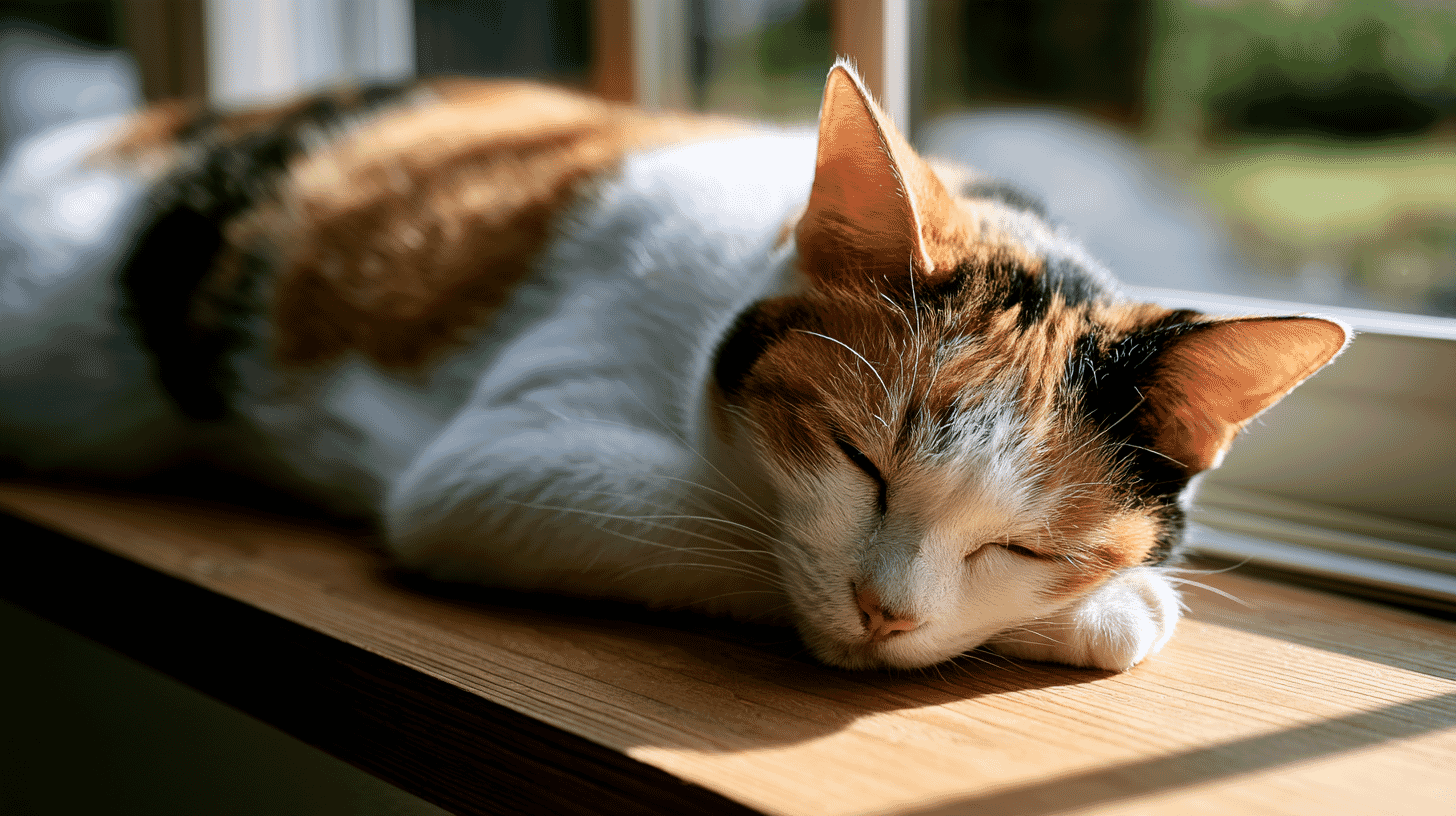
🐱 Calico cats are almost always female. So in July 2024, when a three-month-old calico kitten turned up in a trap set by a cat rescue group in Kumamoto, southern Japan, nobody thought to check. At the animal hospital, the kitten turned out to be a boy. The vet said it was the first one they had ever seen.
The group named him Mike-Taro: "mike" is the Japanese word for calico, and Taro is a classic boy's name. As of September 2026 he is two years old.
Why calicos are almost always female
Whether a cat's fur comes out orange or black depends on a gene that sits on the X chromosome.
Females carry two X chromosomes. Early in development, each cell switches one of them off at random. In some patches of skin the orange version stays on; in others, the black one does. The result is a patchwork. Add a separate gene for white spotting and you get a calico. The British geneticist Mary Lyon proposed this mechanism in 1961.
Males usually carry one X and one Y. With a single X, a tom can be orange or black, but not both.
A male calico has to be male and still carry two X chromosomes. One route is an XXY set of chromosomes, similar to Klinefelter syndrome in humans. Another is a chimera, a cat whose body mixes XX cells and XY cells. In a 2014 case report on an XXY male, the cat's testes had no germ cells at all, and he was sterile.
The orange gene itself went unidentified until very recently. In May 2025, a Kyushu University team led by Hiroyuki Sasaki and a separate team at Stanford University published back-to-back papers in Current Biology. Both found that orange cats are missing a stretch of about 5,000 DNA letters inside a gene on the X chromosome called ARHGAP36. One of the cats in its study was a male calico offered by his owner. He was XXY.
Mike-Taro's own chromosomes have not been reported.
Where "one in 30,000" comes from
The local paper, Kumamoto Nichinichi Shimbun, put "one in 30,000" in its headline with a question mark, and the article presents the figure as something that is said to be true. No source is given.
English-language sources often say one in 3,000 calicos is male, a figure Vetstreet credits to a University of Missouri veterinary study. One count you can check in a published paper comes from the UK. In a survey of veterinary practices published in 1999, 20 of 4,598 male cats, or 0.43%, had coats with orange and black patches.
The same UK study also looked at chromosomes. Of the 11 cats analyzed, six were XX/XY chimeras and only two were XXY. Two more were XX and one was XY. Male calicos are usually explained with a single label, XXY, but the causes vary.
The two figures use different denominators, calicos in one case and all male cats in the other, so they can't be compared directly. Either way, the rescue group, active for more than 25 years, had never taken in a male calico before.
Too rare to give away
The group is Inu Neko Mirai Support, a Kumamoto nonprofit that runs TNR (trap, neuter, return) for stray cats, the same approach used on Ainoshima, Fukuoka's cat island. When the kitten was found he had cat flu, a runny and blocked nose, and an injured leg. He recovered in about a week.
Normally a rescued kitten goes to an adoption event to find a home. Mike-Taro didn't. In an October 2024 interview with Maidona News, the group's head gave two reasons. There was a chance a dealer could get hold of him and sell him on. And because of his chromosomal condition, the members wanted to watch his health closely. He went to live at a member's home.
He became the face of the adoption events instead. He doesn't mind strangers and lets people pick him up. One visitor who came to meet him fell for a different rescue cat at the venue and adopted that cat after a trial period.
Two years old, 4.5 kilograms
According to the September 2026 article, Mike-Taro is two and weighs 4.5 kg (about 10 lb), small for a male. His estimated birthday is April 30, 2024. He lives with other rescue cats at a member's home, and every day he "goes to work" at that member's workplace, where the owner also loves cats.
He adores kittens, playing with them and grooming them. He also refuses to eat the same food twice in a row.
On July 28, 2026, Kumamoto Prefecture was hit by an earthquake that reached 7, the top of Japan's seismic intensity scale. The Japan Meteorological Agency put its preliminary magnitude at 7.1. Mike-Taro didn't panic. The group is helping search for pet cats that ran off during the quake, and its head is urging owners to keep a pet emergency bag with water and food, and to decide in advance where they would evacuate.
His photo has been used on a coin-operated capsule toy. He also appears in a Doraemon-branded children's science book on genes from the publisher Shogakukan, on a page that explains calico coat colors and chromosomes.
The calico who went to Antarctica
In Japan, male calicos are considered lucky. On November 8, 1956, the research ship Soya left Tokyo carrying Japan's first Antarctic research expedition. According to Japan's National Institute of Polar Research, just before departure a woman holding a kitten came to the crew and asked them to take the male calico along as a charm for the voyage. They named him Takeshi, after expedition leader Takeshi Nagata, and he spent the winter at Showa Station. Other accounts of how he came aboard also exist.
Tama, the stationmaster cat credited with saving a rural railway in Wakayama, was also a calico. She was female.
Is any coat color thought to bring luck where you live? And if an animal this rare turned up at a shelter near you, would you keep it or look for a home for it?
References
- https://kumanichi.com/articles/2032119
- https://kumanichi.com/articles/1519091
- https://maidonanews.jp/article/15478900
- https://scienceportal.jst.go.jp/stories/20250623_g01/
- https://doi.org/10.1016/j.cub.2025.03.075
- https://doi.org/10.1016/j.cub.2025.04.055
- https://doi.org/10.1136/vr.144.1.9
- https://doi.org/10.1159/000356466
- https://www.vetstreet.com/dr-marty-becker/can-calico-cats-be-male
- https://www.jma.go.jp/jma/press/2607/28d/202607282030.html
- https://www.nipr.ac.jp/science-museum/archive/special/ouchi/kikaku2020SPR/pdf/09.pdf
- https://gendai.media/articles/-/68139
- https://dime.jp/genre/966512/
- https://doi.org/10.1038/190372a0
- https://wakayama-dentetsu.co.jp/cat-stationmaster/
- https://ja.wikipedia.org/wiki/たま_(猫の駅長)









Global Discussion
4 comments