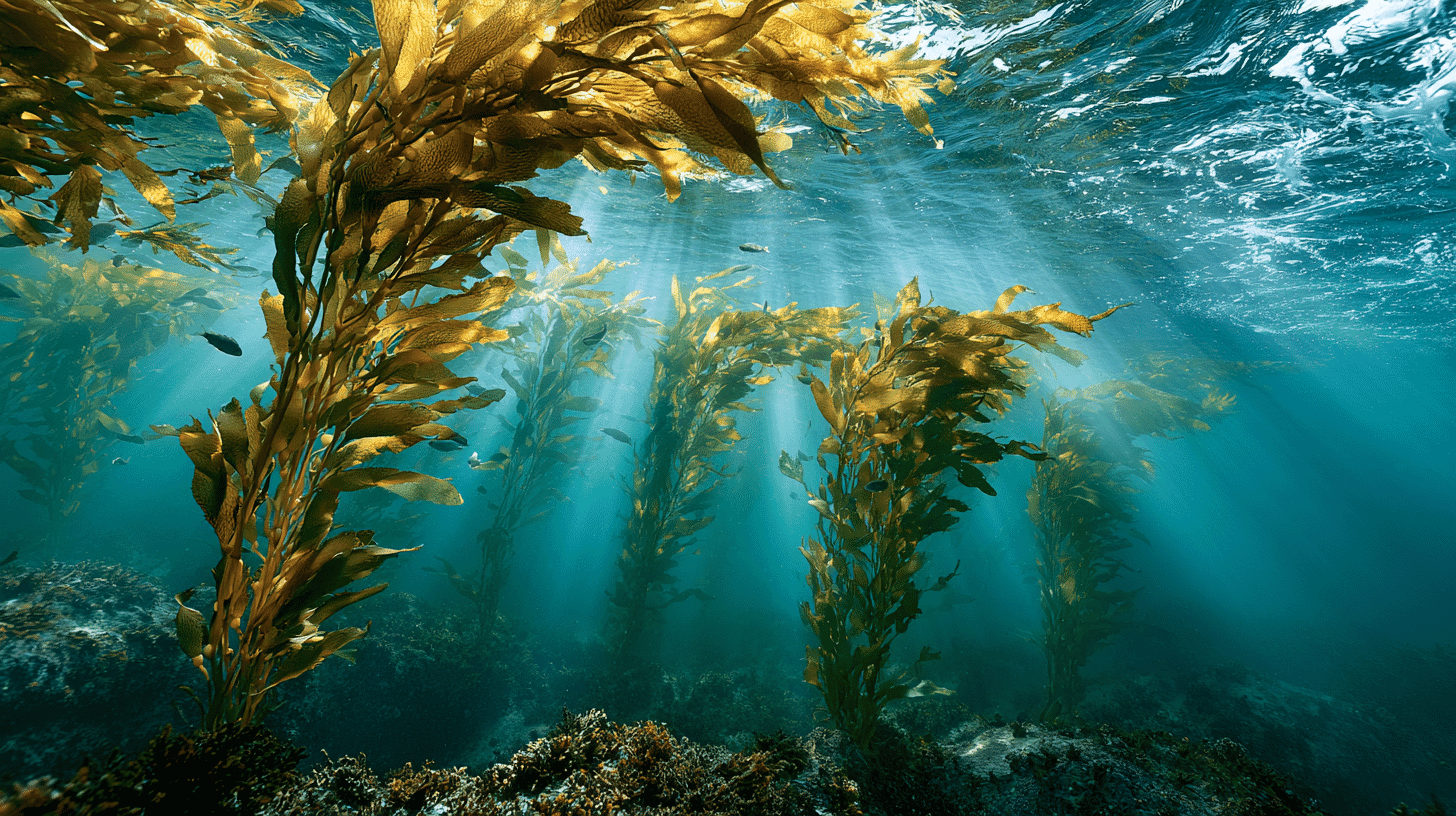
🌊 Rausu, Rishiri, hosome, ma-kombu. Four kelps, four names, four price tiers, four regional identities built up over more than a century of Japanese cooking. A team at Hokkaido University read the DNA of 475 of them and found that the line separating the four simply isn't there. What is there instead is geography, and it cuts the coastline in places the old names never marked.
Four names, one gene pool
The kelp that anchors Japanese cooking is Saccharina japonica, known at home as ma-kombu. For most of the last century three close relatives sat beside it on the taxonomic shelf: var. diabolica, sold as Rausu kombu from the Shiretoko Peninsula; var. ochotensis, the Rishiri kombu sold as a top-grade name; and var. religiosa, the thin-bladed hosome kombu of the Japan Sea coast.
Kenta Chizaki, then a second-year master's student, worked with assistant professor Shingo Akita, associate professor Toshiki Uji and professor Hiroyuki Mizuta at Hokkaido University's Faculty of Fisheries Sciences to test whether those labels correspond to anything in the genome. Across 2022 and 2023 the group collected 475 individual plants from 46 sites in six prefectures, extracted their DNA and read microsatellite regions, the highly variable stretches of the nuclear genome also used in parentage testing.
The researchers then handed the genetic profiles to two independent clustering methods, a Bayesian analysis called STRUCTURE and a distance-based method called DAPC, without telling either which name each plant had been collected under. Neither produced groups matching the four kombu.
What the software found instead was a map. The most plausible ways to split the samples were into 2, 3, 6 or 12 groups, and at the coarse end the divisions ran like this: eastern to central Hokkaido, southern Hokkaido down through Aomori, and everything from Iwate south. Genetic distance between plants rose steadily with physical distance between beaches, the classic signature of one interbreeding species spread along a coast.
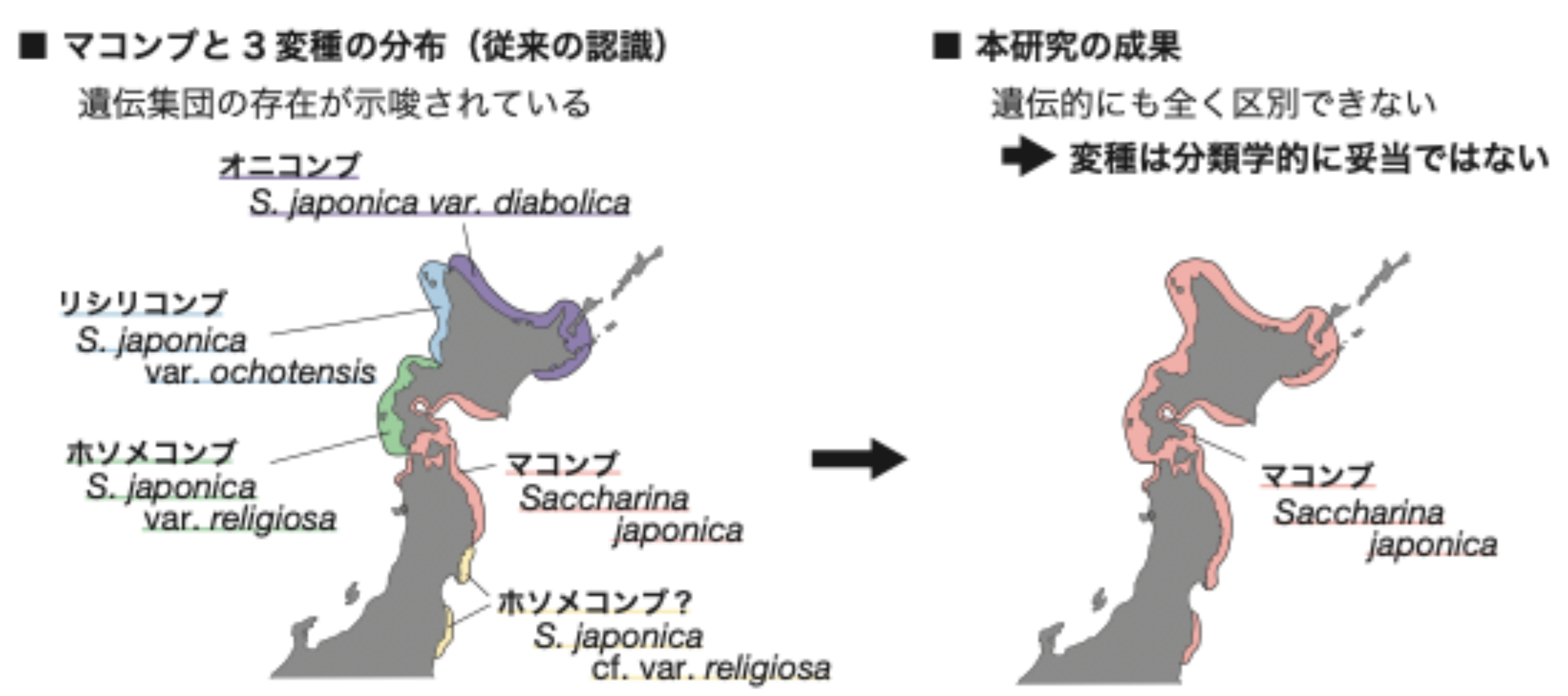
Source: Hokkaido University press release
The team therefore proposed folding the three varieties into ma-kombu. Under the international code of nomenclature a merger keeps the oldest published name, which is why the survivor is Saccharina japonica. The paper went online in the Journal of Phycology on January 8, 2026, and Hokkaido University announced it on February 16.
This is a proposal, not a verdict. Other researchers now get to agree, disagree or ignore it.
Undoing a call made in 1902
The name traces back to a Swedish physician who talked his way into a closed country. Carl Peter Thunberg (1743–1828), a direct student of Linnaeus, reached Dejima in August 1775. Dejima was the artificial island in Nagasaki harbour where Dutch traders were confined during Japan's long period of restricted foreign contact, and Thunberg got in by passing as one of them. He left the following year with the specimens that became his Flora Japonica. Kelp from that late-1700s material was formally described as a species in 1851 by his countryman Johan Erhard Areschoug.
The splitting came later, and it came from Sapporo. Kingo Miyabe (1860–1951) graduated in the second class of Sapporo Agricultural College, the school that became Hokkaido University, alongside Inazō Nitobe and Kanzō Uchimura. He went to Harvard in 1886 to study algae and fungi, earned a doctorate for a flora of the Kuril Islands, and returned to run the university's botanical garden. In 1902 he named the Rausu, Rishiri and hosome kelps as species in their own right, on the strength of differences in tissue structure and blade shape.
That judgement held for a century, then eroded in stages. By the 2000s researchers were noting that the four could hybridise and that the morphological boundaries were vague. In 2006 a multi-gene study pulled the whole group out of the genus Laminaria and into a revived genus, Saccharina. In 2008 Miyabe's three species were demoted to varieties of ma-kombu: still distinguishable, no longer separate. What the Hokkaido team has now shown is that even the varieties don't survive contact with population genetics.
The institution Miyabe helped build is the one that has just overwritten him. He would probably have taken it well; he spent his career drawing lines, and one of them, the Miyabe Line through the Kurils, is still printed on biogeography maps.
The economics riding on a name
Kombu is the glutamate source at the base of dashi, the stock that sits under miso soup, simmered dishes and noodle broth. Remove it and a large share of Japanese food stops tasting like itself.
Almost all of it comes from one place. Hokkaido supplied about 95% of Japan's domestic kombu output in 2023, with 69.5% harvested wild off the seabed and the rest farmed on ropes. By value, kombu ranks third among Hokkaido's marine products behind scallops and salmon, at roughly 6% of the prefecture's 285.6 billion yen (about $1.8 billion) marine harvest in 2024, the largest output of any prefecture in Japan.
And it is shrinking fast. Hokkaido produced 8,213 tonnes of dried kombu in fiscal 2024 according to the Hokkaido Marine Products Inspection Association, the first time output had dropped below 10,000 tonnes since the association's series began in 1981. Fiscal 2025 recovered 20.6% to 9,907 tonnes and still finished under the line for a second straight year. Across thirty years the harvest has fallen to a third of what it was. Sea surface temperatures around Japan have risen 1.33°C over the past century, roughly twice the global average; off Rausu in autumn 2023 the water reached 25°C, which local fishers said they had never seen. A Hokkaido University simulation covering 11 kelp species found that four could disappear from Japanese waters under a mid-range warming scenario and six under a high-emissions one. The prefectural government set up a review panel of research institutes and industry bodies in August 2024 and issued a kombu production stabilisation plan in March 2025.
The first question from the beaches was whether the brands survive.
They do. Rausu kombu and Rishiri kombu are trade names tied to a stretch of coast, not species names. The research does not say the four are interchangeable; it says their differences are phenotypes, shaped by the water each one grows in rather than by separate ancestry. Merge the taxonomy and Rausu kombu still comes off the Rausu coast, and still tastes like Rausu kombu.
What a merger actually moves
Species are the unit that administration runs on.
The most immediate effect is in breeding. Japan's Plant Variety Protection and Seed Act defines its scope to include multicellular algae, so kelp can be registered and protected much like a crop. Now that the four turn out to be one interbreeding population, growers and researchers can cross strains from different coasts to build better farmed lines, a payoff the team names explicitly. The other half of their argument runs the opposite way: because the genetic map has divisions finer than the four old labels, brands can be drawn at higher resolution. Hakodate already sells shirokuchi-hama, kurokuchi-hama and honba-orihama ma-kombu by individual stretch of shore, and the genetics suggests that instinct was right.
The wider point is about conservation and resource management, where the study makes no claims of its own. Red lists, protection statutes and trade rules are all written in species names. Fold four names into one and the accounting shifts underneath them: what looked like four small populations to be tracked separately becomes one large one with regional structure, which can make a species look more secure than its individual local stocks actually are.
The same logic reaches into international law. The 1992 Convention on Biological Diversity recognises each country's sovereignty over the genetic resources inside its borders, and the Nagoya Protocol, adopted in 2010 and in force since October 12, 2014, sets the rules for sharing the benefits of using them. It had 142 parties as of mid-2026 and has produced more than 130 national access-and-benefit-sharing laws. Every one of those frameworks needs an answer to the question of what counts as the species, because that is the unit that determines who owes what to whom.
Seaweed names are being rewritten everywhere
The 2006 study that moved kombu into Saccharina did the same to sugar kelp across the North Atlantic, and the reshuffling has been running through the algae for two decades.
Nori has had it worse. The seaweed wrapped around your sushi changed genus twice inside a decade: Porphyra first, then Pyropia, then in 2020 a team led by Li-En Yang and Juliet Brodie of the Natural History Museum in London split Pyropia again, creating the genera Neopyropia, Neoporphyra, Calidia and Uedaea and reviving Porphyrella. The species farmed in Japan and Korea landed in Neopyropia, the main Chinese one in Neoporphyra. Fields did not move. Labels did.
Seaweeds are shape-shifters, growing thick or thin, long or short according to temperature, current and nutrients, which makes them exceptionally easy to over-split by eye and exceptionally hard to sort out without sequencing. Miyabe was working with the best tools of 1902 and was not being careless. He was reading a body that changes with its address.
Reclassifications like this are more common than they look, and they tend to surface only when they collide with something people care about: a brand, a quota, a protected-species list. Has one happened where you live, and did anything have to be rewritten to follow it?
References
- https://www.asahi.com/articles/ASV9325FFV93IIPE00JM.html
- https://www.hokudai.ac.jp/news/2026/02/post-2185.html
- https://www.hokudai.ac.jp/news/pdf/260216_pr.pdf
- https://doi.org/10.1111/jpy.70120
- https://www.marinespecies.org/aphia.php?p=taxdetails&id=377084
- https://www.ndl.go.jp/portrait/datas/4323/
- https://www.nippon.com/ja/japan-topics/g02520/
- https://www.hokkaido-np.co.jp/article/1312564/
- https://www.pref.hokkaido.lg.jp/sr/sum/kcs/suisan-group/sugata.html
- https://www.pref.hokkaido.lg.jp/sr/gid/218774.html
- https://www.hro.or.jp/upload/41202/dayori94konbu.pdf
- https://elaws.jp/view/410AC0000000083
- https://www.insideeulifesciences.com/2026/07/06/the-numbers-are-in-what-financing-has-the-nagoya-protocol-delivered-for-biodiversity-after-a-decade/
- https://www.sci.news/biology/calidia-pseudolobata-08482.html


Global Discussion
3 comments