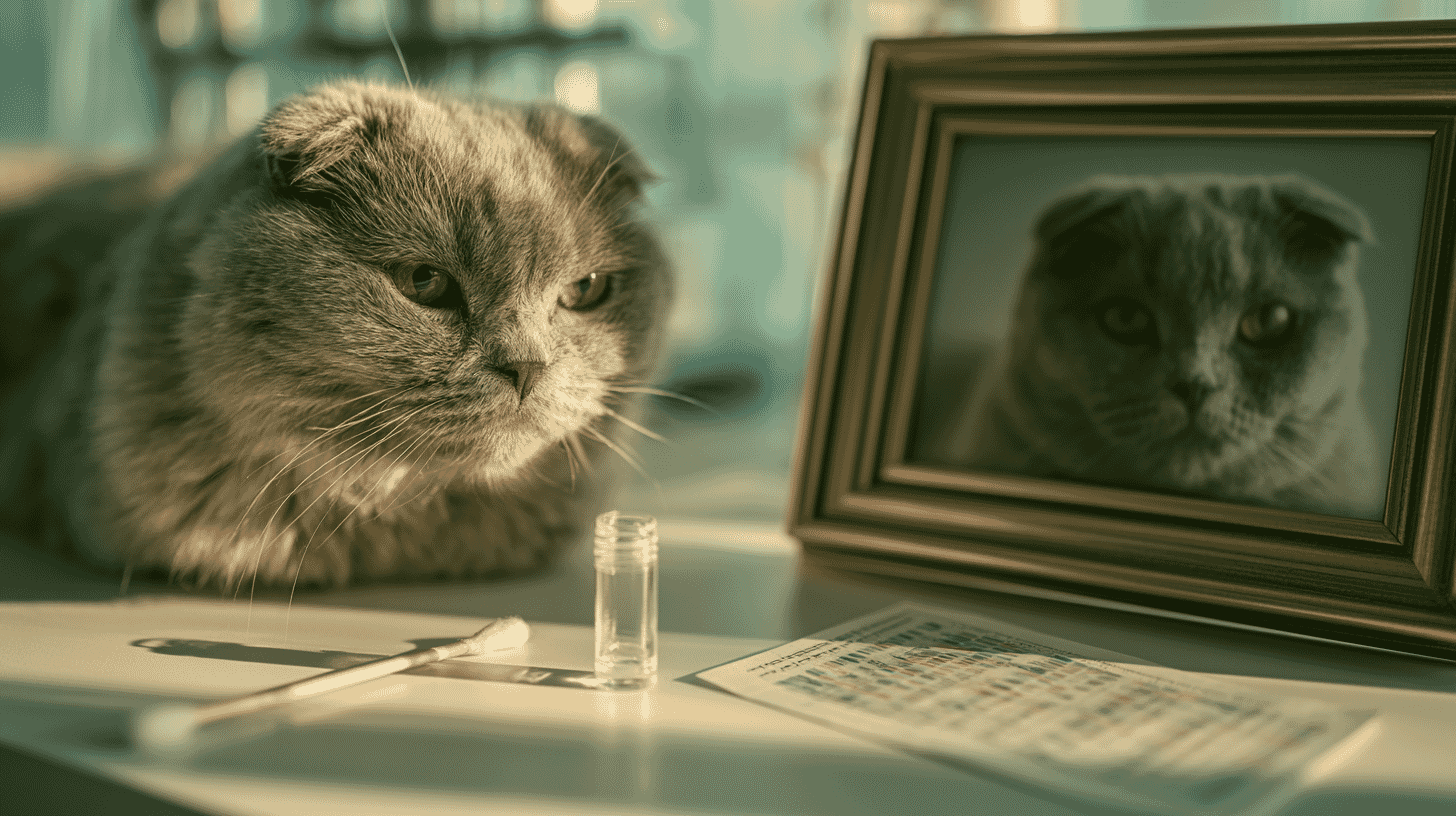
🐱 Those famous folded ears that make Scottish Folds look like little owls? They come from a genetic mutation, and now Japanese researchers have found something stranger. Some cats that look completely upright-eared are secretly carrying the same gene. They call them "cryptic folds," and the discovery lands right in the middle of a global argument about whether this breed should be bred at all.
A cat whose ears straightened out with age
The Scottish Fold's signature look isn't a quirk of grooming. It comes from a single mutation in a gene called TRPV4, which helps cartilage cells respond to their surroundings and shapes how the ears, and the joints, develop. Carry one copy of the mutation and your ears fold forward. That has been the textbook rule for decades.
A team led by Yuki Matsumoto, a specially appointed associate professor of animal genetics at Azabu University's Data Science Center, working with Anicom's research arm, decided to test that rule against real data. Breeders and vets had long whispered about cats that looked straight-eared but seemed to carry "fold" genetics, and kittens whose ears changed shape as they grew up.
Using DNA cheek swabs and photographs from 114 Scottish Folds insured by Anicom's pet insurance, 63 males and 51 females, the researchers matched each cat's genotype to the actual shape of its ears. Fifty-five cats carried one copy of the TRPV4 mutation. And among those, seven (about 13%) had folded ears as kittens but grew into a normal-looking, upright-eared adult.
Matsumoto named them "cryptic folds." Among the 14 cats with usable front-facing photos, this group had significantly smaller ear flaps than genuinely mutation-free cats, though the gap is too subtle to spot by eye. One owner survey reply hinted at something even odder: a cat whose ears folded in winter and stood up in summer, raising the possibility that temperature plays a role. That's a thread for future research.

Source: Anicom Insurance, via JST Science Portal
The practical takeaway is blunt: you can't reliably read this cat's genetics off its face. To know what a Scottish Fold is actually carrying, you need a gene test.
Why ears are never just about ears
The cuteness comes with a catch. The TRPV4 mutation doesn't only fold cartilage in the ears. It affects cartilage and bone throughout the body, and it's tied to a condition called osteochondrodysplasia, a progressive disorder that deforms joints, triggers bony growths, and causes pain. In bad cases, a cat struggles to walk or can no longer jump.
The real danger sits in the breeding math. Pair two folded-ear cats together and roughly a quarter of the kittens inherit two copies of the mutation. Those homozygous cats face the highest risk of severe disease from a young age. This is exactly why breeders have long been told never to mate fold to fold, and why the responsible approach pairs a folded-ear cat only with a straight-eared one.
There's also a detail that reframes a beloved internet meme. Scottish Folds are famous for sitting upright on their haunches with their back legs splayed out, like a person slouching on the floor, the "Buddha sit." It reads as adorable. But vets note it can be a way of relieving joint pain. The pose that racks up likes may be a cat telling you it hurts.
The Azabu team is careful here: a heterozygous carrier doesn't automatically get sick, and the severity varies a lot from cat to cat. They stress their work isn't a recommendation for or against any particular pairing. What it does establish is that some cats carry the risk invisibly.
A breed the world is increasingly walking away from
This is where Japan and much of the West have drifted apart. The folded ear is inseparable from the cartilage problem, since every folded-ear cat carries the gene behind it, and a growing number of places have decided that's a line they won't cross.
The Netherlands banned breeding fold-eared cats back in 2014. Austria followed in 2020, Belgium's Flanders region in 2021, and Norway, Sweden, and the Australian state of Victoria have restrictions too. Some go further than breeding, touching the sale or keeping of these cats. Major registries like the GCCF in Britain and the international FIFe don't recognize the breed at all, and the British Veterinary Association has called for the breeding to stop. There's a particular irony that Scotland, the breed's birthplace, doesn't encourage it either.
Japan has no such rules. Scottish Folds remain one of the country's most popular breeds. Practice is shifting, though. A separate Azabu and Anicom survey of 8,610 cats, published in May 2026, found the share of homozygous Scottish Folds falling significantly from 14.2% in 2017 to 1.9% in 2024, a sign that breeders are already avoiding fold-to-fold pairings. Matsumoto points out that cats, unlike dogs, visit the vet far less often, which made the data hard to gather, part of why a clear, local picture of the health risks has been slow to form.
What a cheek swab could change
The researchers aren't telling anyone to give up the cat already curled on their sofa. Caring well for a Fold you love is responsible, not cruel. Their argument is aimed upstream, at breeding decisions, and their tool is simple. Gene testing has become far cheaper and easier than it used to be. If a cat slated for breeding has ears that look even slightly off, Matsumoto suggests, a TRPV4 test is worth considering.
The mutation isn't confined to Scottish Folds, either. The same variant has been detected in American Curls and Munchkins among others, which widens the question beyond a single breed. The hope is that pairing genetics with better data nudges Japan toward breeding management that puts the animal's comfort first, without waiting for a ban to force the issue.
In much of Europe and Australia, the decision has already been made for breeders by law. In Japan, it's still left to individual choice and a gene test most owners have never heard of. How does your country handle breeds whose signature looks come with a built-in health cost: is it regulation, or is it left up to the breeder?








Global Discussion
4 comments