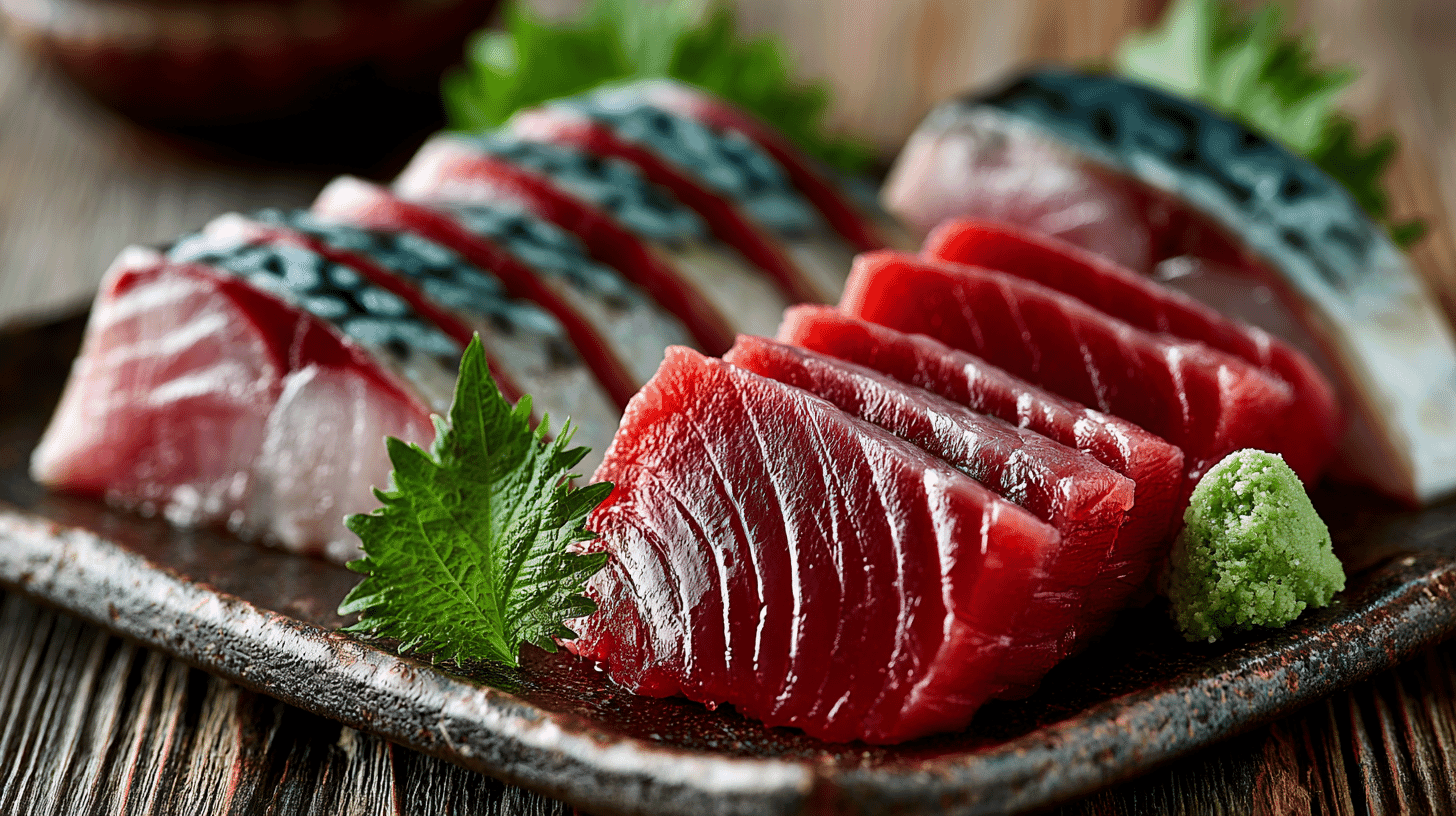
⚡ Imagine biting into a slice of fresh mackerel sashimi: no parasite worries, no off-flavors from freezing, just the fish exactly as it should taste. A research team in Japan has built a machine that fires 30,000 volts through a fillet for one-millionth of a second, killing the parasite hidden inside while leaving the fish untouched. Here is the story of "pulse power" and why it matters for anyone who loves raw fish.
The uninvited guest that thrashes inside your stomach
If you have eaten sushi or sashimi, you have eaten food that was once checked for anisakis, a thread-thin worm a few centimeters long that lives in mackerel, horse mackerel, squid, and many other seafood species.
Swallow a live one and it can burrow into your stomach wall, triggering pain sharp enough to send people to the emergency room, along with nausea and vomiting. In rare cases it sets off an allergic reaction. It is not a pleasant way to learn about marine biology.
In Japan, anisakis is now the single most common identified cause of food poisoning. Of the 1,037 food-poisoning cases logged by the Ministry of Health in 2024, 330 were traced to anisakis, ahead of norovirus on 276, making it the single most common identified cause. And those are only the reported cases. Analysis of medical insurance records suggests the real annual figure is closer to 20,000. The worm only became its own category in Japan's food-poisoning statistics in 2013; before 2007, fewer than ten cases were logged a year. Better diagnosis, more raw-fish eating, and celebrities sharing their hospital stories have all pushed the visible number up.
Freezing works, but it comes at a price
Heat kills anisakis instantly, which is why grilled fish carries no risk. For raw fish, until now there has been exactly one reliable non-heat option: freezing. Hold the fish at minus 20°C for 24 hours or more and the parasite dies.
The catch is what freezing does to the fish itself. Thawed fillets leak moisture, lose color, and turn soft. In Japan, frozen-then-thawed seafood also has to be labeled as such, which lowers its market value. For a cuisine built on the texture and shine of never-frozen fish, "just freeze it" has always been an unsatisfying answer.
Striking the fish with lightning, but only the parasite feels it
The alternative comes from an unexpected field: pulse power.
Pulse power is the trick of storing electrical energy and then releasing it in an extraordinarily short burst: a microsecond, or even a billionth of a second. Compress the release enough and you get a momentary surge of enormous power, the same principle behind a camera flash or a bolt of lightning.
Takao Namihira, an associate professor at Kumamoto University's Institute of Industrial Nanomaterials, had spent more than two decades studying pulse power before he ever met an anisakis. The breakthrough came through a partnership with Japan Seafoods, a seafood processor in Fukuoka whose president had been searching for years for a way to kill the parasite without freezing. According to interviews the professor has given, he confirmed in the lab, within a week, that a pulse could kill a worm buried inside a fillet.
Why does the fish survive what the parasite does not? The team believes the pulse damages the parasite's nervous system rather than cooking it or rupturing its cells. A multicellular animal like anisakis dies when its nerves are hit hard enough. Each pulse raises the fish's temperature by only about 0.1°C, so the flesh is never heated in any meaningful way. Seasoned buyers at Tokyo's Toyosu market who tasted treated fillets reportedly could not tell them apart from untreated raw fish. In testing, a batch of horse-mackerel fillets seeded with 1,000 anisakis came out with every worm killed.
"Just place the fish on it": a device that took nine years to go quiet
In April 2026, Kumamoto University unveiled the finished product: a "compact anisakis-killing device." Operation is almost comically simple: you place the fish inside, and an electrode glides slowly across it, treating the flesh section by section. One full pass, and any anisakis inside is dead. The device delivers 30,000 volts, roughly four times the voltage running through neighborhood power lines, but only for one-millionth of a second at a time.
Getting there took about nine years. An earlier prototype, built two years ago, worked but was deafening: each discharge cracked at over 100 decibels, comparable to a pile driver on a construction site. The finished version is nearly silent.
The technology is patented and described as a world first for using electricity to kill the parasite. It is not in your local supermarket yet. The current compact unit costs around 15 million yen (roughly $94,000 at the exchange rate when this piece was published), and the team is aiming to bring that down to about 6 million yen (roughly $38,000 at the same rate) within three years, with commercial rollout to supermarkets, sushi restaurants, and fish markets targeted around fiscal 2029. For now, the professor describes it as a tool meant for specialists, with further work needed to make it cheaper and small enough for anyone to use.
Turning safe sashimi into something Japan can share
So if you are eating sushi in Tokyo next month, this machine is not yet what is protecting you. That job still belongs to careful handling, visual inspection, and freezing where required. What the device offers is a glimpse of where Japan's raw-fish safety is heading.
The ambitions reach beyond fish. The same team has already killed toxoplasma parasites in pork in the lab and is testing the approach on parasites in horse meat, a Kumamoto specialty. Other parasites, the ones in firefly squid, in icefish, in flounder, are on the list. One thing pulse power cannot do is kill bacteria; simple organisms without a nervous system would need so much power that the food itself would cook. Raw beef liver, sadly, stays off the menu.
The researchers also imagine something larger: a Japan-led international standard for pulse-treated seafood, a certified label that says "this fish is safe to eat raw." As raw fish moves from exotic novelty to everyday food in countries around the world, a guarantee like that could turn Japan's hard-won food-safety know-how into an export of its own, and give travelers one more reason to trust the plate in front of them.
Raw fish has gone global, from ceviche to poke to supermarket sushi. How is parasite risk in seafood handled where you live: through freezing rules, inspection, or simply trust in the fishmonger? We would love to hear about it.
References
- https://news.yahoo.co.jp/articles/fef1e1fe998aa035856aa81ecc1a6a3a6d5eb98b
- https://levtech.jp/media/article/focus/detail_462/
- https://www.kumamoto-u.ac.jp/whatsnew/sizen/20210622
- https://news.yahoo.co.jp/articles/d2a22ee28d57b31e9f4f44ececfbfdc99fc34ab4
- https://nposfss.com/article/sfss52_p04/
- https://www.chusho.meti.go.jp/sapoin/index.php/cooperation/project/detail/4566






Global Discussion
4 comments