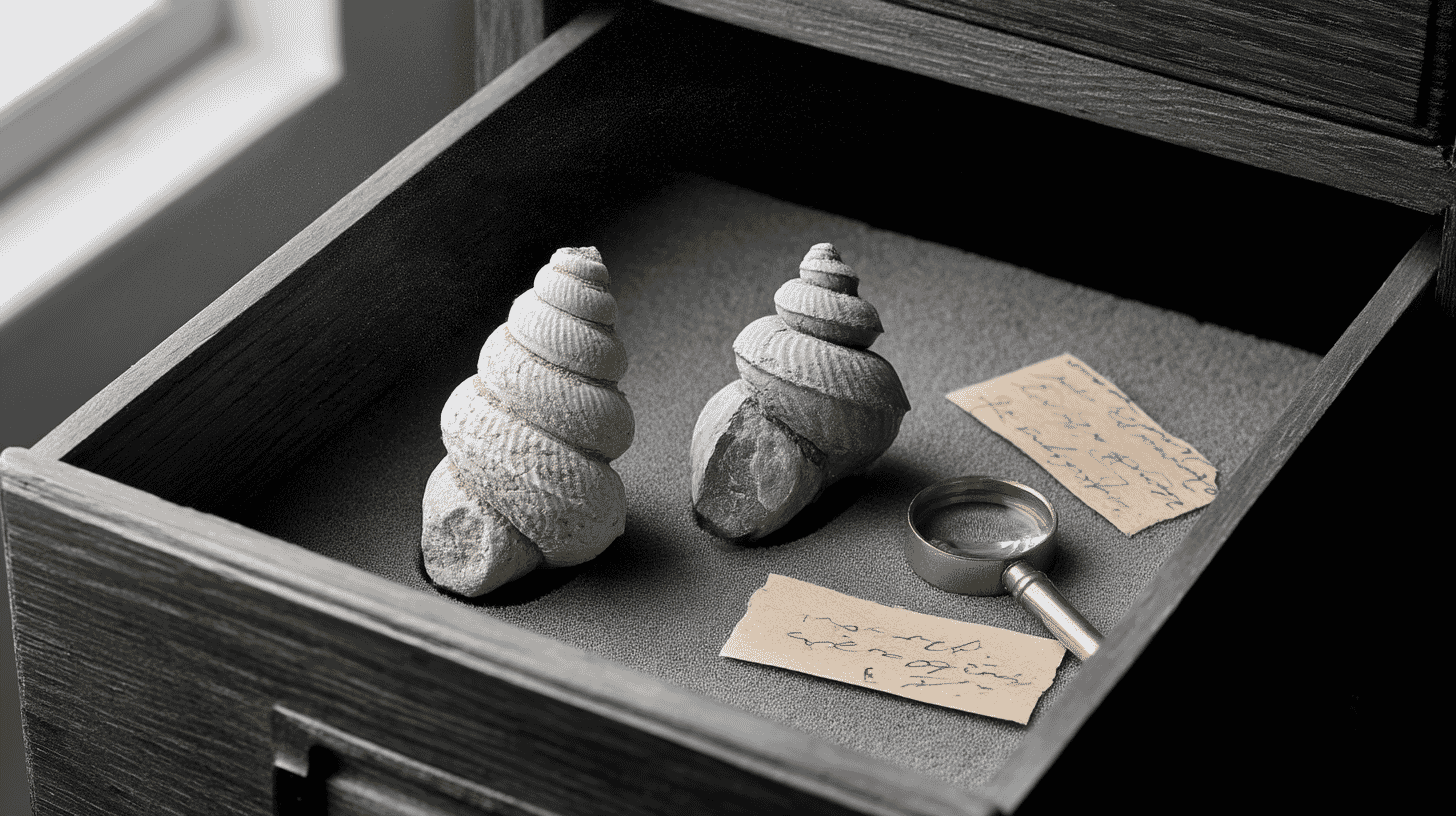
It looks like a soft-serve cone that lost an argument with gravity. Three of them, none taller than a matchbox, have just pushed an entire family of ammonites about ten million years past the date the textbooks gave for its extinction.

Life reconstruction of Heterocarinella japonica. The soft body and shell pattern are imagined, as no fossil evidence for them exists. Illustration by Daisuke Aiba, courtesy of the Fukada Geological Institute
Three stones that waited twenty years in a museum drawer
Nobody went out and dug these up for the study. Two of the three fossils were collected more than twenty years ago by two amateur researchers. The third was picked up roughly fifteen years ago by an undergraduate at Yokohama National University who was working on a graduation thesis. All three were catalogued into the collection of the Mikasa City Museum in Hokkaido, and there they stayed.
In 2025, Daisuke Aiba, a senior researcher at the Fukada Geological Institute in Bunkyo Ward, Tokyo, ran them through an X-ray CT scanner. The paper came out open access on August 29, 2026 in Paleontological Research, the English-language journal of the Palaeontological Society of Japan (vol. 30, pp. 164-173), and the institute announced it two days later, on August 31.
The animals were small. The three shells stand 4.2, 1.6 and 1.7 centimetres tall. "It is what we call a heteromorph ammonite, shaped like a sea snail, and the largest one has a shell height of 4.2 centimetres," Aiba told the Hokkaido broadcaster HTB.

The three fossil specimens of Heterocarinella japonica, all held at the Mikasa City Museum. Courtesy of the Fukada Geological Institute
They now have a name: Heterocarinella japonica. Hetero- is Greek for different, flagging it as a heteromorph, one of the ammonites that abandoned the neat flat spiral. Carine- is Latin for keel. Japonica is for Japan. The keel is the point: a sharp ridge along the flank of the shell that, the paper says, no other genus in the family carries.
A family that was supposed to have died out
That family is the Turrilitidae, and until this paper its dates looked settled. Middle Albian to the end of the Cenomanian, roughly 108 to 93.9 million years ago, then gone, wiped out around the Cenomanian-Turonian boundary along with a long list of other marine groups during Oceanic Anoxic Event 2.
The three Hokkaido fossils come from Santonian beds, roughly 86.3 to 83.6 million years ago. That is about ten million years on the wrong side of the line, in rock where only the Nostoceratidae, a later family of screw-shaped ammonites running from the Turonian to the end of the Maastrichtian, were supposed to be found.
"It was found in beds from a time when the Turrilitidae were thought to be already extinct, and this discovery shows that they had not died out at all, they had survived," Aiba said.
The two families are almost impossible to separate by eye. Both look like sea snails. The difference is inside the shell, in the siphuncle, the thin tube that runs through the chambers: close to the top of the whorl in most turrilitids, in the middle or lower part in nostoceratids. CT let Aiba look without breaking anything. What he saw put the fossils in the older family and, the institute says, made this the first new turrilitid genus described from Japan in roughly 150 years of Japanese palaeontology.
Europe had the same fossil filed under the wrong family
Once Aiba went back through the literature, Tridenticeras, a genus from the Turonian and Coniacian of Europe that had long been parked among the Nostoceratidae, turned out to have its siphuncle in the turrilitid position too. It had been sitting in plain sight, misfiled.
The paper is unusually blunt about why. The misclassification, it says, came from limited knowledge of the siphuncle, an internal structure nobody could see without cutting the fossil open, and from a habit of letting stratigraphic expectations outrank the evidence of shape. Put less politely: if everyone knows a family died out 93.9 million years ago, then a 90-million-year-old specimen cannot belong to it, so it gets assigned somewhere else, and the extinction date survives another decade unchallenged. The reasoning runs in a circle, and it takes a scanner to break it.
Why Hokkaido keeps producing these
The reason is the Yezo Group. The pile of Cretaceous marine rock that runs up the spine of Hokkaido from around Urakawa in the south to Cape Soya at the northern tip, and then carries on into Russian Sakhalin, is over 8,000 metres thick and took more than 50 million years to accumulate, spanning roughly 120 to 68 million years ago. More than 500 ammonite species have been reported from it.
Readers who have never heard of the Yezo Group have almost certainly seen one of its fossils. Nipponites mirabilis, named by Yabe in 1904 on a specimen from Obira in Hokkaido and now held as UMUT MM7560, is the tangled, knotted ammonite that turns up in most general books about strange shells. It is a genus named after Japan itself, and it was famous abroad long before Japanese dinosaurs were. In 2016, when the Geological Society of Japan picked a rock, a mineral and a fossil for each of the 47 prefectures, Hokkaido's fossil was the ammonite. The Mikasa City Museum, where the new specimens live, displays around 1,000 fossils, including roughly 600 ammonites from about 190 species.
Aiba's paper adds a specific argument to that general fame. The Turrilitidae, once spread worldwide, survived the anoxic event, shrank back to Europe through the Turonian and Coniacian, and then held on only in the northwestern Pacific. The Cretaceous sea over what is now Hokkaido appears to have been the family's last address, a refuge that other ammonite groups also seem to have used.
Failures, or engineering
Heteromorphs have had a rough century. They were long written off as bizarre evolutionary experiments or degenerates, read through Otto Schindewolf's idea of typostrophism, in which lineages age and decay like individuals.
That reading has been coming apart since the 1980s, when Takashi Okamoto showed with a growth model that the seemingly chaotic coil of Nipponites could be derived from a helicoidal ancestor by a small change in growth parameters, and that the winding may have helped stabilise the animal's posture. In 2020, hydrostatic modelling by Peterman, Mikami and Inoue found that Nipponites stayed neutrally buoyant through its whole life, with stability values of 0.07 to 0.10, slightly higher than a living nautilus, and probably spent its days slowly pirouetting in place while hunting plankton. A 2021 review counted four separate occasions on which heteromorphy evolved independently among ammonoids, and argued that adaptation to a planktic life may have driven selection toward smaller hatchlings and higher fecundity.
Four independent origins is a hard number for the degeneration story to absorb. What is still open is how much of the shape is adaptation and how much is a developmental byproduct that simply was not fatal. Heterocarinella does not settle that. What it does is add a keel nobody expected, on an animal that should not have been alive.
What the dinosaur-first camera misses
Aiba was born in Tokyo in 1989 and holds a doctorate from Yokohama National University. He worked as a researcher and curator at the Mikasa City Museum before moving to the Fukada Geological Institute, and outside the journals he is best known for conceiving and supervising the Pokemon Fossil Museum, a touring exhibition that opened at the Mikasa City Museum in July 2021 and, according to the National Museum of Nature and Science, has been at the Field Museum in Chicago since May 22, 2026 for its first run outside Japan.
The fossils behind this result were out of the rock and catalogued years before anyone looked again. What it took was a CT scanner and a willingness to doubt a date everyone had stopped checking. The two amateur finders' only reward is that their stones are now the physical basis of a genus. Invertebrate taxonomy rarely gets a camera crew, but this is where the timeline of life actually gets rewritten, one drawer at a time.
The institute even attached a note to its press release asking reporters to use the Japanese word for fossils emerging from strata rather than the archaeological word for excavating human-made objects. A field that polices its own verbs that carefully is not a quiet one.
The fossils are held at the Mikasa City Museum and are due to go on public display, though as of the reporting on September 1, 2026 no date had been announced.
So where is the great fossil locality in your country, and does anyone visit it? And a harder one, given how many of the world's best specimens sit in museums far from where they were found. Should countries restrict the export of fossils, or does that just stop the science from happening?
References
- https://fukadaken.or.jp/?p=9866
- https://doi.org/10.2517/prpsj.260014
- https://www.jstage.jst.go.jp/article/prpsj/30/0/30_260014/_article
- https://news.yahoo.co.jp/articles/1b62da00882dd5aa0e8f310337e7bb22c19483df
- https://news.yahoo.co.jp/articles/8015892c91d4588dc84016edd175908f7c98eb5c
- https://www.city.mikasa.hokkaido.jp/museum/detail/00001351.html
- https://museum.bunmori.tokushima.jp/museum_documents/museumnews/mnews070/070_2-3_cc.html
- https://www.um.u-tokyo.ac.jp/UMUTopenlab/en/library/b_12.html
- https://doi.org/10.1371/journal.pone.0235180
- https://pubmed.ncbi.nlm.nih.gov/33438316/
- https://scienceportal.jst.go.jp/stories/20260327_s01/
- https://www.gsj.jp/Muse/prefrock/index.html
- https://prtimes.jp/main/html/rd/p/000000972.000047048.html









Global Discussion
3 comments