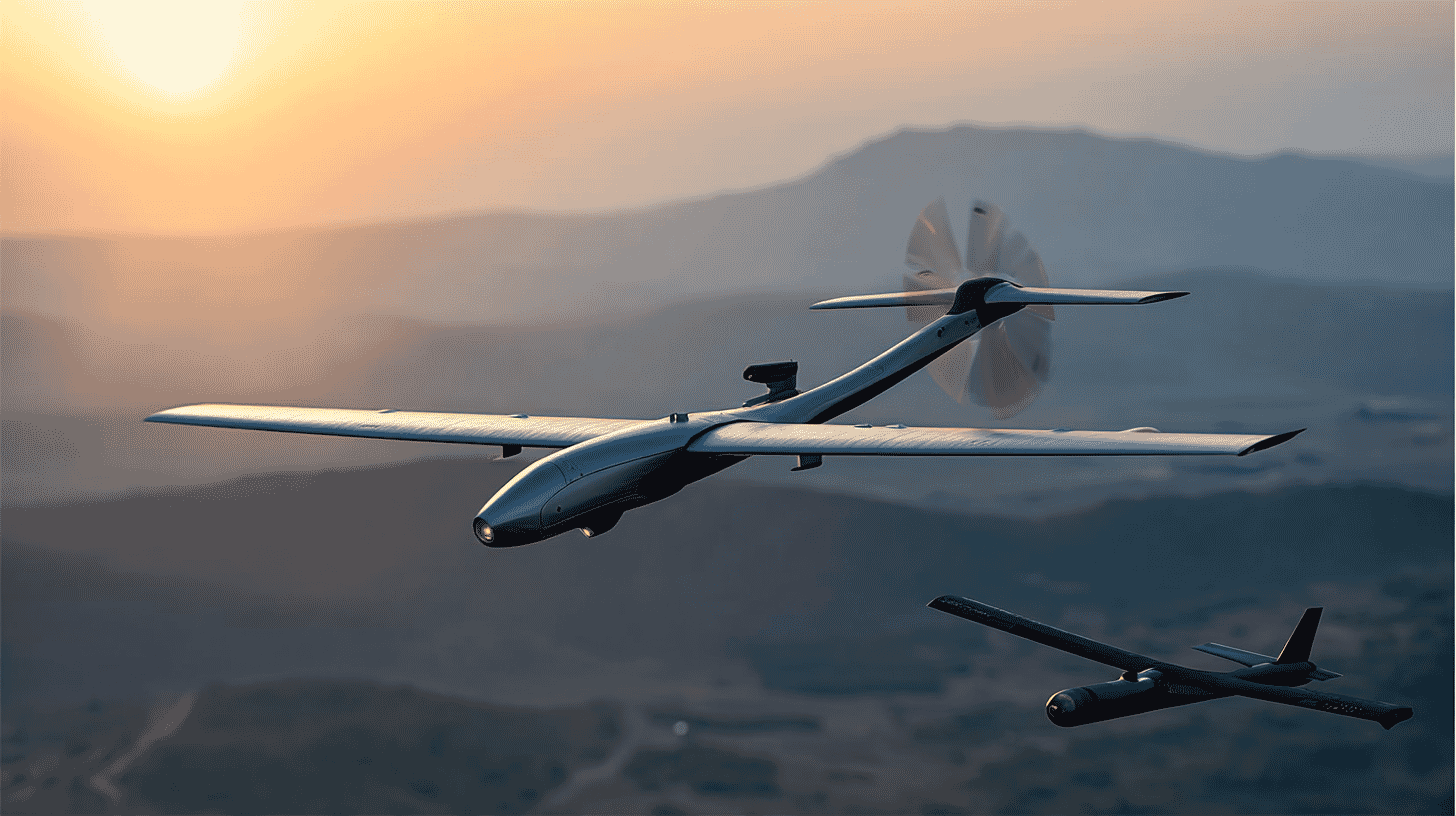
🛩️ A 40-minute loiter time. A top speed of 312 km/h. A range of 75 kilometers. A Japanese startup has just unveiled a fixed-wing interceptor drone designed to "stalk and shred" Shahed-type kamikaze drones, and Ukraine's official media has the CEO on record explaining the layered air defense vision behind it. A Patriot missile costs $4 million. A Shahed costs $20,000. The math broke years ago. Now a Tokyo-listed drone company is trying to fix it.
On April 28, 2026, Tokyo-based Terra Drone Corporation released the first flight footage of "Terra A2," a fixed-wing interceptor drone it develops with WinnyLab LLC, a Ukrainian defense-tech firm held through its subsidiary Terra Inspectioneering. The same day, Ukraine's official media platform UNITED24 published an interview with CEO Toru Tokushige conducted on-site. The company is positioning the Terra A2 not as a standalone product, but as the middle layer of a three-tier layered air defense architecture, partnered with the already battle-proven Terra A1.
Inside the Terra A2: 75km Range, 40-minute Loiter, 312 km/h
The Terra A2 is a fixed-wing interceptor purpose-built to chase and destroy autonomous attack drones like Russia's Shahed-136 across long distances and extended flight times. Specifications:
- Maximum range: 75 km
- Top speed: 312 km/h (faster than the Shahed-136's roughly 200 km/h)
- Endurance: 40 minutes or more
- Maximum altitude: 5,000 m (reported figure; not listed in the manufacturer's published specifications)
- Warhead: 750 grams (same caveat)
In the UNITED24 interview, Tokushige said: "Our Terra A2 drone can stay in the air for about 40 minutes, patrol an area, and immediately intercept targets. After that, another unit is launched, allowing us to cover gaps in defense." He noted that relatively few companies are currently working with fixed-wing interceptor designs, giving Terra Drone what he sees as a competitive advantage in the segment.
The shorter-range Terra A1, meanwhile, has been operationally deployed in Ukraine since April 17, 2026, and has already scored confirmed kills against Shahed-136 type drones. Its unit price is roughly 400,000 yen (about $2,500). The A2 will sit at a higher price point, but it remains orders of magnitude cheaper than missile-based alternatives.
[Update since publication] On May 19, 2026, Terra Drone announced it had delivered the Terra A2 into Ukraine's combat environment and begun live operations. On June 15 it confirmed the A2 had successfully intercepted a long-range Shahed-type attack drone, describing the result as evidence of "continuous combat operability and repeatability" rather than a one-off. Both the A1 and the A2 now have confirmed intercepts.
How Are Shahed Drones Actually Being Stopped Right Now?
A natural question follows: what are the current methods for intercepting kamikaze drones, and is this a genuinely new approach? Worth unpacking.
Over the past two years, Ukraine has built a layered air defense by stacking roughly seven different counter-drone methods against Russia's saturation attacks:
- Expensive surface-to-air missiles: Patriot (reported at roughly $4M per shot, more for higher-end variants), IRIS-T, NASAMS. Reliable, but cost-disastrous against Shaheds estimated at $20,000 to $50,000. In the Middle East, U.S. forces reportedly fired several Patriots at single targets.
- Mobile fire groups, Pickup trucks with machine guns and thermal imagers, parked along expected approach lanes. Cheap but blind above 2 km altitude. Effectiveness rates around 40% or below.
- Anti-aircraft guns, Germany's Gepard and Rheinmetall's Skynex. About €4,000 per engagement, but limited to a 4.5 km radius.
- Electronic warfare, GPS spoofing and jamming. Effective and cheap, but newer Shahed variants with hardened guidance are increasingly resistant.
- Fighter aircraft and helicopters, F-16s and attack helicopters can knock down drones, but operational costs are steep and sortie capacity is finite.
- Interceptor drones, Small drones priced at $2,000 to $5,000, rammed into incoming Shaheds. Scaled up by Ukraine in late 2025, and by February 2026 these accounted for over 70% of Shahed shootdowns above Kyiv.
- Sea-launched interceptors from unmanned vessels, World's first successful interception in April 2026, opening a new layer for coastal defense.
So "use a drone to kill a drone" is no longer the novel idea, it became mainstream during 2025. What's actually new is the Terra A2's operational concept: a fixed-wing platform that loiters long enough to patrol an area and intercept on-demand. Smaller FPV-style or quadcopter interceptors have endurance of just 10–15 minutes, and can only cover the area near their launch point. A fixed-wing platform that flies for 40 minutes and ranges out to 75 km enables persistent overhead coverage for cities or critical infrastructure.
That's why Tokushige told UNITED24: "It is impossible to defend using just one type of system. You need multiple layers, short, medium, and long range, with different speeds." The A2 fills the gap that smaller interceptors can't reach.
A1 (Short Range), A2 (Medium Range), and a Long-Range Tier in Development
According to industry publication Drone Journal, Terra Drone's defense product roadmap forms a three-tier architecture:
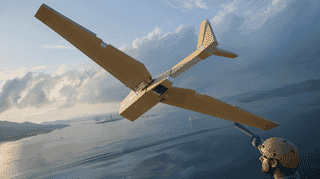
- Terra A1 (short range, 20–30 km), Vertically launched rocket-style interceptor. Rapid deployment, instant launch. Co-developed with Amazing Drones.
- Terra A2 (medium range, 70–100 km): Horizontally launched fixed-wing interceptor. Long endurance plus area patrol, co-developed with WinnyLab, and designed to work with radar so that wide-area surveillance, detection, tracking and interception run as one chain.
- Long range (150–200 km class), Engine-propelled fixed-wing platform under development.
Other reports suggest Terra Drone is also exploring jet-powered interceptor drones and low-cost missile alternatives. "In Ukraine, drones evolve in six-month cycles, not the 10–20 year cycles of traditional defense industries. That's why startups are critically important," Tokushige said.
What the United24 Interview Actually Revealed
The April 28 piece on Ukraine's official media outlet UNITED24 went beyond hardware specs. Two strategic threads stood out.
First, AI integration. Tokushige said Terra Drone is embedding AI into its platforms to enable autonomous target detection and engagement, reducing reliance on human operators, a pressing need given that most current interceptors are manually flown.
Second, international expansion. Terra Drone is positioning Ukraine-validated technology for global markets, with early participation in Japanese defense tenders already underway. "Specific financial figures are not yet available, but the potential is hundreds of millions of dollars in the defense segment alone," he said.
Reports also cite inquiries from Gulf states including Saudi Arabia and the UAE. Terra Drone already supplies industrial drones to Saudi Aramco, and the company plans to leverage that Middle East footprint for interceptor expansion.
The Terra Drone–Amazing Drones partnership has also drawn diplomatic friction: on April 8, 2026, Russia's Foreign Ministry summoned Japan's ambassador in Moscow to formally protest the investment, a measure of how much weight the move carries internationally.
How $2,500 Broke the Air Defense Math
Why is the world suddenly paying close attention to Ukraine-bred interceptor drone tech? The answer is economics:
- Shahed drone: ~$20,000 to $35,000 per unit
- Patriot interceptor missile: about $4M per shot
- SM-6 ship-launched missile: ~$6M per shot
- Terra A1: ~$2,500 per unit
- Merops (built by U.S. firm Perennial Autonomy, validated in Ukraine): about $15,000 per unit
During recent Middle East flare-ups, U.S. forces reportedly burned through Patriot interceptors at a rate that alarmed planners. Army Secretary Dan Driscoll told a congressional hearing in April 2026 that the service bought roughly 13,000 Merops interceptors within about eight days of the conflict starting. Defending against cheap saturation attacks with multimillion-dollar missiles is a one-way path to magazine depletion and fiscal exhaustion. "Everyone started doing the maths. It simply doesn't make economic sense and people are finally waking up to that," Tokushige said, describing the surge of inquiries from Middle Eastern customers.
In March 2026, Ukraine's Commander-in-Chief Oleksandr Syrskyi disclosed that interceptor drones now account for roughly one in three of all Russian aerial targets shot down, and over 70% of Shahed kills above Kyiv. In a single month, Ukrainian interceptor crews flew about 6,300 sorties and destroyed more than 1,500 Russian UAVs.
Domestic Win, First Order from Japan's Defense Ministry, $740K
The "Japanese defense tender participation" Tokushige mentioned in the United24 interview materialized as a concrete outcome just ten days later.
On May 8, 2026, Terra Drone announced its first formal contract from Japan's Acquisition, Technology & Logistics Agency (ATLA), 300 units of "Modular UAV (General Purpose, Training Type)" worth a total of 115.43 million yen (about $740,000). Delivery is set for September 30, 2026, to a Defense Ministry-designated site. This is the company's first official defense contract on Japanese soil.
What was ordered is not the Terra A1 or A2 interceptor, it's a general-purpose training UAV. But the significance is meaningful. Clearing ATLA's strict procurement requirements within a short window of the company's defense market entry signals that Terra Drone's development speed and mass-production capacity have received public-sector validation.
The backdrop is a structural shift in Japan's defense budget. The fiscal 2026 budget allocates roughly 277.3 billion yen, the largest amount on record, to unmanned-asset-inclusive defense capability enhancement, making "unmanned systems at the core of defense" an explicit national policy. The traditional bias toward large, high-priced equipment is finally giving way in Japan to low-cost, mass-producible, rapidly deployable unmanned assets.
This means Terra Drone is now executing in two parallel tracks: deploying Ukraine-validated interceptor technology to international markets (Middle East, NATO), while building trust with Japan's ATLA through training UAVs first, likely paving the way for domestic procurement of interceptor drones themselves down the line.
Closing, A Japanese Company Rewriting Broken Air Defense Economics
Terra Drone, the world's largest industrial drone company by some measures, has entered defense, brought a battle-validated interceptor system from Ukraine to global markets, and is building a layered counter-drone architecture powered by AI. The Terra A2 reveal is a milestone where the broader vision starts becoming concrete hardware.
Cheap mass attacks answered with cheaper mass interception, this inversion of air defense economics may soon play out in Iran, North Korea, and other theaters. If Japan's manufacturing strengths translate into mass production capability and unit economics in the defense space, this becomes more than just a new weapons story.
In Japan itself, the Terra Drone trajectory is splitting opinion: some welcome it as Japan finally building serious defense tech, while others worry it erodes the country's pacifist identity. In your country, how are people processing the rise of interceptor drones and this new "drone vs. drone" form of air defense?
References
- Terra A1 and A2 Interceptor Drones, UNITED24 Media
- Ukraine–Japan Drone Alliance Builds a $2,000 Answer, UNITED24 Media
- Novel interceptor drones bend air-defense economics in Ukraine's favor, Defense News
- Stopping Shaheds: Ukraine's Solutions, Ukraine's Arms Monitor
- Ukraine's Air Defenses, World Class, and Improving, CEPA
- Yahoo Japan / Norimono News original Japanese coverage
- Terra Drone Press Release, Terra A1 Operations Begin in Ukraine
- Terra Drone Press Release, First Order from Japan's ATLA, 300 Modular UAVs (PR TIMES)






Global Discussion
15 comments