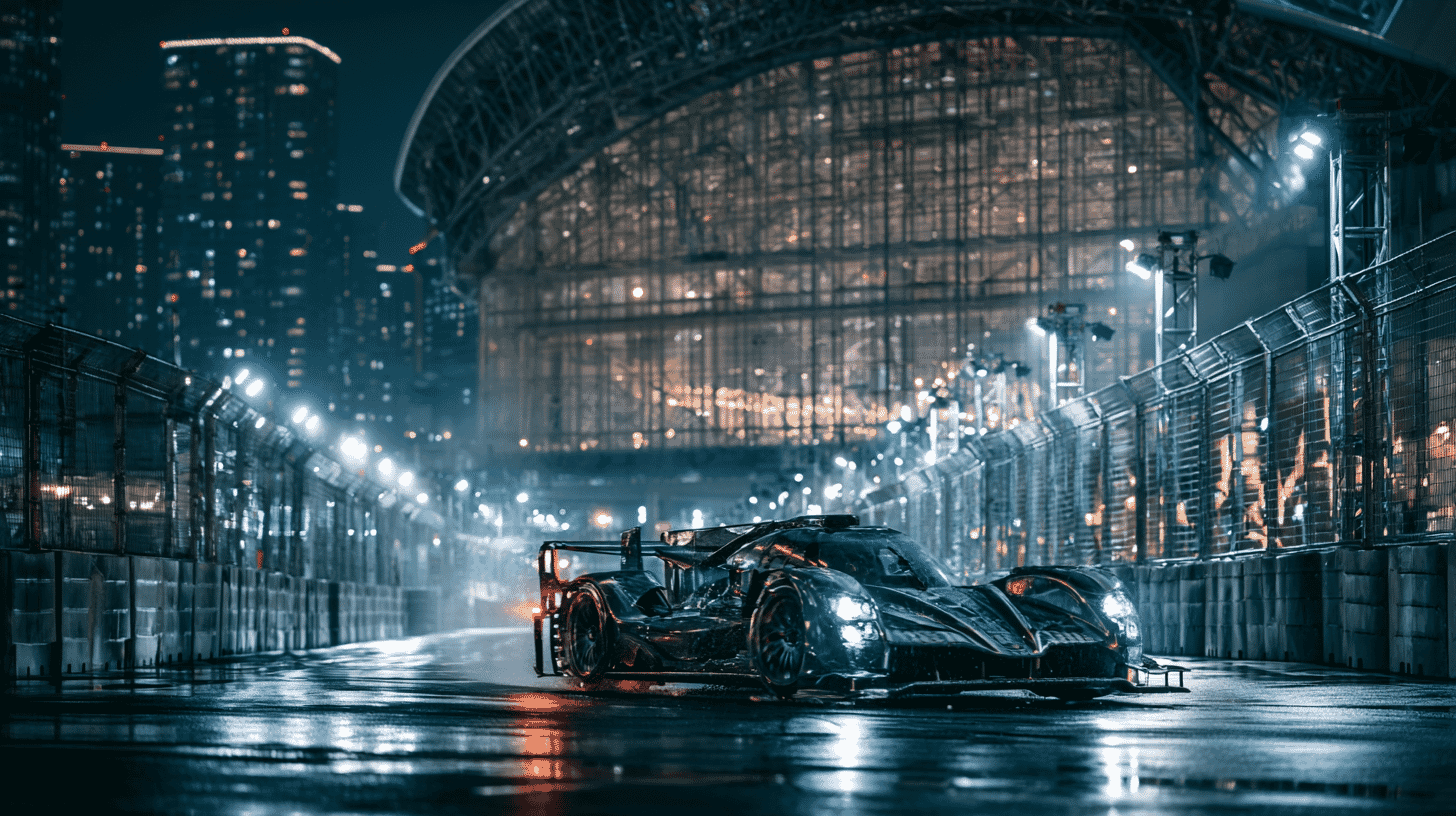
🌃 At five past eight on a Saturday night in late July, cars with no engine note went racing around a convention centre on Tokyo Bay. It was Formula E's first night race in Japan. Two Japanese companies were there, doing two completely different jobs, and by the end of the weekend those jobs had started to look less different than they used to.
Why Tokyo raced after dark
The 2026 TDK Tokyo E-Prix ran on July 25 and 26 as Rounds 14 and 15 of Formula E's twelfth season. The track is a temporary one: 2.575 km, 18 turns, wrapped anti-clockwise around Tokyo Big Sight, the exhibition complex on the Ariake waterfront. Tokyo has been on the calendar since 2024, and this was its third edition, the first under floodlights, with both races starting at 20:05.
Racing at night is part showmanship and part weather. Tokyo in late July is punishing, and the evening slot sets the cars against the city skyline. It also hands the teams a problem: they practise and qualify in afternoon heat, then race hours later on a cooler surface, which is a different tyre question entirely.
The lighting, and most of the site's temporary power, came from generators burning HVO, a diesel substitute made from waste cooking oil and similar fats. Formula E says the fuel cuts lifecycle CO2 by up to 90% against conventional diesel, and that the 2025 Tokyo race saved 21.3 tonnes of it.
Neither race went to script. On Saturday, Dan Ticktum of Cupra Kiro took the lead from Jake Dennis on the final lap of 36 and won. On Sunday, rain turned the circuit into a lottery, Nyck de Vries of Mahindra gambled on a dry setup and won, and a multi-car crash brought out a red flag with two laps left.
Nissan is here as a car company
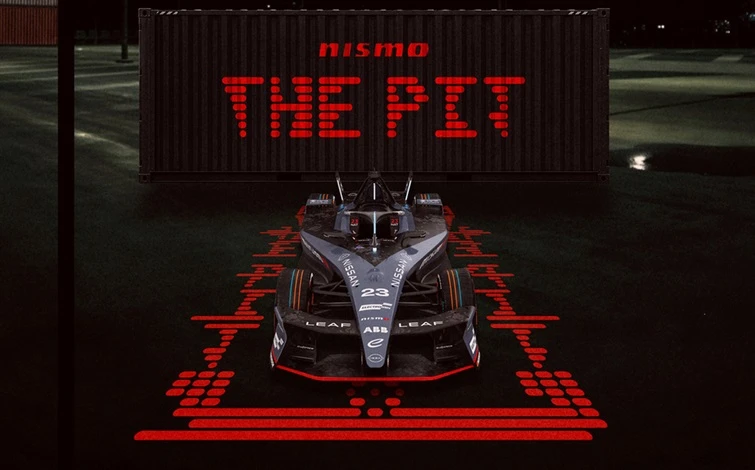
Source: Nissan Motor newsroom
Nissan has been in Formula E since Season 5 in 2018/19, the first Japanese carmaker to enter, and it is still the only one running a works team. Tokyo is its home race, and the cars arrived in a one-off livery drawn from NISMO, the company's performance sub-brand: grey and black with a red accent, keeping the cherry blossom motif the team has carried for years. It was also the last home race for Nissan with the current GEN3 Evo machine.
The technical story Nissan tells about the programme runs in both directions. By the company's own account, the driving records of Leaf owners around the world, a pool covering 28bn km, feed into the design of the software that runs the race car. The very efficient battery management software written for racing then feeds back into road EVs. Takuro Iwase, the team's chief powertrain engineer, developed electric powertrains for the X-Trail and the Serena e-POWER before moving across in 2025. He told the Japanese edition of Motorsport.com that the engineering skills involved are not identical but transfer almost one for one between production and racing work, with the obvious caveat that you cannot simply bolt a race part onto a road car.
The weekend itself was uneven. Oliver Rowland, the reigning world champion, had taken pole at every Tokyo E-Prix ever held. This time he was knocked out in the qualifying group stage, started 15th, and climbed to seventh, the only points scored on Saturday by either of the Japanese-linked teams. Sunday was a recovery: Rowland led late before his last Attack Mode came too late to hold the podium, finishing fourth, with Norman Nato sixth.
Yamaha is here as the parts inside
Yamaha Motor is not a car company. It builds motorcycles, outboard engines, industrial robots and boats, and it had not contested a four-wheel world championship since walking away from Formula 1 in 1997. It came back through a side door.
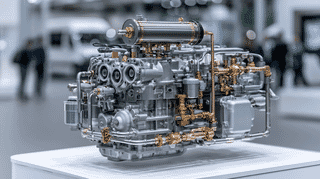
In March 2024 Yamaha signed a multi-year technical partnership with Lola Cars, the British constructor. From Season 11 the two have supplied an electric powertrain to a squad run by Germany's ABT, entered as the Lola Yamaha ABT Formula E Team. The series hands teams roughly 70% of the car as standard equipment, chassis and battery included. What is left open is the motor, the inverter and the gearbox, along with the software that governs them, and that package is precisely what Yamaha builds. The stated goal is unusually blunt for a corporate mission: acquire what the company calls the ultimate energy management technology for electric powertrains.
Year one was tuition, 32 points and 11th in the teams' standings. Year two produced something better. At Shanghai on July 5, 2026, Lucas di Grassi started 19th in changeable weather and bet on the track drying. He ran a dry setup, spent nothing early, and came forward once the surface turned, taking the lead on the final lap. It was the team's first win, in its second season, and for di Grassi, who has said he will retire from racing at the end of this year, something close to a farewell.
Tokyo did not extend the run. Both cars finished outside the points on both nights, 12th and 13th on Sunday. Yamaha was visible anyway, in the free Fan Village beside the circuit, where its stand showed the e-Axle, a three-in-one motor, inverter and gearbox unit rated up to 450 kW, next to HARMO, an electric marine drive. Same architecture as the race package, different destination.
What an electric race is actually a contest of
The thing that trips up newcomers is that Formula E is not really a flat-out speed contest. Every car gets the same battery holding a fixed amount of energy for a fixed distance, so the race becomes a budgeting exercise: how much you spend, when you spend it, how much you claw back under braking. Around half the energy used across a race is recovered that way.
Layered on top is ATTACK MODE, a temporary power boost each driver has to take twice, activated by steering through a marked zone off the racing line. Take it early and you lose track position. Take it late and you sit behind cars you could have passed, betting you will still have the run at the end. Ticktum on Saturday, di Grassi in Shanghai: both settled it there.
Efficiency makes the same point from another angle. Formula E puts the GEN3 Evo's motor efficiency above 95%, against roughly 40% for a typical combustion engine, with a top speed of 322 km/h. Saturday brought one more variable: Round 14 required a mandatory Pit Boost stop for a fast mid-race charge, while Sunday used the standard format.
The two positions are converging
The day before the first race, at Tokyo Big Sight, Nissan announced something that rearranges the picture. From Season 13 in 2026/27, when the GEN4 car arrives, it will supply its powertrain to Andretti Formula E under a multi-year deal, stepping in after Andretti and Porsche announced in May 2026 that their partnership would end with Season 12. That takes the cars running Nissan power from two to four, and with them the development data coming back. It also means Nissan will be doing, alongside its own team, the job Yamaha has been doing all along.
Yamaha moved the other way in April 2025, agreeing to extend its work with Lola beyond 2027 and into GEN4. There will be more to develop in that era: 600 kW of peak power, a 55 kWh battery, regeneration up to 700 kW, efficiency above 97%, and permanent all-wheel drive instead of the limited version GEN3 Evo allows.
The battery, though, stays a spec part. Whatever these two companies learn, they will learn it through the same narrow opening: motor, inverter, gearbox, software. It is a small opening, and it happens to be the section of an electric vehicle that a motorcycle maker and a carmaker can both build.
Tokyo has now tried this once. Floodlights, an exhibition hall for a backdrop, and cars quick enough to be frightening but quiet enough that you hear the tyres working. Would that land where you live, or does a race still need the noise?
References
- https://prtimes.jp/main/html/rd/p/000000073.000152544.html
- https://global.nissannews.com/ja-JP/releases/260722-02-j
- https://global.nissannews.com/ja-JP/releases/260724-01-j
- https://www.nissan-global.com/JP/INNOVATION/TECHNOLOGY/ELECTRIFICATION/FORMULA_E/
- https://news.yamaha-motor.co.jp/2026/032142.html
- https://news.yamaha-motor.co.jp/2026/032158.html
- https://global.yamaha-motor.com/jp/news/2025/0410/formulae.html
- https://www.as-web.jp/overseas/1337643
- https://www.as-web.jp/overseas/1338069
- https://www.fiaformulae.com/en/formula-e-gen4-unleashed
- https://jp.motorsport.com/formula-e/news/formulae-2026-tokyo-eprix-nissan-preview/10839389/
- https://fiaformulae.com/en/news/1066678/porsche-and-andretti-to-conclude-partnership-at-the-end-of-2025-26-formula-e-season



Global Discussion
4 comments