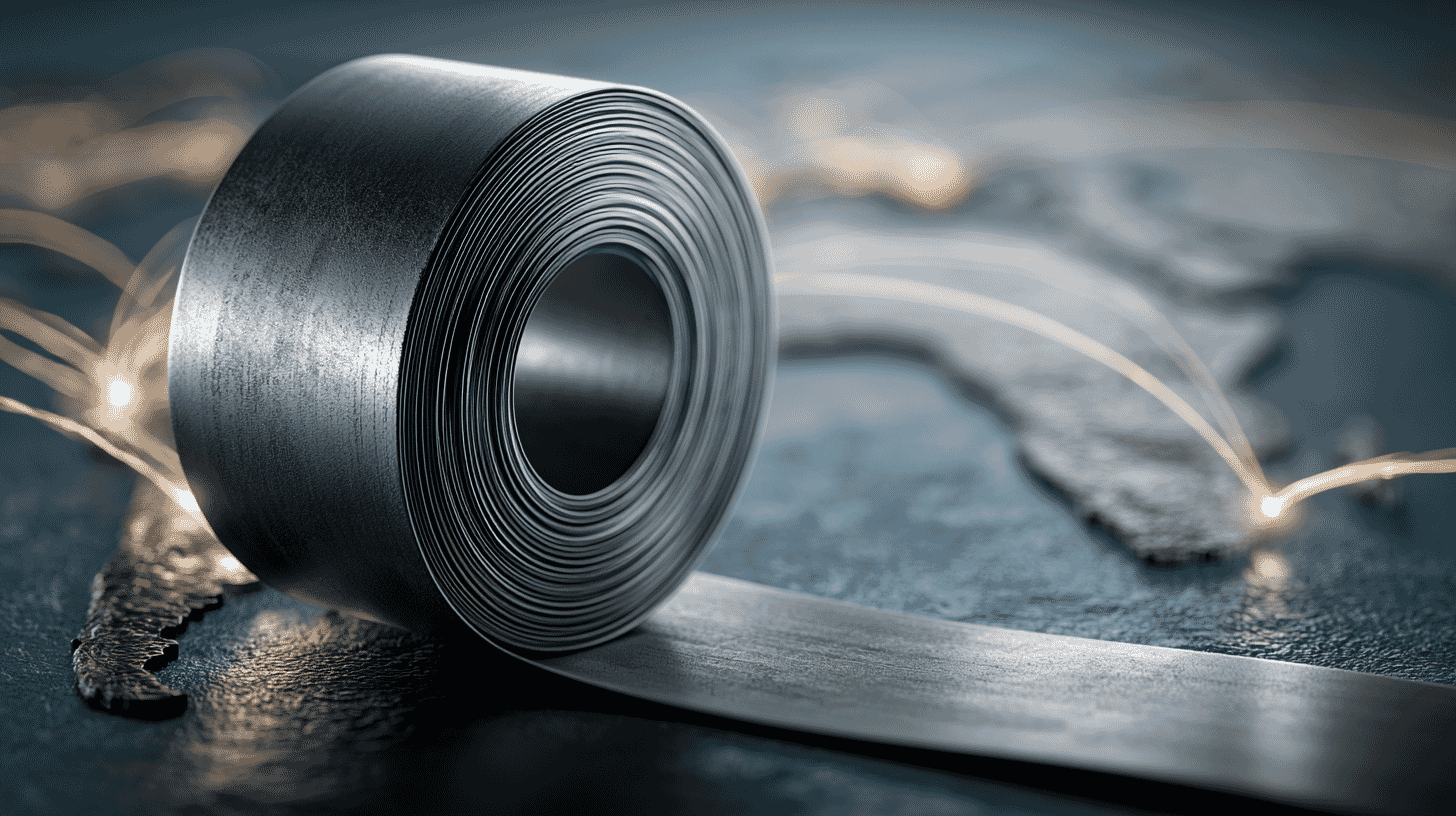
⚙️ Every electric car hides an iron heart: a tightly packed stack of steel sheets, each thinner than a business card, spinning thousands of times a minute. Get that stack even slightly wrong and the motor bleeds energy as heat. The tooling that stamps and bonds those sheets is an overlooked chokepoint of the EV era, and one of the firms that shapes it employs fewer than a thousand people just outside Tokyo. Now it is betting on two metals that defeated engineers for decades.
The part no one sees inside an electric motor
An EV motor core is a stack of laminations: hundreds of stamped rings of electrical steel, insulated from one another and pressed together. The steel itself comes from giants like Nippon Steel, JFE and POSCO. But turning a coil of that steel into a finished core, punching each layer to micron tolerances and locking the layers together without shorting them, is a craft of its own. That craft lives in the stamping die.
Kuroda Precision Industries, based in Kawasaki just outside Tokyo, is one of the world's leading makers of those dies for EV drive motors. A 2024 report in the Nikkei put its share of the global market for EV-drive motor-core dies at roughly 30 percent, placing it in the top group of suppliers. It is not a household name. Sales for the year ended March 2026 came to ¥19.5 billion, about $124 million at 157 yen to the dollar, and the payroll runs to roughly 640 permanent staff, or about 980 counting temporary workers. The company began in 1925 as Japan's first dedicated maker of measuring gauges and marked its centenary in 2025.
For most of that century, gauges and ball screws were the business. Motor-core dies changed that. Until about two years ago, president Hiroshi Kuroda told the trade press in 2024, ball screws were the mainstay; now motor-core work in the die business is the company's largest line. More than 30 mass-production projects are running worldwide, most of them in North America, and roughly 85 percent of the die division's sales go overseas.
What is easy to miss is that Kuroda mostly does not mass-produce the cores itself. It licenses its technology and sells the dies, leaving volume production to partners: Italy's EURO group among them, along with Chinese and Korean firms, plus a domestic joint venture set up in 2023. That asset-light model is how a company this size ends up inside supply chains far larger than itself.
Why stamping steel is harder than it sounds
How efficient a motor is comes down to how little energy leaks away as heat inside the core, a loss engineers call iron loss. One way to cut it is to make each lamination thinner and stack more of them. But thinner sheets are fussier to punch, and the traditional trick for holding the stack together, crimping little dimples through it, creates tiny electrical bridges that leak energy.
Kuroda's answer was to glue the layers inside the die itself. Its Glue FASTEC process lays adhesive onto each sheet and bonds the stack as it is stamped, keeping the layers electrically isolated. It took about a decade to develop and first went into a production vehicle motor in 2005. The company says the method lifted productivity by more than 10 percent, cut iron loss by 10 to 20 percent, and raised motor torque by 17 percent against the conventional approach. The recipe is deliberately kept as a black box, which is much of why rivals struggle to copy it.
That moat matters, because the competition is fierce and fast. Kuroda is not the biggest die maker overall. By QYResearch's 2025 estimate, Mitsui High-tec leads the broader motor-core die market with about 18 percent, EuroGroup Laminations holds around 12 percent and Kuroda about 10 percent, and the top five together account for only some 52 percent of global revenue.
The sharper pressure is speed. Kuroda has said that a Japanese carmaker's new-model project runs about three years while Chinese makers work to roughly six months, and that a supplier who cannot match that pace does not even get considered. The company cut its die lead times and, by his account, only began getting onto Chinese projects around 2024.
The forty-year wall: metals that fight back
The next frontier is not the die but the metal it stamps, and here Kuroda is walking straight into problems that have blocked the whole industry for decades.
The first is amorphous alloy, an iron-silicon-boron ribbon cooled so fast from the melt that it never forms a crystal structure. Its iron loss can fall to a tenth of ordinary electrical steel, which is huge for fast-spinning motors. Engineers have known this since the 1980s. The catch is the ribbon itself: thin, hard and stubborn, it was, for roughly forty years, nearly impossible to punch and stack in volume without destroying the tooling.
The second is permendur, an alloy of iron and cobalt in almost equal parts. It carries the highest saturation flux density of any practical soft-magnetic material, which lets a motor be smaller, lighter and more powerful. That makes it a candidate for high-speed motors and the electric aircraft known as eVTOLs. But permendur is notoriously awkward to machine and stamp compared with ordinary electrical steel, and about half its weight is cobalt.
Vision2030 and the bet on difficult metal
In mid-2026 Kuroda launched a five-year plan called Vision2030, using its centenary as the pivot. The near-term move is concrete: mass production of EV motor cores starts in the second half of the current fiscal year. The ground for it was laid earlier. An eighth building went up at the Nagano mother factory at the end of 2023, housing a 300-ton high-speed press, and that plant has since earned JIS Q 9100, the quality standard for aerospace and defense work, a telling credential for a firm with its eye on aircraft.
The timing is not comfortable. For the year ended March 2026 sales rose 12.8 percent, but operating profit fell almost 90 percent and the company slipped to a net loss, hit by a weaker product mix, widening losses at its German subsidiary and restructuring costs. Kuroda also pointed to China's export controls on rare-earth magnets disrupting motor-core production, and to the global EV slowdown weighing on orders. It forecasts a return to profit in the year to March 2027.
The longer bet is on the difficult metals. By throwing its die and lamination know-how at amorphous and permendur, the company is angling for high-speed motors, aircraft electrification and other future uses rather than the mature EV core alone. It is a fitting move for a firm whose die chief, Katsunori Ishii, likes to say its engineers have seen more motor-core drawings than anyone in the world. The strategy is not to build the motors, or even make the steel, but to own the hardest step in between.
Cobalt, geopolitics, and whose motor you are driving
Permendur's cobalt content is where the story stops being about metallurgy and starts being about maps. The Democratic Republic of Congo mined about 76 percent of the world's cobalt in 2024, according to the Cobalt Institute. In February 2025 the DRC halted cobalt exports outright, and the benchmark LME three-month price climbed from around $21,550 a tonne to $36,170 within weeks. Exports restarted in October 2025, but under quotas tight enough that prices kept climbing: cobalt passed $50,000 a tonne in December 2025 and touched about $55,835 in January 2026, the highest in roughly three and a half years. It has held near $56,000 a tonne through the middle of 2026. A material that could help put electric aircraft in the sky is bound to one of the most concentrated supply chains on Earth.
That is the backdrop to a contest most drivers never think about. The iron heart of the motor in your next EV was shaped by a die, and that die was most likely made in Japan, Italy or China. Japan's edge rests on hard-won process secrets; China's on speed and scale; Europe's on integrated, large-diameter production. The market is still open enough that the top five makers hold barely half of global revenue, which means the balance can shift.
So here is a question worth asking next time you settle into an electric car: whose motor core is spinning under the floor, and where was the die that stamped it actually made?
References
- https://www.japanmetaldaily.com/articles/-/263967
- https://www.nikkei.com/article/DGXZQOUC011570R00C24A7000000/
- https://emidas-magazine.nc-net.com/industry/2654/
- https://kanagata-shimbun.com/202508kurodaprecision100-top/
- https://kurodaprecision.com/jp/ir/data/briefing/
- https://www.jetro.go.jp/biznews/2025/06/2ec0c18d54b6d458.html
- https://www.iru-miru.com/article/80328




Global Discussion
4 comments