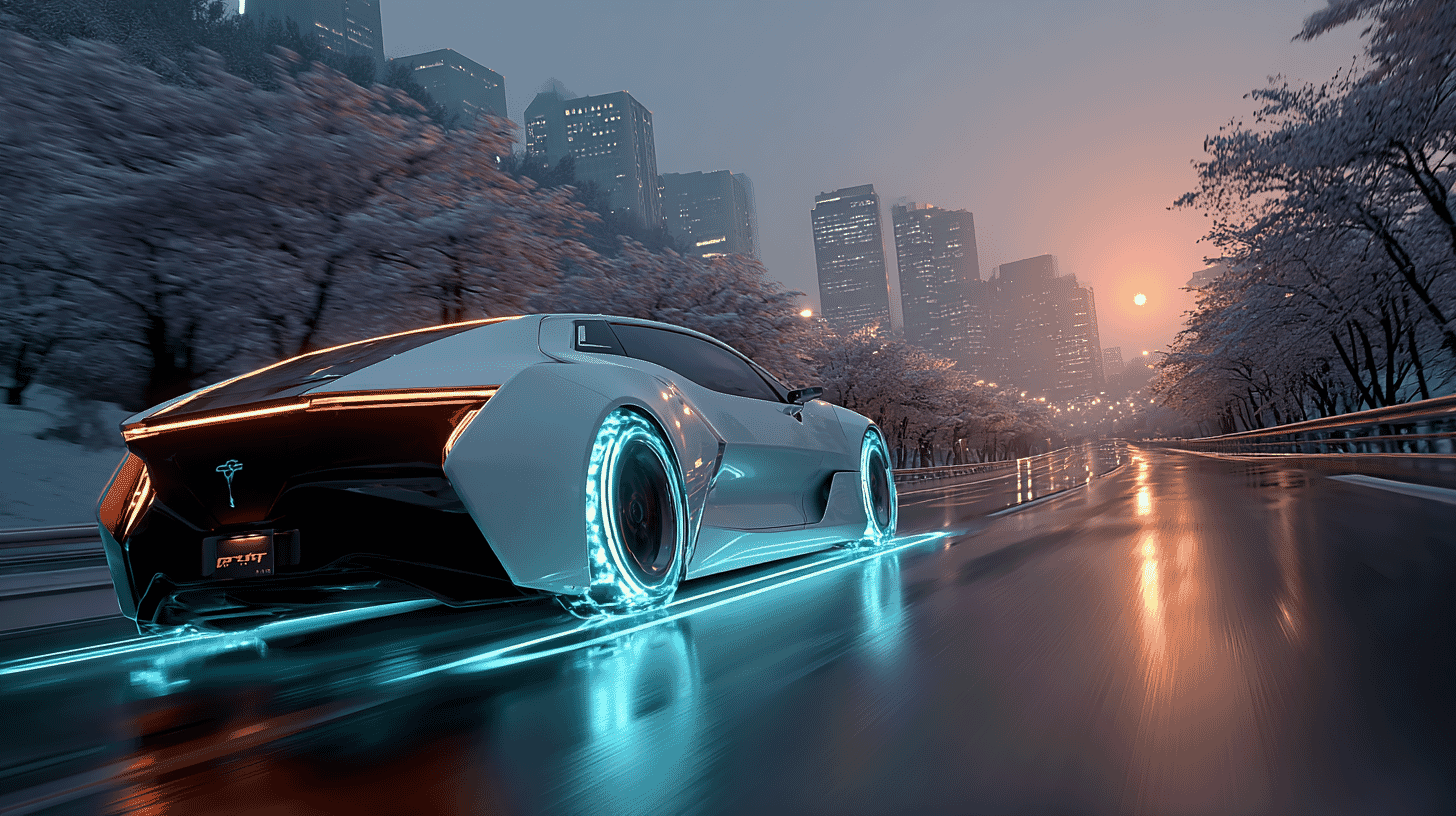
What if your EV never needed to stop for charging? DENSO, one of the world's largest automotive suppliers, and the University of Tokyo have signed a 10-year agreement to build roads that wirelessly charge cars while they drive. They have already logged 500 km of non-stop driving, and the technology could cut EV battery sizes, costs, and the need for charging stations.
DENSO and University of Tokyo: A 10-Year Bet on the Future of Driving
On March 30, 2026, DENSO and the University of Tokyo held a joint press conference and signing ceremony at Sanjo Conference Hall on the university's Hongo campus to announce a 10-year partnership agreement, effective April 1, 2026 through March 31, 2036. The partnership's hub, the DENSO-UTokyo Lab, opened on April 1 at the university's Institute of Industrial Science, co-led by Associate Professor Hirotaka Homma for UTokyo and Executive Officer Shinichi Yatsuka for DENSO. This marks the University of Tokyo's first organization-to-organization long-term partnership in the mobility field.
Their shared vision is captured in the phrase "The more you drive, the more it's replenished", reimagining mobility not as a drain on energy, but as a contributor to society's energy ecosystem. The partnership treats vehicles as part of a broader social system connecting energy, data, and urban infrastructure.
DENSO President Shinnosuke Hayashi emphasized that for resource-limited Japan, "wisdom and technology are our greatest resources." University of Tokyo President Teruo Fujii added that the initiative "can contribute to solving not just Japan's challenges, but global ones as well."
How Dynamic Wireless Power Transfer Works
At the heart of this partnership is DWPT, Dynamic Wireless Power Transfer. Think of it as wireless smartphone charging, but for cars, and at highway speeds.
The concept is straightforward: transmitting coils are embedded in the road surface, and receiving coils are mounted on the underside of the vehicle. As the car passes over the road coils, electricity is transferred wirelessly through a magnetic field, no cables, no stopping.
What makes DENSO's approach distinctive is the power routing. Rather than sending electricity straight to the battery, the system first powers the drivetrain directly, the inverter, motor, and air conditioning. Only surplus energy goes to the battery, and the battery fills in when road power isn't available. This reduces battery cycling and extends its lifespan.
The numbers are impressive. On DENSO's test track, with coils installed on just 40 meters of a 200-meter oval, a test vehicle maintained its battery level while driving more than 500 km continuously. The system achieves approximately 85% power reception efficiency at speeds ranging from low speed to 130 km/h (about 80 mph).
Separately, Professor Hiroshi Fujimoto's team at the University of Tokyo launched Japan's first public road demonstration in Kashiwa City, Chiba Prefecture in October 2023. Their system delivers enough power in 10 seconds of charging to drive approximately 1 km. The transmitting coils are embedded just 2.5 cm (about 1 inch) deep in fiber-reinforced concrete, and power transmission efficiency has reached over 96.4%.
Why Smaller Batteries Change Everything
If cars can charge while driving, the single biggest cost and weight problem of EVs disappears.
Today, EV batteries account for roughly 30–40% of a vehicle's total cost. For heavy-duty trucks, batteries alone can weigh over 5 tons (11,000 lbs) just to achieve a range under 1,000 km (620 miles). This weight drives up material costs and energy consumption in a vicious cycle.
DWPT breaks this cycle. Associate Professor Yudai Honma at the University of Tokyo ran mathematical optimization simulations to determine how much road would need to be electrified. In a model based on Kashiwa City, just 1.6% of the total road surface equipped with DWPT would allow every vehicle in the city to drive indefinitely without stopping to charge.
Smaller batteries mean lighter, cheaper, more efficient vehicles. They also reduce demand for critical minerals like lithium and cobalt, a strategic advantage for resource-poor nations like Japan. And with less space consumed by batteries, vehicle interiors get roomier and designers gain new freedoms.
Consider the cost implications: if battery capacity can be cut by half or more, the price of an EV could drop by thousands of dollars, potentially making electric vehicles cheaper than their gasoline equivalents without government subsidies.
The Four Pillars of the Partnership
The DENSO-University of Tokyo agreement is organized around four major themes:
Energy circulation and data linkage for social value. DWPT and its optimal deployment sit at the center, with EVs reconceived as distributed energy storage devices that support the power grid rather than just drawing from it, a concept known as V2G (Vehicle to Grid).
Infrastructure-coordinated mobility. Integrating vehicles with social infrastructure to structurally reduce traffic accidents and congestion, using safety assurance and cybersecurity technologies.
Strengthening the technology base for sustained value creation. Advancing automotive SoC (System on Chip) design, software, and AI, spanning from manufacturing to maintenance in a unified framework.
Cultivating talent for future society. Building educational programs that bridge research, demonstration, policy design, and real-world implementation, for students and working professionals alike.
How Japan's Approach Differs from the Rest of the World
DWPT research is a global race, but each player has a different playbook.
Israel's Electreon has been the most commercially aggressive, deploying copper coils under roads in Tel Aviv, Sweden's Gotland Island, and more recently partnering with UCLA in California to electrify a bus route ahead of the 2028 Olympics. However, their system reportedly achieves only about 64% power reception efficiency, significantly below the 85–96% numbers coming out of Japan.
Sweden was once the world's most ambitious country for electric roads, targeting 3,000 km of electrified highways by 2035. But its final assessment report, published in December 2024, concluded that a national electric road network would not be cost-effective without adoption by trading partners like France and Germany. The program has since been paused.
The United States is moving more cautiously, with Michigan planning the country's first public wireless charging road. France is testing both inductive and conductive rail systems through 2026.
China is taking a different approach, planning 500 km of overhead-wire electric roads in Xinjiang province for coal-mining trucks that operate 24 hours a day.
Japan's approach stands apart in its scope. Where other countries tend to treat DWPT as an infrastructure project, "how do we electrify roads?", DENSO and the University of Tokyo frame it as a systemic redesign of society. Their 10-year roadmap integrates energy policy, urban planning, semiconductor development, AI advancement, and workforce training into a single cohesive vision. This reflects a distinctly Japanese philosophy: rather than solving one problem in isolation, engineer the entire system around it.
Challenges Ahead
For all the promise, significant hurdles remain.
The cost of embedding coils in roads at scale is enormous. Maintenance, power grid upgrades, and ensuring interoperability across vehicle brands all require coordination that extends far beyond any single company or university.
Safety is another concern. Foreign objects, metal debris, animals, or accumulated road salt, between the road and vehicle coils could cause overheating. Standards for foreign object detection in wireless EV charging systems are still being developed internationally.
International standardization is perhaps the biggest wildcard. Static wireless charging already has the SAE J2954 standard, but dynamic (in-motion) charging lacks a global consensus. Until automakers commit to building receivers into their vehicles as standard equipment, DWPT will remain a technology in search of mass adoption.
DENSO and the University of Tokyo are targeting commercialization around 2030, but the timeline depends heavily on regulatory progress and industry buy-in.
Why Ten Years
The phrase DENSO uses is "turning movement into value": replacing transportation-as-consumption with an act that circulates energy and accumulates data as you drive.
But the ten-year horizon itself says something about where the technology actually stands. The 85% reception efficiency and the 500 km non-stop run are numbers from a test track and a demonstration stretch. As Sweden concluded in 2024, when it decided a national electric road network would not pay for itself without neighbouring countries joining in, the hard part of DWPT is not the physics but the return on the infrastructure. DENSO and UTokyo bundled semiconductors, urban design, and workforce training into a decade-long agreement because that part sits beyond what any single company's engineering can reach.
How is EV charging infrastructure developing in your country? If roads could charge your car while you drive, how would it change your daily life? We'd love to hear your thoughts.
References
- https://www.denso.com/jp/ja/news/newsroom/2026/20260330-01/
- https://monoist.itmedia.co.jp/mn/articles/2603/31/news072.html
- https://car.watch.impress.co.jp/docs/news/2097589.html
- https://news.yahoo.co.jp/articles/d4b3bd1fc8e3e1f142a9eb561cfbb4e1a27f9988
- https://www.jst.go.jp/pr/jst-news/backnumber/2024/202502/pdf/2025_02.pdf








Global Discussion
12 comments