🔬 We keep finding plastic in places it has no business being: human blood, clogged arteries, brain tissue. But there is an uncomfortable catch nobody likes to say out loud. The smallest, most worrying particles are also the ones we can barely measure. A team in Tokyo has now built a cheap optical sensor that grabs them straight out of the water.
The problem isn't the plastic. It's the ruler.
When a plastic bag or fishing net breaks down in the ocean, it does not stop at the "microplastic" stage. Particles smaller than 5 millimeters get the microplastic label, but they keep shattering, down past a micrometer, into the range scientists call nanoplastics, roughly one nanometer to one thousand nanometers across. At that size they slip through cell membranes, which is exactly why they keep turning up inside living things.
The evidence that this matters has been piling up fast. Researchers in the Netherlands first quantified plastic particles in human blood in 2022. In 2024, a study in the New England Journal of Medicine linked micro- and nanoplastics lodged in arterial plaque to a higher risk of heart attack and stroke. A separate analysis published in Nature Medicine in 2025 found these particles accumulating in human brain tissue at higher levels than in the liver or kidney, and rising between 2016 and 2024.
So why hasn't this translated into hard rules? Partly because regulators run into a wall the public rarely hears about: you cannot manage what you cannot measure. When the European Union restricted intentionally added microplastics under its REACH chemicals law in 2023, its own scientific committee recommended covering particles all the way down to one nanometer. Then it backed off and set a temporary floor at 100 nanometers, not because anything smaller is safe but because anything smaller could not be reliably detected, and therefore could not be enforced. The U.S. Food and Drug Administration made a similar admission in 2024, saying it could not conclude whether the particles in food are harmful, citing the lack of a standardized way to measure them.
The lab tools that do exist, such as Raman spectroscopy and pyrolysis gas chromatography-mass spectrometry, are powerful but expensive, slow, and demanding to run. That is the gap a group at the Institute of Science Tokyo set out to close.
A peptide that grabs plastic, and a gold film that notices
Science Tokyo, for readers outside Japan, is the university formed in 2024 by merging Tokyo Tech with Tokyo Medical and Dental University. The work came out of the lab of associate professor Mana Toma of the Department of Electrical and Electronic Engineering, who specializes in plasmonics and biosensors, with assistant professor Shuo Cheng of the School of Environment and Society.
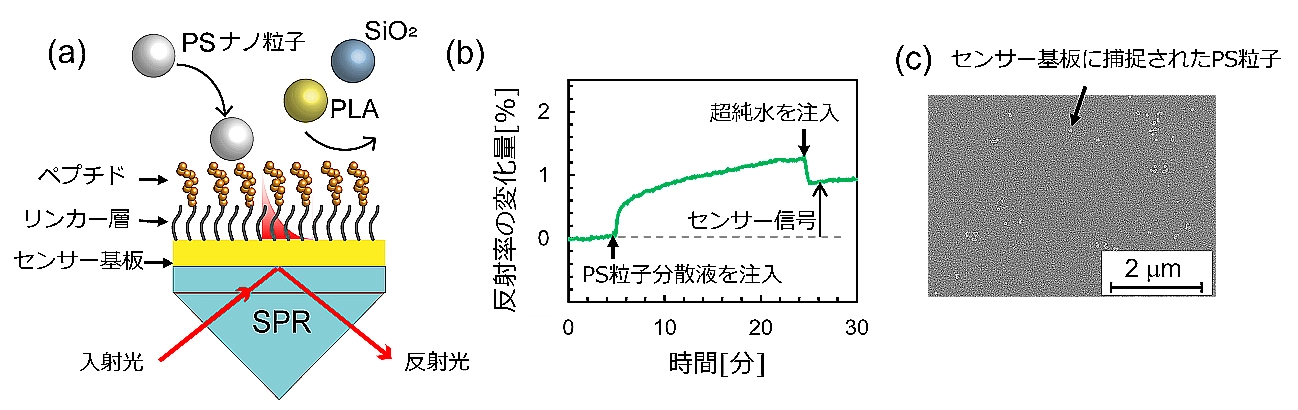
Their device sidesteps the usual approach entirely. Instead of analyzing what a particle is made of, it physically catches the particle first. The trick is a short peptide (a small chain of amino acids) that happens to stick to polystyrene, one of the most common plastics. The team anchored this peptide onto a thin gold film through a polyethylene glycol (PEG) linker, which suppresses non-specific sticking so the surface grabs polystyrene and little else. Think of it as molecular Velcro tuned to grab one specific kind of plastic.
The "noticing" half is surface plasmon resonance, or SPR. Shine light on a gold surface at the right angle and the free electrons in the metal start to oscillate in sync with it, a resonance exquisitely sensitive to anything touching the surface. When polystyrene nanoparticles get caught by the peptides, they nudge the optical conditions right at the gold, and that shift shows up as a change in the reflected light. No dye, no fluorescent tag, no chemical labeling required.
Source: Institute of Science Tokyo
What the sensor showed, and what it didn't
The results went online on May 9, 2026 and are due to appear in the journal Biosensors and Bioelectronics. In the lab, the sensor detected 50-nanometer polystyrene particles suspended in water within 20 minutes, with no labeling step. Scanning electron microscopy confirmed the particles really were stuck to the surface. Crucially, a bare gold film without the peptide barely responded. And when the team tried silica and biodegradable polylactic-acid particles instead, the sensor stayed quiet. The peptide, in other words, was doing real selective work, not just catching anything that drifted by.
Then they pushed it out of the beaker. Spiking aquarium water and water from a real Tokyo pond (Senzoku Pond) with polystyrene particles, they got signals that tracked with concentration, a first hint that this could work on actual environmental samples.
It is worth being clear-eyed about the limits, which the researchers themselves flag. So far it only catches polystyrene; other plastics will need their own peptides. The detection floor was 1.3 micrograms per milliliter, still well above the vanishingly low concentrations found in real seawater, so this is not yet a field kit you dip in the bay. And the pond water gave weaker responses than clean lab water, a reminder that salts and organic gunk in the real world interfere with the chemistry. This is a proof of principle (that peptide capture plus an optical readout can work), not a finished product.
Why a cheaper ruler matters
It is tempting to file this under "incremental lab science." That undersells what is actually at stake. The entire global argument about nanoplastics, whether they are dangerous, how much is too much, what should be banned, keeps stalling on the same missing piece: a measurement that is cheap, fast, and reproducible enough to use widely. The EU drew its enforcement line at 100 nanometers because of exactly this gap. A method that reliably catches a 50-nanometer particle is poking at the size range regulators had to wave off.
A peptide-and-gold sensor is not going to clean a single beach. But cheaper, simpler instruments are how a field stops debating in the dark. If detecting the smallest particles becomes routine rather than a job for a handful of well-funded labs, the conversation can finally move from "we think it's everywhere" to "here is how much, and where." For a country like Japan that eats a lot of seafood and sits in some of the most plastic-saturated waters on Earth, that shift is not abstract.
What Japan put on the table this time was a tool, not a tougher rule. Where does your country put its effort: into measuring the invisible stuff, or into regulating it before the tools exist?
References
- https://www.isct.ac.jp/ja/news/atok186pu332
- https://doi.org/10.1016/j.bios.2026.118748
- https://echa.europa.eu/hot-topics/microplastics
- https://single-market-economy.ec.europa.eu/sectors/chemicals/reach/restrictions/commission-regulation-eu-20232055-restriction-microplastics-intentionally-added-products_en
- https://www.nature.com/articles/s41591-024-03453-1







Global Discussion
4 comments