🦐 Japan's biggest telecom company is now farming shrimp, not in the ocean, but on dry land.
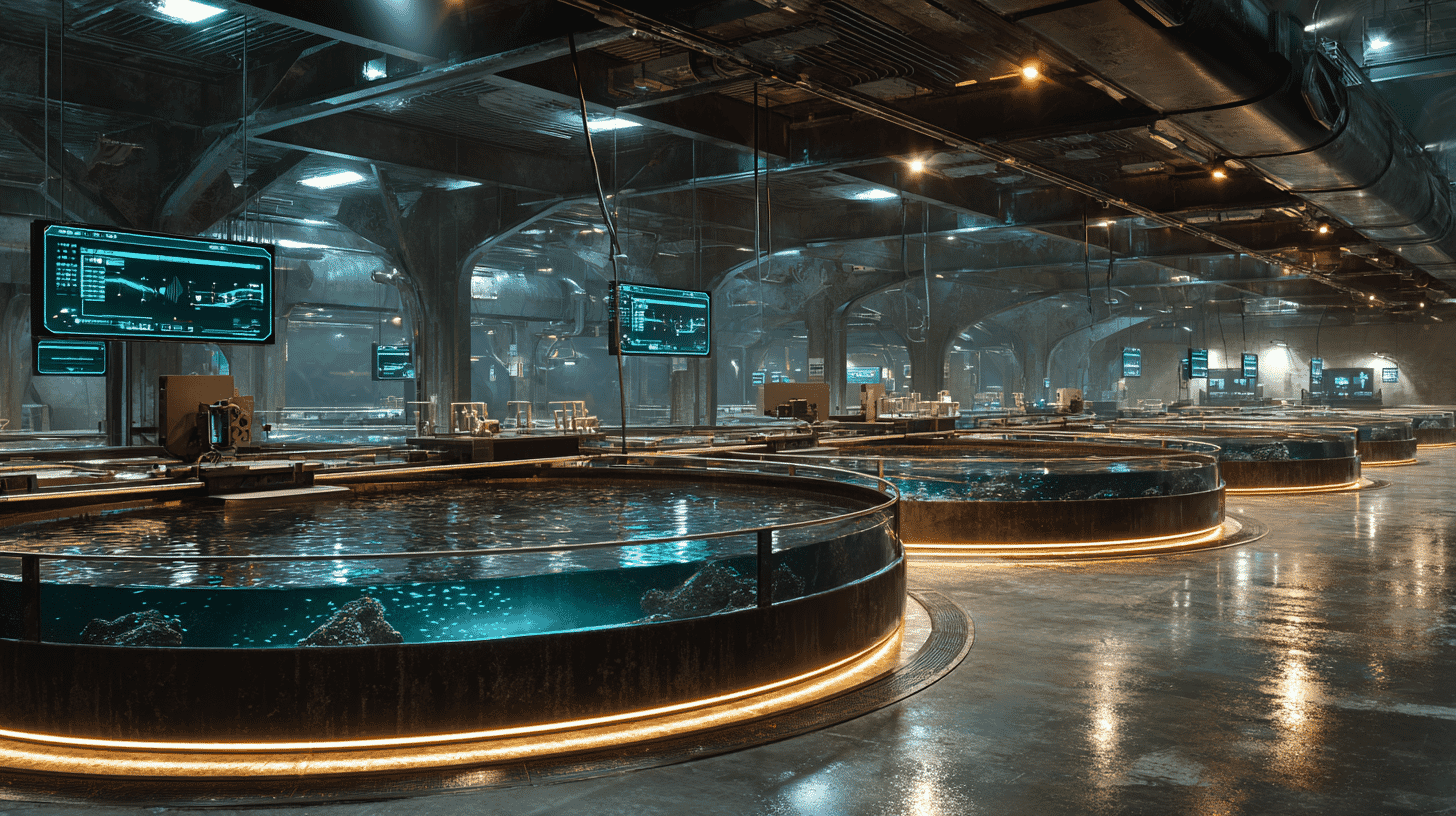
Inside a former Suzuki parts factory in Iwata, Shizuoka, 16 massive water tanks holding 400 tons of brine are home to hundreds of thousands of whiteleg shrimp. Annual production capacity: 180 tons. Largest domestic share in Japan. Time to build it from zero: under three years. Number of team members with prior aquaculture experience: almost none.
Over 90% of the shrimp on Japanese plates is imported. Climate change and rainforest destruction are quietly unravelling that supply chain. NTT's strange detour into shrimp farming sits at the leading edge of a global trend, where food security meets sensor networks and big telecom infrastructure.
Shrimp Is Japan's Hidden Vulnerability
The Japanese eat a lot of shrimp by global standards. Sushi, tempura, ebi furai, ebi chili, shrimp crackers, picture Japanese cuisine without shrimp, and a substantial chunk of it disappears.
But over 90% of the shrimp Japan eats is imported, mainly from Vietnam, India, Indonesia and Ecuador.
The problem: that supply chain is quietly fraying.
Tropical pond farms in Southeast Asia, many of them built on cleared rainforest land, get hit hard by typhoons and rising sea temperatures. Water pollution from feed and waste, cannibalism among stressed shrimp, and disease outbreaks make pond mortality rates brutal. The environmental cost is also coming under international scrutiny: since 1980, shrimp farming has been responsible for the global destruction of more than 3.4 million acres of carbon-absorbing mangrove forests, predominantly in Southeast Asia.
Japan once farmed black tiger prawns along its own coasts, but rising sea temperatures and water quality issues have made that increasingly unviable. Japan's combined capture and aquaculture production has fallen from a 1984 peak of 12.82 million tons to 3.27 million tons in 2024, down 4.9% year on year and roughly a quarter of the peak.
The "land of fish" has a shrimp problem.
Why Is Japan's Phone Company Doing This?
Enter, of all companies, NTT Group, Japan's giant telecommunications conglomerate, the closest local equivalent to AT&T or Deutsche Telekom.
NTT Group launched a subsidiary called NTT Green & Food in 2023. Construction on a leased Suzuki auto-parts building in Iwata, Shizuoka prefecture began that October, and the Iwata Plant held its completion ceremony on 3 December 2024, with first shipments inside the same fiscal year. In August 2024 the company also bought Kaiko Yukinoya, a shrimp operation in the same city, from Kansai Electric Power. The Iwata Plant alone is planned at 110 tons a year; together the two sites make up Japan's largest land-based shrimp hub at around 200 tons.
President Yoshikazu Kuzumi originally worked in NTT's new-business development division, looking for ways to apply NTT's research and technology to primary industries like fishing and agriculture. According to a report by Nonfiction writer Toru Yamakawa published by President Online, whiteleg shrimp (バナメイエビ, Litopenaeus vannamei) was chosen for a very pragmatic reason: it reaches market size in just four months, meaning three harvest cycles a year. Trial-and-error feedback gets folded into the next production batch quickly, essentially, IT-startup tempo applied to aquaculture.
Less than three years after founding, the business reached 180 tons of annual production capacity. National izakaya chains and major conveyor-belt sushi chains now serve "NTT shrimp," and NTT Green & Food has become Japan's largest land-based aquaculture operator by share.
16 Tanks, 400 Tons of Water, Endless Sensors
Walking through the Iwata facility, it feels less like a fish farm and more like a semiconductor plant.
Water pumped from underground, seawater and freshwater blended to the optimal salinity, fills 16 tanks holding 400 tons in total. Each tank contains several hundred thousand whiteleg shrimp.
The brown, frothy stuff floating on the surface isn't dirt. It's "biofloc", clumps of microbes that have broken down shrimp waste and uneaten feed, helping clean the water continuously.
Sensors hang into each tank like dangling cables. Water temperature, salinity, dissolved oxygen, ammonia concentration, pH, microbial density, all monitored 24/7 in real time. The whole facility runs on Wi-Fi, and the moment any reading drifts outside its target range, an alert pings the responsible staffer's smartphone.
Underwater cameras watch the shrimp themselves, tracking behavior and water clarity. This is, at its core, NTT doing what NTT does best: IoT, sensor networks, and data-driven production control. Just applied to crustaceans.
The "N-Times Theory" That Didn't Work
It wasn't smooth from the start.
NTT has a long-standing internal concept called the "N-times theory" (N倍の理論). If you can prove a system works at one unit of scale, scaling it up by N gives you N times the result. Run one server reliably, you can run a hundred, or a thousand. That's standard infrastructure logic.
Shrimp, it turns out, don't follow that rule.
The pilot experiments were conducted in Toyama prefecture. When the team tried to replicate the same setup in Iwata, the results didn't match. Underground water in the two regions differs in temperature, bacterial composition, and mineral content. What worked in one place broke in the other.
The hardest variable was water flow. In land-based aquaculture, you have to keep shrimp waste and uneaten feed circulating, not letting it settle in dead zones, where bacteria can wreck water quality fast. Flow speed and direction have to be tuned precisely. And because biofloc water is cloudy, you can't just look and see where the problem is.
The team spent months adjusting water temperature, ammonia levels, pH, dissolved oxygen, and microbial density, using sensor data to find the right operating envelope. Kuzumi's takeaway, paraphrased: "Whoever masters the water masters land-based aquaculture."
The Aquaculture Amateurs Took the Largest Share
Here's what's striking: almost no one at NTT Green & Food had aquaculture experience before joining.
The team is made up of NTT Group engineers, IT specialists, and new-business developers, what Kuzumi calls "amateurs at fishing." This crew of outsiders went from zero to Japan's largest land-based aquaculture operator in under three years.
Kuzumi argues this is itself evidence that the industry can be entered by people without primary-industry backgrounds. NTT's organizational strength isn't really "0 to 1" creation, it's "1 to 100" standardization. Once a working recipe exists, NTT is built to replicate it.
That's the next phase: franchise the system. Sell the land-based aquaculture package to other businesses. Inquiries are already coming in from food manufacturers that want to produce their own shrimp, and from local governments asking whether closed-down schools could be repurposed as shrimp farms.
Kuzumi's stated goal is that within 10 years, land-based aquaculture should supply a meaningful share of Japan's shrimp consumption. Against national demand, 180 tons is a rounding error today. The question is how fast it scales.
The Global Land-Based Aquaculture Race
NTT isn't alone in this. Land-based aquaculture, formally known as RAS (Recirculating Aquaculture Systems), is a global trend, and Japan is one player among many.
The numbers vary by research firm, but estimates of the global RAS market in 2024 range from USD 3.4 billion to USD 5.2 billion, with forecasts reaching USD 8.2 billion by 2034 or higher. Growth rates run around 8–10% annually. Over half of new RAS systems installed in 2023–2025 included IoT-based water quality sensors, which means NTT's data-driven approach lines up with where the industry is moving globally.
A few notable players:
Atlantic Sapphire (Norway/USA) built a large land-based Atlantic salmon facility near Miami called Bluehouse, and has been the sector's flagship name. It has also had a rough run. Persistent problems, water temperature control among them, kept output below plan and drained cash. In May 2026 the company announced a restructuring agreement with its five largest shareholders and convertible loan holders, securing a minimum of $20 million in fresh liquidity and setting out plans to delist from the Euronext Oslo Børs and go private. The company said it needed the money urgently to meet obligations and avoid insolvency proceedings. Its Danish pilot facility was leased out to a third party in 2025.
Vertical Oceans (Singapore) has taken a different approach: stack the tanks vertically and farm shrimp inside a city. The company has been automating its Singapore site, installing a robotic gantry system in 2025.
Apollo Aquaculture Group is another Singapore flagship, vertical farming of shrimp, grouper, and coral trout, central to Singapore's "30 by 30" food security strategy.
What makes NTT's positioning distinctive is the angle: a telecom infrastructure company entering aquaculture sideways. Atlantic Sapphire was built by salmon industry veterans. NTT walked in from a completely orthogonal direction: IT, sensors and control engineering.
The Cost Problem Nobody Talks About Enough
Is land-based aquaculture a "dream technology"? Not quite yet.
The biggest issue is cost. For land-based salmon farming, initial investment runs up to 12 times higher than net-pen farming, and operational costs, particularly electricity to power the RAS and pump cool water, can be up to 50% higher. Industry analyses suggest land-based RAS facilities need a minimum production capacity of 5,000 tons of Atlantic salmon per year to be economically viable. Most large flagship projects haven't hit that threshold.
For shrimp specifically, initial capital intensity is lower than salmon, but the electricity question remains. NTT Green & Food has to grow volume and bring down unit cost simultaneously.
Then there's the price-versus-taste question. NTT claims that its trading partners rate its shrimp on par with high-grade kuruma ebi (Japanese tiger prawn). Whether Japanese consumers will pay a meaningful premium over Thai-farmed whiteleg shrimp at scale, that's a different bet entirely.
Traditional aquaculture players have also been skeptical. The reaction from some veterans amounts to: "Don't lecture us about aquaculture after three years." Whether IoT and standardization can solve the deep biological complexity that conventional shrimp farmers wrestle with daily, that's a fair open question.
Food Security Becomes a Tech Story
Still, NTT's bet matters in the context of Japan's broader food security situation.
Japan's food self-sufficiency on a calorie basis sits at 38% (FY2024, per figures the Ministry of Agriculture, Forestry and Fisheries released in October 2025), among the lowest in the developed world. Seafood varies enormously by category, and for shrimp, octopus and squid, import dependence is overwhelming.
Rising ocean temperatures, marine pollution, geopolitical risk, currency volatility, the assumption that "you can always buy food on the world market" no longer fully holds.
NTT Green & Food's roadmap for 2026 reportedly includes deeper energy optimization, AI-driven feeding automation, and domestic production of shrimp fry (currently imported). If those land, the operation becomes a much more strategically interesting piece of Japan's "tech diplomacy" in food.
Countries with small land masses and high food import dependence, Singapore, the UAE, are obvious customers for a packaged Japanese land-based aquaculture system. Japan's national "food tech strategy" explicitly positions land-based aquaculture, alongside vertical plant factories, as a flagship export sector.
What About Your Country?
"A telecom company is farming shrimp" sounds strange the first time you hear it. But sit with the pieces, IoT, sensor networks, data-driven control, repurposing closed factories, franchise-style standardization, and it actually fits NTT's DNA almost perfectly. The shrimp just happened to be the thing those technologies got applied to.
The same logic could extend to scallops, salmon, sea urchins, shellfish. Land-based aquaculture is going to keep expanding its species coverage over the coming decade.
So, where does your country's seafood actually come from? How is climate change being discussed in your fisheries sector? Is land-based or recirculating aquaculture making real progress where you live? Does the idea of a telecom company or a chip maker getting into food production seem realistic to you, or unsettling?
Tell us in the comments.
References
- https://news.yahoo.co.jp/articles/0526e198e6fcb1548a62b82ac9bd678f7f2a3951
- https://president.jp/articles/-/112203
- https://www.gminsights.com/industry-analysis/recirculating-aquaculture-system-market
- https://thefishsite.com/articles/can-land-based-ras-overcome-its-issues
- https://www.undercurrentnews.com/2025/04/16/vertical-oceans-installs-robotic-gantry-to-land-based-singapore-shrimp-facility/
- https://thefern.org/2026/05/salmon-farms-on-land-take-aim-at-a-19-billion-industry/






Global Discussion
14 comments