
🩹 You bang your knee, and your hand is already there, rubbing, before you've decided to do anything. Japanese parents have a chant for it: itai no itai no tonde ike, roughly "pain, pain, fly away," sung while stroking the sore spot. A team at Kyushu University says it has now found the specific nerve cells that make the trick work, at least in mice.
A theory from 1965 that nobody could put a name to
The idea that touch can mute pain is old. In 1965, Ronald Melzack and Patrick Wall published a paper in Science proposing that the spinal cord holds something like a gate. Signals from the thick fibers that carry touch, called Aβ fibers, can shut down traffic coming in from the thin fibers that carry pain. Rub the injury and the gate swings closed.
Gate control theory became one of the most influential ideas in pain science, and it built an industry. Those electrode pads a physiotherapist tapes onto a sore back, buzzing away at the skin, exist because of it.
But "Aβ fibers" is a category, not an address. The skin is wired with a long list of sensory neuron subtypes that all look broadly similar from the outside. In the 61 years since, no one had shown which of them delivers the relief you get from rubbing an injury. You cannot answer that question by recording from nerves. You have to remove one subtype and watch what breaks.
Why the researchers timed mice licking their paws
The Kyushu group, led by Distinguished Professor Makoto Tsuda with Daichi Sueto, then a graduate student, as first author, started from an observation that is easy to overlook. Hurt animals groom the injury. A mouse with a sore paw licks it, over and over.
Everyone assumed the saliva was doing something, and it partly is, since mouse saliva contains compounds that dampen bacteria and blunt heat-sensing proteins. What nobody had tested was whether the mechanical act of a tongue repeatedly touching skin was itself the painkiller.
So the team bred mice in which one subtype of touch neuron in the dorsal root ganglion, labelled Npy2r-Cre, could be deleted. Then they injected capsaicin, the compound that makes chili peppers burn, into the animals' hind paws and started a stopwatch.
Mice missing those neurons licked for about three times as long, according to the Nikkei's report on the study. The detail that makes the result interpretable is what did not change: the number of separate licking bouts stayed the same. Each round of licking simply did less for them, so they kept going, chasing relief that wasn't arriving.
Then they switched the neurons on with light
That is suggestive, not proof. The confirmation came from running the experiment in reverse.
Using optogenetics, which makes selected neurons fire when illuminated, the researchers switched the Npy2r-Cre population on directly. Licking time dropped to roughly half of normal, the Nikkei reported, and the animals showed less pain behavior overall.
Electrophysiology filled in the wiring. These sensory neurons connect onto inhibitory interneurons in the substantia gelatinosa, a thin band near the surface of the spinal dorsal horn. Activating them suppressed the firing of lamina I neurons, the cells that forward pain information up to the brain, even while pain-carrying C fibers were still shouting at them. The gate, in other words, is real, and this population is one of the hands on it.
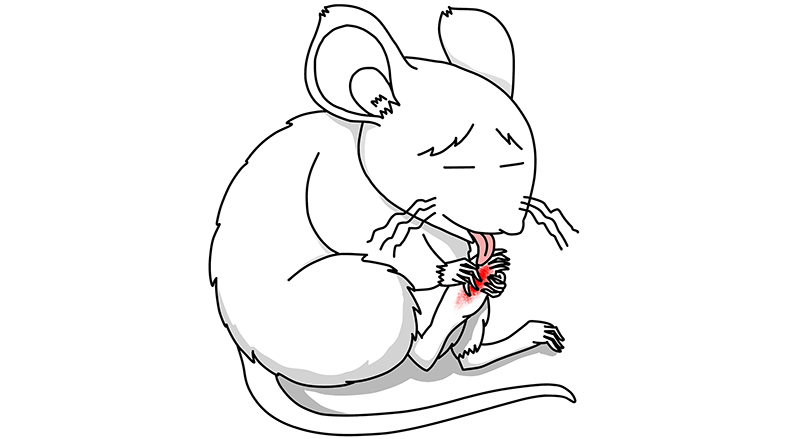
Source: Kyushu University press release
Kyushu University describes this as the first identification anywhere of a touch-neuron population that suppresses pain. The scope is worth keeping straight: this is mice, and the paper itself describes Npy2r-Cre as a group of Aβ fibers that includes rapidly adapting touch receptors rather than consisting only of them. The findings were published online in PNAS on July 15, 2026, US time.
The goal here isn't a pill
Tsuda has been direct about the next obstacle: finding out whether humans carry an equivalent population, which he has named as the group's next research task.
If the answer is yes, the payoff looks unusual. You would not be developing a drug but a device, something that stimulates skin at whatever frequency and pattern selectively recruits those particular fibers. It would work through a mechanism entirely separate from analgesics, and it would work immediately, the way rubbing does.
There is no shortage of demand. A 2023 policy paper from the Health and Global Policy Institute, a Tokyo think tank, cites a national chronic pain prevalence of 22.5% of Japanese adults. That works out to an estimated 23.15 million people. The same paper puts the resulting economic loss at around ¥2 trillion, or roughly $12.7 billion at ¥157 to the dollar. Existing options for those patients are drugs with ceilings and side effects, or the blunt, low-selectivity buzz of a TENS unit.
Where this sits in the global race against pain
Pain research in the United States and Europe has spent the last decade chasing molecules, driven hard by the opioid crisis. The most visible result so far is suzetrigine, sold as Journavx, which the FDA approved on January 30, 2025. It blocks NaV1.8, a sodium channel found in peripheral pain neurons but not in the brain, which is how it relieves pain without the addiction risk. Vertex, its maker, calls it the first new class of pain medicine in more than 20 years.
The cell-mapping side of the field got its own recognition this year. The Brain Prize 2026 went to David Ginty at Harvard Medical School and Patrik Ernfors at Karolinska Institutet, for cataloguing the sensory neuron types behind touch and pain and tracing how their signals move through the spinal cord.
Read against that backdrop, the Kyushu work is doing something narrower and more practical. It is not proposing a new target molecule, and it is not building another atlas. It takes a folk remedy that every culture has some version of, and asks which cells you would need to hit to reproduce it on demand.
The team also concedes the part it hasn't explained. Rubbing a wound feels better partly because it distracts you and partly because being touched is reassuring, and neither of those runs through the spinal gate. That is the next project.
Almost every language seems to have its own version of the gesture, if not the words. What did the adults in your family say while they rubbed?
References
- https://www.kyushu-u.ac.jp/ja/researches/view/1519/
- https://www.phar.kyushu-u.ac.jp/research/view.php?cId=1039
- https://www.pnas.org/doi/10.1073/pnas.2601766123
- https://newswitch.jp/p/49796
- https://www.nikkei.com/article/DGXZQOSG153OZ0V10C26A7000000/
- https://investors.vrtx.com/news-releases/news-release-details/vertex-announces-fda-approval-journavxtm-suzetrigine-first-class
- https://brainprize.org/winners/touch-and-pain-2026
- https://hgpi.org/research/ncd-cp-20230331.html







Global Discussion
0 comments