
🛸 Say "teleportation" and most people picture a body dissolving on one transporter pad and reappearing on another. In 1998, a Japanese physicist made "teleportation" happen for real, in a lab at Caltech, and nothing was beamed anywhere. Twenty-six years later, the same trick is the engine inside a quantum computer you can log into over the internet. This is the story of how a lab curiosity nobody could find a use for became the heart of Japan's bid to build its own next computer.
The day a state crossed the room
In 1998, Akira Furusawa was a visiting researcher in Jeff Kimble's group at the California Institute of Technology. That year, his team pulled off something physicists had argued was barely possible: the world's first unconditional quantum teleportation. The result was striking enough that Science named it one of the ten biggest scientific breakthroughs of 1998.
A note on "first," because it matters. A year earlier, in 1997, a group in Innsbruck led by Anton Zeilinger had demonstrated quantum teleportation with single photons, but their version was conditional. It only worked some of the time, and you had to throw away the runs that failed. Furusawa's experiment, using continuous beams of light rather than single particles, worked every time, on demand. No discarding, no asterisk. That "unconditional" part is what made it a building block instead of a stunt.
What got teleported (and what didn't)
Here's the part that trips everyone up, and Furusawa has spent much of his career correcting it. He wrote a whole 2009 book asking Is Teleportation Possible?, and elsewhere put it more bluntly still, making "quantum teleportation is not teleportation" a chapter heading in print.
Nothing physical moves. No atoms travel. What gets transferred is a quantum state: the full, fragile description of a particle of light, which the laws of physics otherwise forbid you from copying or even fully measuring without wrecking it. Teleportation is a way to lift that state off one system and stamp it onto another some distance away, using a shared resource called entanglement.
And it is not faster than light. The trick always requires sending some ordinary information, a few numbers from a measurement, over a normal channel, at normal speed, for the receiving end to finish the job. Strip away the science-fiction word and what you have is a method for relocating something that cannot be photocopied. Beautiful. Also, for a long time, apparently useless.
Two decades of "so what?"
This is where the story stalls, and honest accounts shouldn't pretend otherwise. Furusawa moved back to the University of Tokyo, kept refining the technique, and kept hitting the same question from every direction: what is this for? You teleported the quantum state of a light beam across a lab bench. It carried no message faster than light. It moved no matter. To an outsider, and to plenty of insiders holding the purse strings, it looked like an exquisite answer in search of a problem.
The work continued anyway, out of the spotlight: entanglement controlled among three parties, then nine, reliability pushed up year after year. Impressive on paper. Twenty years went by like that.
The reframe that changed everything
The turn came around 2013, and it was a shift in how to think about the trick rather than a new gadget.
Stop treating teleportation as a way to move information from A to B. Treat it instead as an operation: a step. When you teleport a quantum state, you can tweak the measurement in the middle, and that tweak quietly applies a chosen mathematical operation to the state as it passes through. Do it once, you've performed one step of a calculation. Chain thousands of these teleportations together, adjusting the knob each time, and the string of teleportations becomes the program.
In other words, the party trick wasn't a dead end. It was the processor. Furusawa's group worked out how to build a computer whose every clock tick is a teleportation, an approach physicists call measurement-induced computing. The thing nobody could find a use for turned out to be the use.
A computer you can log into
On November 8, 2024, RIKEN, the University of Tokyo, the national science agency JST, NTT, and the startup Fixstars Amplify announced they had built a working optical quantum computer running on exactly this principle, and connected it to the cloud. It was billed as the world's first general-purpose platform of its kind.
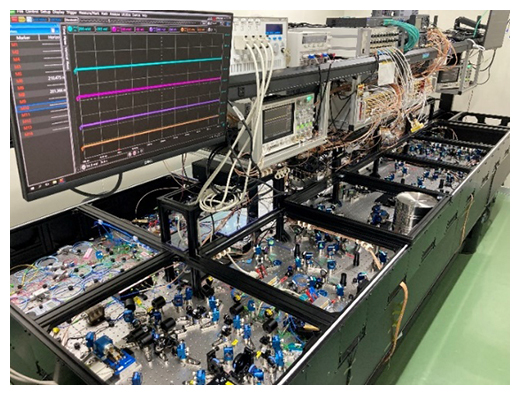
Source: RIKEN press release (Nov 8, 2024)
The machine is strange, in the good ways. Its qubits are pulses of light. Its core runs at close to room temperature, with no shimmering gold chandelier of dilution refrigerators chilling things to a hair above absolute zero, the way superconducting machines need. Light is fast, light travels down ordinary fiber, and you can pack more computation into a small space by multiplexing pulses in time. The heart of it, an ultra-broadband light source, was built by NTT's device labs from technology originally developed for high-speed telecom.
It would be dishonest to oversell what it does today. This is an analog, continuous-variable machine handling roughly 100 inputs, and right now it performs arbitrary numbers of linear operations rather than the full universal toolkit. Real error correction is still the goal, not the achievement, and it is what separates a lab demonstrator from a computer you'd trust with a hard problem. Furusawa, who leads the optical quantum computing team at RIKEN's quantum center and runs Japan's national moonshot project on the topic, has set 2050 as the target for a large-scale, fault-tolerant, room-temperature version. That is a long road. But the road now exists, and it starts at a teleportation experiment from 1998.
Whose machine will it be?
The arc has a commercial third act. In September 2024, a startup called OptQC spun out of Furusawa's lab, led by his former student Kan Takase. It raised funding, set up shop, and began building Japan's first domestically made optical quantum computer at a national research center, aiming to switch on commercial service in 2026.
Update: On July 21, 2026, OptQC and Japan's National Institute of Advanced Industrial Science and Technology (AIST) said the first machine, an optical quantum computer named MoQuren, had been installed at AIST's G-QuAT center and started operating, the first time a commercially aimed domestic optical quantum computer has entered a working research environment. Takase has framed the mission bluntly: Japan currently defaults to buying its quantum computers from abroad, and he wants to flip that within five years.
That's the stake under all the physics. The global quantum race is usually told as a contest of qubit counts between American giants (IBM, Google and the rest) running superconducting machines. Japan's bet is different in kind: a homegrown approach, built on a technique a Japanese researcher invented and spent a quarter-century maturing, aimed at not being a customer in someone else's supply chain.
A curiosity from 1998 is becoming a computer Japan can call its own. When the next generation of computers arrives, where will yours come from, and what is your country betting on to get there?
References
- https://www.riken.jp/pr/news/2024/20241108_2/index.html
- https://www.jst.go.jp/moonshot/program/goal6/64_furusawa.html
- https://www.optqc.com/company
- https://www.optqc.com/roadmap
- https://utf.u-tokyo.ac.jp/project/pjt93
- https://xtech.nikkei.com/atcl/nxt/column/18/00001/09763/
- https://prtimes.jp/main/html/rd/p/000000027.000148901.html









Global Discussion
4 comments