🧬 Roughly half of your DNA was once somewhere else in your DNA.
Genes that move around the genome have been known for decades. What nobody could explain was how one of them, a small piece of bacterial DNA called IS621, manages to cut itself loose in the first place. To escape, it needs a particular molecule. The switch that produces that molecule only clicks into place after the escape. A team at the University of Tokyo has now watched the trick up close. The answer is small, and leaky.
Half your genome used to live somewhere else
In the 1940s, a geneticist named Barbara McClintock noticed that the speckled colour patterns on maize kernels behaved as if bits of DNA were changing address. Her colleagues largely ignored her. She was awarded the Nobel Prize in Physiology or Medicine in 1983, decades after the fact, once bacteria proved her right.
Today these mobile stretches of DNA go by the name transposable elements, or more casually, jumping genes. They are not a rare curiosity. The 2001 sequencing of the human genome put at least 45% of it down to these elements and their worn-out remains. A 2011 reanalysis using more sensitive detection argued that repetitive and repeat-derived sequence runs closer to two-thirds. Most are long dead and permanently silenced, but the ones that still work are a major engine of genetic change.
Bacteria carry the simplest versions that can still move on their own, called insertion sequences. A typical one packs a single enzyme that snips the element out of one spot and drops it into another. The IS110 family, though, does something odder: it first loops itself into a small circle of DNA, then inserts that circle somewhere new.
The RNA that acts as a bridge
In June 2024, Professor Hiroshi Nishimasu's group at the University of Tokyo's Research Center for Advanced Science and Technology, working with Dr. Patrick D. Hsu's team at the Arc Institute in Palo Alto, published two papers in Nature on the same day explaining how that circle gets inserted.
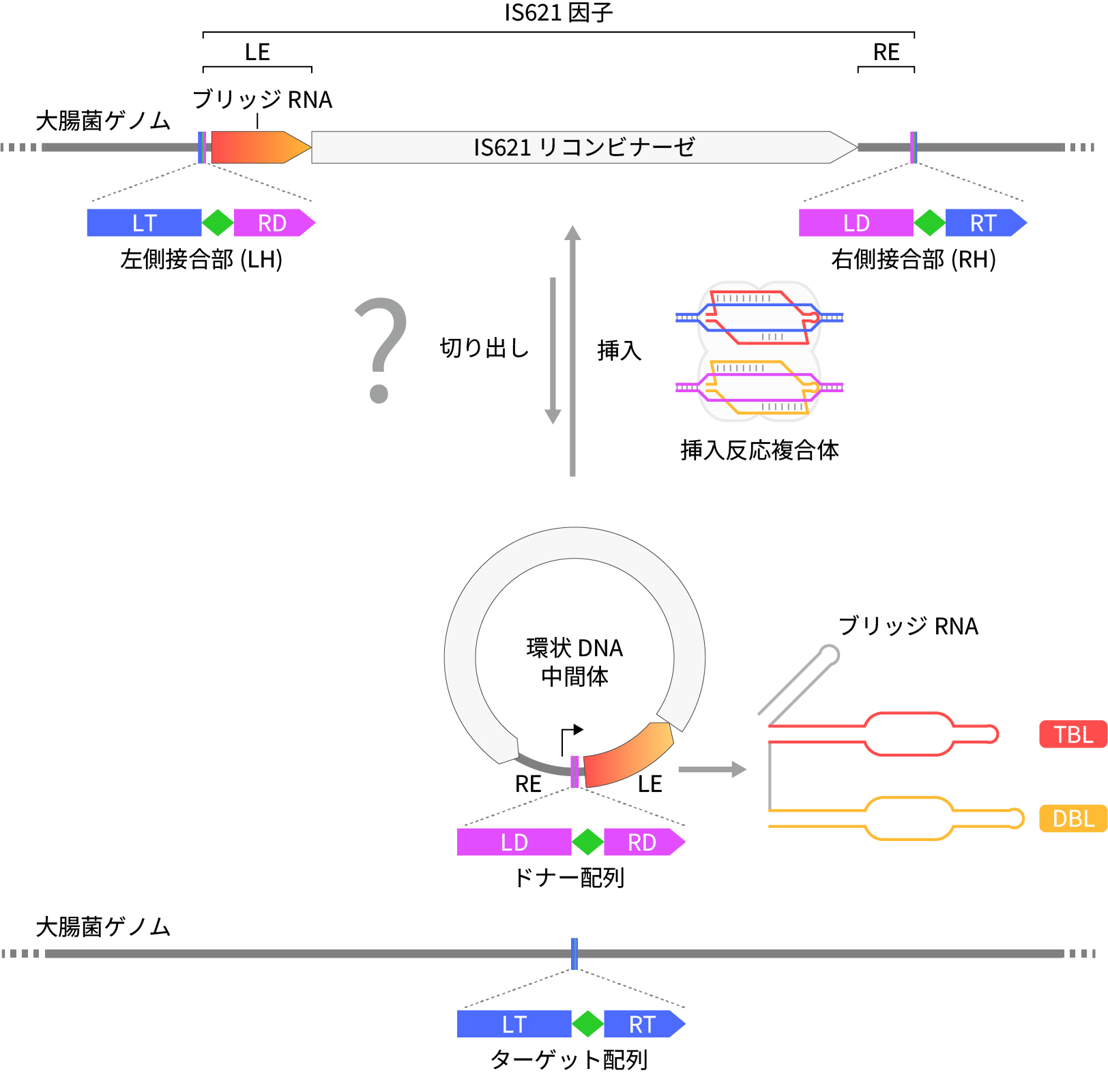
The element they studied, IS621, lives in the genome of E. coli. It makes two things: an enzyme called a recombinase, and a short non-coding RNA the researchers named the bridge RNA. The RNA has two loops. One grips the DNA being moved, the other grips the spot it is being moved to. The enzyme holds both and swaps the strands.
That design is what got biologists excited. Change the sequence in the loops and you change what the system moves and where it goes, both sides independently programmable. It is a nucleic-acid-guided system, like CRISPR, but built for rearranging DNA rather than cutting it.
The chicken-and-egg problem left behind
What the 2024 work did not explain was the excision itself. Getting out.
In the bacterial genome, IS621 sits as a straight stretch: a left end, a recombinase gene, a right end. The switch that turns on bridge RNA production, a promoter, only comes into existence once the element has folded into a circle and its right and left ends meet. So the element needs bridge RNA to cut itself out, but the switch that produces bridge RNA only exists once it is already out.
The chicken-and-egg framing is the University of Tokyo's own, from its press release.
Source: RCAST, the University of Tokyo
The answer was a trickle
To find the missing chicken, the researchers sequenced all the RNA in a strain of E. coli called Mach1, which carries IS621 at three separate spots in its genome.
Something was being transcribed around those three sites, in small quantities, and some of it contained bridge RNA. Not the flood that comes from a circularised element, just a faint background hum. The team then checked whether excision was actually happening under ordinary growth conditions, and it was: circular DNA intermediates showed up in Mach1 but not in a control strain, BL21(DE3), which has no IS621. The scars left behind after excision turned up at all three sites.
A trickle of bridge RNA leaks out of the genome, enough to trigger an inefficient cut. That cut produces the circle. The circle builds the promoter, bridge RNA production ramps up, and the element inserts itself somewhere new with much better odds.
U-shape versus X-shape
The team also asked why cutting out is so much harder than putting in, given that both reactions use the same enzyme and the same RNA. Cryo-electron microscopy, which freezes molecules and reconstructs their shape from thousands of images, gave two answers.
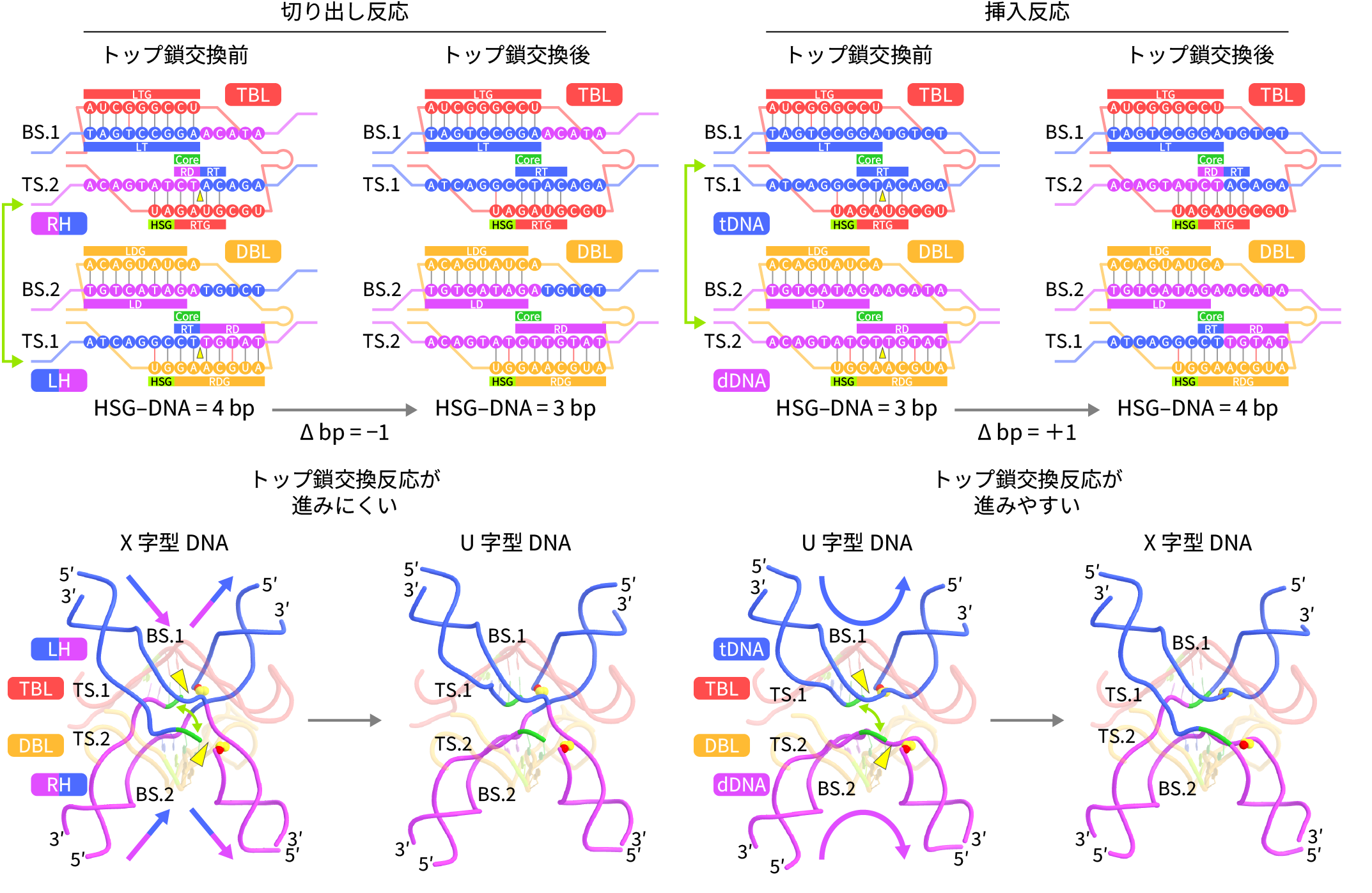
The first is a handshake. The bridge RNA carries two short guide stretches of two bases each, four in total, that pair up with the DNA. The researchers call them handshake guides. During insertion, the number of base pairs in that handshake rises from three to four as the reaction proceeds. During excision, it falls from four to three. One reaction tightens its grip as it goes, the other loosens it.
The second is geometry. The excision complex holds four recombinase molecules, the bridge RNA and two pieces of DNA, and in that arrangement the two DNA duplexes lie straight and cross over each other in an X. The insertion complex reported in 2024 looked nothing like it: there, the two DNAs were bent into U shapes. Insertion therefore runs from bent to straight, which is energetically downhill. Excision has to bend straight DNA, which is uphill.
Source: RCAST, the University of Tokyo
Three brakes hold excision back at once: the bridge RNA is scarce to begin with, the handshake weakens instead of strengthening, and the DNA has to be forced into an awkward shape. In a comment carried in the release, graduate student Eisuke Tsujimoto says that being inserted somewhere new quickly after excision is a key strategy for a mobile element to survive rather than be lost. The three brakes look like the machinery that enforces that priority.
Where this sits in the global race to edit genomes
Gene editing has spent a decade getting very good at small changes. CRISPR-Cas9, which won Emmanuelle Charpentier and Jennifer Doudna the 2020 Nobel Prize in Chemistry, cuts DNA at a chosen spot and lets the cell's repair machinery do the rest. Fixing a single letter, or breaking a gene, is now routine.
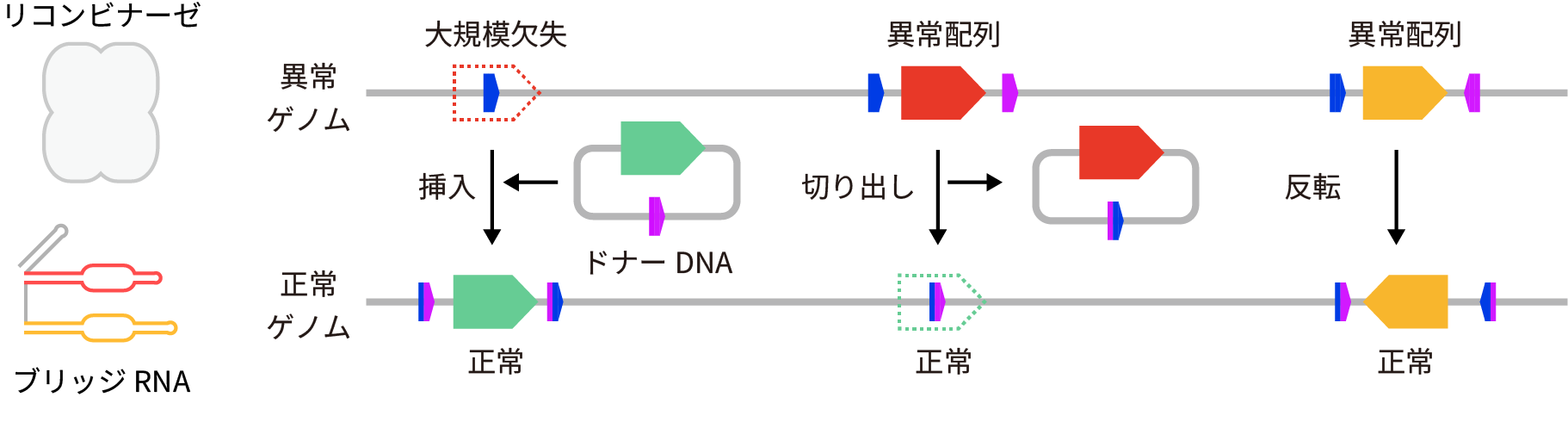
Moving large blocks around is the harder problem, and it has mostly been solved by bolting systems together. PASTE, developed in the United States, combines a CRISPR-based editor with an integrase to drop in cargo of roughly 36 kilobases. It works, but it is a stack of parts. Doing all three operations with a single enzyme is not new either. Cre-lox has managed insertion, excision and inversion for decades. The catch is that Cre only acts on a fixed recognition sequence that has to be installed in the genome first.
The appeal of the bridge system is that it aims all three at a chosen sequence using nothing but a rewritable RNA. This is not a claim that it beats PASTE on efficiency. The difference is that nothing has to be installed in the genome beforehand, and the scale it can move. In a 2026 Science paper, the Arc Institute team, with Nishimasu's group among the co-authors, engineered a version tuned for human cells. They report insertion efficiency of up to 20%, genome-wide specificity as high as 82%, and stretches of DNA up to 0.93 megabases moved. Nearly a million base pairs, relocated on purpose.
Source: RCAST, the University of Tokyo
If you know that the handshake guides and the U-versus-X geometry are what tilt the system toward insertion, you can deliberately tilt it the other way when excision is what you want, such as cutting out a runaway repeat expansion. The release frames the findings as design principles for what the field is starting to call bridge editing.
Plenty is still unknown. The team writes plainly that they cannot yet say whether IS621 moves at a steady low rate or is switched on by something, and that the element's biological purpose is an open question. As of August 2026 this is a mechanism explained, not a therapy delivered.
Basic research like this rarely makes headlines until it becomes a treatment. This one was funded through Japan's public science agencies and grew out of a Japan-US collaboration that started with the 2024 papers. How does fundamental science get paid for and talked about where you live?
References
- https://www.rcast.u-tokyo.ac.jp/ja/news/release/20260818.html
- https://www.nature.com/articles/s41586-026-10903-y
- https://www.rcast.u-tokyo.ac.jp/ja/news/release/20240627.html
- https://pubmed.ncbi.nlm.nih.gov/40997214/
- https://www.jst.go.jp/pr/announce/20260818/index.html
- https://www.nobelprize.org/prizes/medicine/1983/press-release/
- https://www.nobelprize.org/prizes/chemistry/2020/summary/
- https://journals.plos.org/plosgenetics/article?id=10.1371%2Fjournal.pgen.1002384
- https://doi.org/10.1038/s41587-022-01527-4
- https://www.addgene.org/collections/cre-lox/
- https://news.yahoo.co.jp/articles/327b5ae6f785b3ce956f64876e3c5acec6d6b5c2






Global Discussion
4 comments