
🚀 At 4:41 in the morning on October 20, a rocket will climb away from a small island in southern Japan carrying a spacecraft built to land on one of Mars' two moons, scoop up a few spoonfuls of grey dust and bring them home. Nobody has ever returned material from anywhere in the Martian system. Japan gets one narrow window and five years of flying to try.
A launch time fixed to the second
JAXA announced on August 20 that H3 Launch Vehicle No. 10 will lift off at 4:41:03 a.m. Japan time on October 20, 2026, carrying the Martian Moons eXploration probe, better known as MMX. The backup window runs from October 21 to November 7. The pad is the large-vehicle launch complex at the Tanegashima Space Center.
The second-by-second precision is not ceremony. MMX is not being dropped into Earth orbit; it is thrown directly onto a trajectory that intersects Mars, and that geometry lines up for only a brief stretch of each day.
JAXA's published flight plan sets out the sequence. The four solid boosters fall away about 1 minute 56 seconds and 1 minute 58 seconds after liftoff, the fairing splits at roughly 3 minutes 17 seconds, and the first stage separates at about 4 minutes 59 seconds. The second stage then burns twice with some 53 minutes of silent coasting in between, and MMX lets go 1 hour 11 minutes 12 seconds after liftoff, 592 kilometers up and moving at 11.2 kilometers per second.
The most important place nobody has visited
Phobos is the larger of Mars' two moons, though calling it a moon is generous. It measures roughly 27 by 22 by 18 kilometers, closer to a battered potato than a sphere, and orbits so tightly that it laps the planet about three times in a single Earth day. JAXA calls it the most important unclimbed peak in the solar system.
Where it came from is still an open question. One camp says Phobos is debris from a massive impact on Mars that later clumped together; the other says it is an asteroid from the outer solar system that got caught by Martian gravity. Telescopes and orbiters have argued this to a draw for decades, because the answer is written in the rock's chemistry, and chemistry is what you cannot read from a distance.
There is a bonus in the plan. Meteorite strikes have been flinging material off Mars for billions of years, and some of it should have settled onto Phobos. JAXA estimates that around 0.1 percent of the returned sample could be Martian in origin. A tiny fraction of a small sample, but it would be actual Mars sitting in a laboratory on Earth.
Why the Hayabusa2 trick will not work here
Japan was the first to pull off an asteroid sample return. Hayabusa delivered grains of asteroid Itokawa in 2010; Hayabusa2 brought back 5.4 grams of Ryugu in 2020. NASA's OSIRIS-REx has since topped that by mass, returning 121.6 grams from asteroid Bennu, but Japan is the only agency to have done it twice. Both Hayabusa craft used the same shortcut: fire a projectile into the surface, catch the debris that sprays up, leave within seconds. It works because those asteroids have almost no gravity, so the spacecraft never really lands.
Phobos has gravity. It is feeble, but it is real, and that changes the design completely.
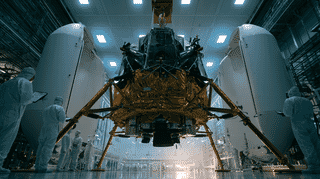
MMX comes down on four legs with bellows-style shock absorbers, so it settles instead of bouncing off into space, and the legs can be re-extended because the plan calls for two landings. Each time it will sit there for two or three hours, working almost entirely on its own, since radio signals take many minutes to cross the distance.
Sampling falls to a five-axis robotic arm built by Kawasaki Heavy Industries, tipped with a corer that is driven into the regolith. The inner tube holding the sample is withdrawn and carried to the return capsule, a scaled-up version of the Hayabusa design about 1.5 times larger. A second device from NASA, mounted on one landing leg, blows gas at the surface and collects what floats up. Two mechanisms, one target of at least 10 grams, roughly double what Ryugu yielded. Both depend on that arm to deliver the goods. If it jams, having two collectors buys nothing.
The 4,480-kilogram probe was built by Mitsubishi Electric in three modules, for cruising, exploring and coming home, each shed as its job ends. It is unusually international, too. NASA also supplies a gamma-ray and neutron spectrometer. France's CNES and Germany's DLR jointly built a rover called IDEFIX that lands ahead of the main touchdown to check the footing, and ESA contributes Ka-band deep-space communications and ground support.
The rocket has something to prove too
MMX rides the beefiest version of Japan's flagship rocket, designated H3-24L: two LE-9 main engines, four solid boosters and a long fairing, standing about 63 meters and weighing about 575 tons fully fuelled. The four-booster configuration debuted only in October 2025, carrying the HTV-X1 cargo craft to the International Space Station. MMX will be its second outing.
H3's eighth flight failed on December 22, 2025. JAXA later concluded that a delamination present since manufacturing inside the adapter that holds the satellite spread under in-flight shock and broke the structure apart. Japan's heavy-lift capability sat on the ground for months. The rocket returned to flight on June 12, 2026 with a stripped-down booster-less variant, and the standard configuration flew successfully again on August 11, 2026 with a navigation satellite aboard. MMX is next.
MMX was originally meant to launch in fiscal 2024. In December 2023, with H3 development running late, it was pushed to fiscal 2026, and the reason it moved by two full years rather than a few months is orbital mechanics: Earth and Mars line up favourably only about once every 26 months. Miss October and November, and the next real opportunity is 2028.
Who gets to Mars rocks first
The competitive picture changed drastically while MMX waited. NASA's Mars Sample Return, long the top priority of American planetary science, is effectively finished. Cost estimates climbed to 11 billion dollars, then to between 6 and 7 billion dollars after a redesign, and Congress declined to fund it in the fiscal 2026 appropriations agreement enacted in January 2026, stating that the existing program was not supported. Perseverance is still on Mars sealing sample tubes, with no approved mission to collect them as of August 2026.
China is moving the other way. Tianwen-3 is scheduled for two Long March 5 launches in late 2028, aiming to bring back at least 500 grams from the Martian surface, with return targeted for 2031 and July of that year cited in mission planning.
Tianwen-3 targets the planet's surface, MMX targets a moon, and JAXA does not blur the two. What MMX would be the first in the world to do is return a sample from a Martian moon and close a round trip to the Martian system. If that 0.1 percent estimate holds and its capsule comes down before China's, it will carry the first Martian material any spacecraft has delivered to Earth. The two schedules are only months apart. The development cost shown at the August 13 unveiling has been reported at 55.3 billion yen, roughly 350 million dollars at current rates. Not a like-for-like comparison with a Mars surface mission, but still an order of magnitude below the cancelled American program.
Nozomi's long shadow
Japan has attempted Mars once before. The Nozomi probe launched in 1998, suffered a cascade of failures on the way, and in 2003 the team gave up on entering Martian orbit and let it fly past. Nobody involved has forgotten it. If MMX arrives in 2027 as planned, it will be the first Japanese spacecraft to reach the Martian system at all. Phobos itself has a bad record too: neither the Soviet Phobos 1 and Phobos 2 in 1988 nor the Russian-Chinese Phobos-Grunt in 2011 reached it.
From there, if everything works, it spends about three years observing and sampling, departs in 2030 and drops its capsule over Australia in fiscal 2031. That is a long time to hold your breath, and all of it starts with one rocket, at 4:41:03 on an October morning.
Japan has spent 28 years since Nozomi getting back to the starting line. How does your country talk about a space mission whose results will not arrive until the 2030s, and does that kind of patience get funded where you live?
References
- https://www.jaxa.jp/press/2026/08/20260820-1_j.html
- https://www.jaxa.jp/press/2026/08/files/jaxa20260820-1_01.pdf
- https://www.mmx.jaxa.jp/mission/
- https://www.mext.go.jp/kaigisiryo/content/000034537.pdf
- https://news.mynavi.jp/techplus/article/20260813-4814923/
- https://news.mynavi.jp/techplus/article/20260820-4842835/
- https://innovatopia.jp/spacetechnology/spacetechnology-news/116080/
- https://space-connect.jp/h3-mission/
- https://www.jaxa.jp/hq-disclosure/h3f8/index_j.html
- https://science.nasa.gov/blogs/osiris-rex/2024/02/15/nasa-announces-osiris-rex-bulk-sample-mass/
- https://spacenews.com/chinas-tianwen-3-mars-sample-return-mission-moves-into-spacecraft-construction-phase/
- https://www.livescience.com/space/mars/nasas-mars-sample-return-is-dead-leaving-china-to-retrieve-signs-of-life-from-the-red-planet
- https://spacedaily.com/t-perseverance-mars-sample-return-congress-cancelled-2026/








Global Discussion
3 comments