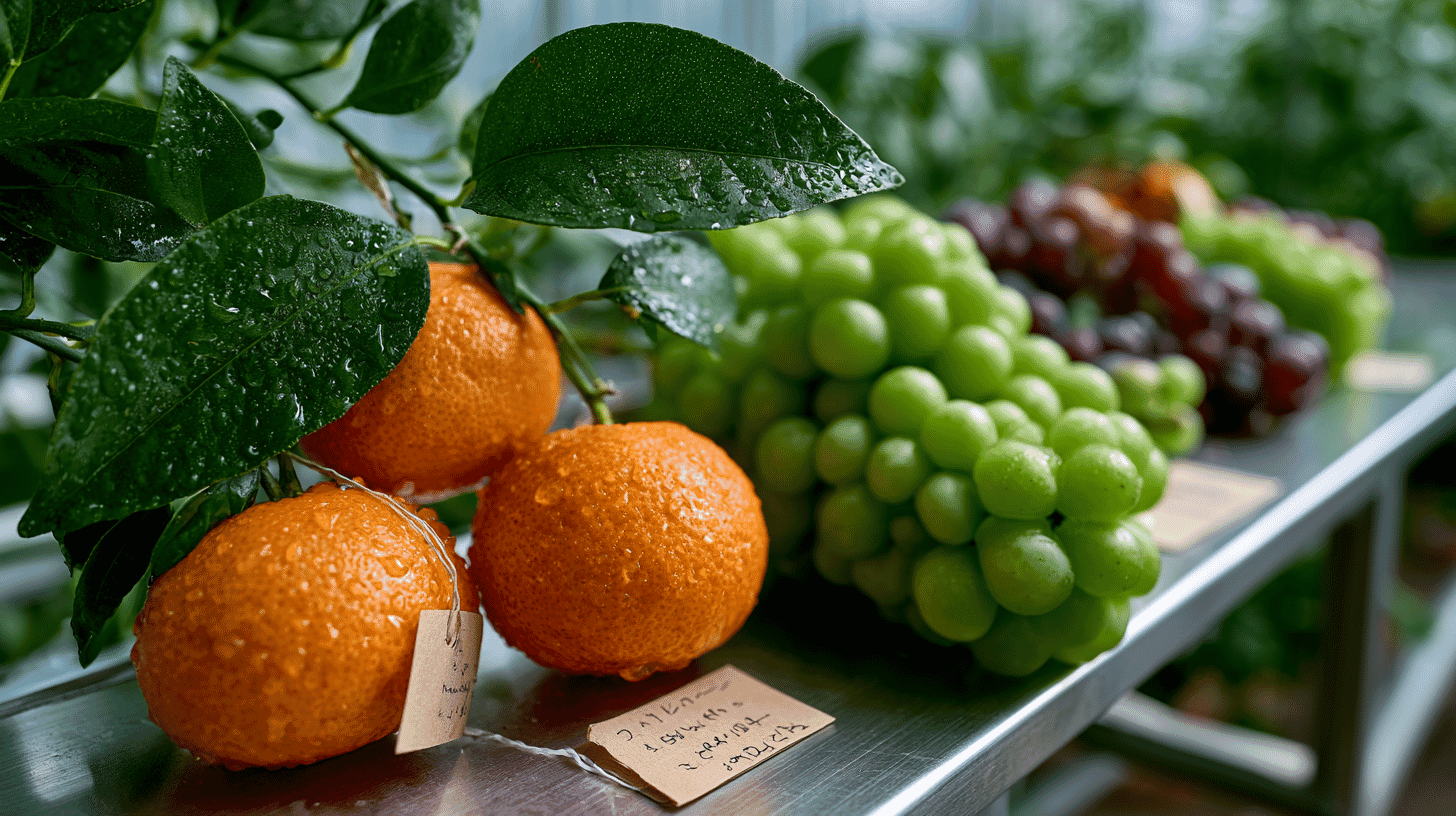
🍊 A premium orange that Ehime spent two decades breeding turned up for sale on a Chinese shopping site. Grown, the seller said, in Sichuan. Cases like this are why Japan is rewriting its seed law right now, adding ten years to breeders' rights and letting officials block exports before a variety is even registered. The catch: the clock is running out on some of the very fruits the law is meant to protect.
The citrus that showed up in China
In April, a reporter for the Mainichi Shimbun browsing Taobao, one of China's biggest online marketplaces, found something odd: a mandarin sold as "Ehime No. 48," also labeled with the Chinese name hong gongzhu, or "red princess." When the reporter asked the seller in a chat whether it was really Ehime No. 48, the answer came back plainly: yes, a newer variety, its saplings raised in Sichuan.
That name is not a coincidence. "Beni Princess" (official variety name: Ehime Kashi No. 48) is a high-end citrus that Ehime Prefecture began developing in 2005, crossing the jelly-textured Beni Madonna with the intensely sweet Kanpei. It was registered as a protected variety in 2022 and only reached full commercial shipment in March 2025, about two decades from the lab to the store shelf.
On June 12, Agriculture Minister Norikazu Suzuki confirmed at a press conference that the orange's saplings may have leaked to China, and that similar names had been spotted on Chinese seedling sites. For Ehime, it was a grimly familiar story. Fruit sold in China as "Ehime No. 28" and "Ehime No. 38," earlier citrus from the same prefecture, has been on the market there for more than a decade.
What the new law would change
The bill is built around a few blunt fixes.
The headline change is time. A breeder's right, the exclusive right to produce and sell a registered variety, currently lasts 25 years, or 30 for woody perennials like fruit trees and grapevines. The amendment adds ten years to both, pushing them to 35 and 40. To put that in context, the international treaty most countries follow (UPOV) sets a floor of 20 years, and the longest terms among member states had been around 30. Japan is deliberately going past the pack.
The second fix targets a specific loophole. Registering a variety takes three to six years of field trials, and during that gap the breeder has no protection at all. Plenty of leaks happen in exactly that window. The bill creates the power to block the export of a candidate variety while its application is still pending.
Then there's the border. Under current rules it is illegal to export protected seedlings to certain countries, but enforcement kicks in only at the moment of export. The new law pushes that line back: simply storing seedlings in a warehouse for the purpose of illegal export would itself infringe the breeder's right. The bill also makes lawsuits easier: seeds sold under a registered variety's name can be presumed to be that variety without a physical comparison, shifting part of the burden onto the accused. It raises the fine for misusing a registered name from ¥100,000 to ¥200,000 (about $600 to $1,200).
The bill cleared the lower house on June 19 after a unanimous committee vote and moved to the upper house. Most of it is set to take effect on December 1, 2026.
Why the last overhaul wasn't enough
Japan already tightened this law once, in 2020. That version, passed after the Shine Muscat grape became the poster child for fruit piracy, let breeders designate which countries their seedlings could legally go to, and required a license for farmers to propagate registered varieties themselves. It took effect in stages through 2021 and 2022.
It helped, but it arrived too late for the crops that had already escaped. Shine Muscat, bred over decades by Japan's national research institute NARO, was never registered abroad in time; today it grows across China and South Korea on an area many times larger than in Japan, and the agriculture ministry estimates the losses from the leak to China at more than ¥10 billion a year (roughly $65 million), a figure it derives by multiplying Chinese output by local prices and an assumed 3% royalty rate. A 2020 government survey found 36 varieties being sold online in China and Korea under the same names they carry in Japan's registry. (We covered the Shine Muscat losses in more detail in an earlier piece.)
The lesson was an awkward one. A law protects only what is still inside the fence when the fence goes up.
A race against the clock
Which is why the timing of this bill matters more than it looks. The ten-year extension applies not only to future varieties but to existing ones, as long as their rights haven't already expired when the law takes effect.
That turns the parliamentary calendar into a countdown. According to the farm newspaper Nihon Nogyo Shimbun, breeders' rights on Setoka, a popular, easy-to-peel citrus bred by NARO, are due to lapse in October 2026, and the pear variety Akizuki expires around the same time. If the law is enacted and promulgated in time, they get another decade of protection. If the debate drags, they fall out of protection and become "general varieties" anyone can grow freely. Two decades of public breeding work could hinge on a matter of weeks.
Update: The revised law passed the upper house on July 17, 2026. Because the term extension reaches any registered variety whose rights are still alive on the day the law takes effect, which is the day it is promulgated, Setoka lands inside the deadline after all. (Added July 29, 2026)
Can a Japanese law reach a Chinese orchard?
Here's the honest limit: a Japanese statute stops at Japan's border. Once a seedling is growing in Sichuan, Tokyo can fine and sue people inside Japan, tighten its warehouses, and block exports, but it cannot uproot a foreign orchard. The only real protection abroad is to register the variety in each country under the UPOV treaty, and do it fast, before the plant spreads. Beni Princess is reportedly still only pending registration in China.
The bill isn't without critics at home, either. When the 2020 law passed, some farmers and campaigners worried that tightening rules on self-propagation would squeeze small growers and hand too much control to seed companies and public institutes. A petition urging the upper house to deliberate carefully surfaced this time as well. Supporters counter that without stronger rights, Japan's already-declining rate of new variety registrations will keep falling, and there will be fewer premium fruits to protect in the first place.
So the amendment is one lever, not a cure. Whether "red princess" and the next Shine Muscat can be kept home will depend just as much on how fast Japan registers its fruits overseas, and on how willing the countries already growing them are to cooperate.
Japan treats a grape or an orange as intellectual property worth decades of protection. In your country, how are farmers' new crop varieties protected, and would anyone even think to sue over a stolen sapling?









Global Discussion
0 comments