A Ukrainian soldier scored Japanese snacks and cup noodles out of 10. His zine was reprinted in at least seven times the quantity expected. Who sent the box, and what instant noodles already meant in Ukraine.
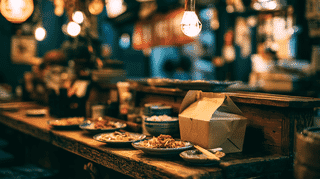
Japan made 'mottainai' a global word, yet its restaurants often refuse to box up leftovers. A 2024 government guideline shows why: legally, you are meant to eat it on the premises.
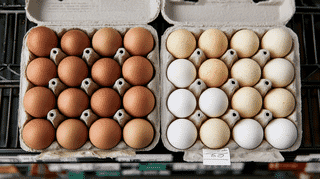
A Japanese team tracked 563 metabolites and 107 tasters to show how hen housing changes egg flavour, in a country where 96.6 percent of laying hens are still caged and cage-free eggs cost about twice as much.
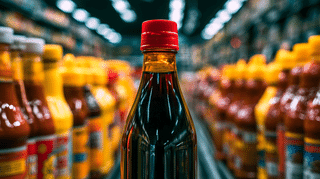
Kikkoman's third US soy sauce plant has opened in Jefferson, Wisconsin, a $560 million investment. Fifty-five years after a village voted 54 to 14 on the first one, North America now supplies two-thirds of group profit.
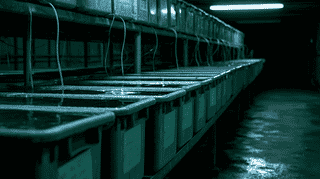
A Shizuoka lab has closed the breeding loop on the douman crab. Individual boxes are standard practice in Southeast Asia; what took eight years was larval die-offs and timing the female's molt.
Japan culled 1,381,700 deer and wild boar in fiscal 2024, and 5.6 percent of that mass became meat. The rest goes to a hole in the ground or an incinerator, and the capacity is not there. Scotland does it differently.
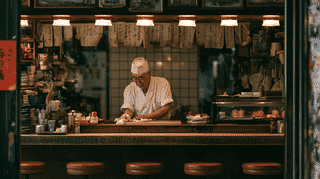
Sushi shop bankruptcies in Japan rose 45.5% in the first half of 2026, yet only 18.8% were losing money, the lowest in Teikoku Databank's 20 years. They are not failing. They close because nobody takes over.
Rausu, Rishiri, hosome, ma-kombu: four kelps sold under four names and four price tiers. A Hokkaido University team read the DNA of 475 plants and found no genetic line between them.
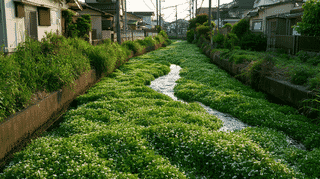
In spring 2026 a meter-tall mat of watercress smothered a suburban river in Matsuyama. Japan calls it a priority-control invasive species, yet farms ship 362 tons a year. How New Zealand, Australia and the US see it.
Warming seas pushed a pufferfish north across the Tsugaru Strait, and the hybrids do not fit Japan's 1983 table of edible species and parts. How the rulebook caught up, and why the Mediterranean has the same gap.
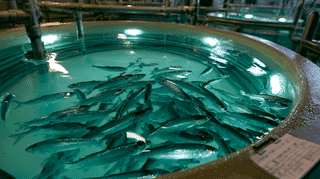
Murakami's salmon run fell from 55,000 fish to 1,400 in a decade. Now the town is spending about $32,000 to attempt what Norway and Chile have not: closing the life cycle of chum salmon entirely on land.
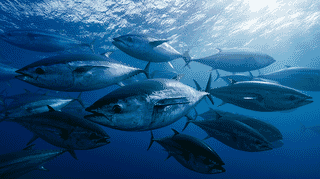
A kawakawa hybrid made bluefin tuna sperm at eight months, and rainbow trout now spawn Chinook salmon yearly. Inside Japan's 20-year surrogate broodstock effort and Kindai's 32-year tuna project.
SUSHI BUS puts a working conveyor-belt sushi lane on the upper deck of an open-top double-decker and sends it around Tokyo from October 2026. Seventy minutes, all you can eat, 20 seats.
Pacific fishing nations agreed on August 18, 2026 to raise the quota for bluefin tuna over 30 kilograms by 25 percent, to 14,836 tons in the western Pacific, and to cut the quota for juveniles by 6 percent.
Japan's 2025 seafood output fell to 3,577,400 tonnes, the lowest since 1956, while FAO puts world production at 235 million tonnes. Comparing quota rules with Norway and the US shows why fewer fishermen isn't the answer.
Kewpie sets up an Indian sales company in September 2026. In the US, egg yolk is what legally makes mayonnaise mayonnaise. In India, egg is what earns the non-vegetarian mark. Same ingredient, opposite verdicts.
Japan's calorie-based food self-sufficiency fell to a record-low 37% in fiscal 2025 while the production-value measure rose to 66%. A 48% rise in rice prices moved both. By production value, Japan ranks above the US.
Japan's food exports hit 897.7 billion yen (about $5.7 billion) in the first half of 2026, a record. Green tea rose 83.5% and yellowtail 69.0%, but the yen was 5.5% weaker, so about half the growth was currency.
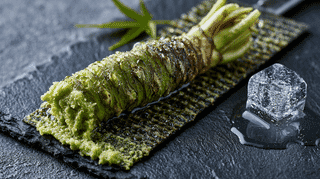
Sensitive teeth affect roughly a third of adults in some surveys, and the usual fix is to seal the surface over. A Tokyo Dental College team has shown that 6-MSITC, a compound in Japanese wasabi, pushes dentin-building cells to lay down new tissue instead. It began with a question asked at a sushi counter in Kanda.
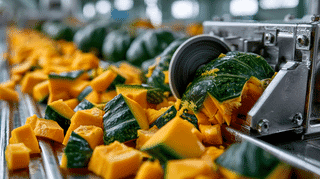
The only machine on Earth that cuts pumpkins into deliberately irregular 'rangiri' pieces. How Hokkaido's Synthemec cracked the paradox, then brought its parts in-house to win on precision and lead time, against an industry built for uniform cuts.