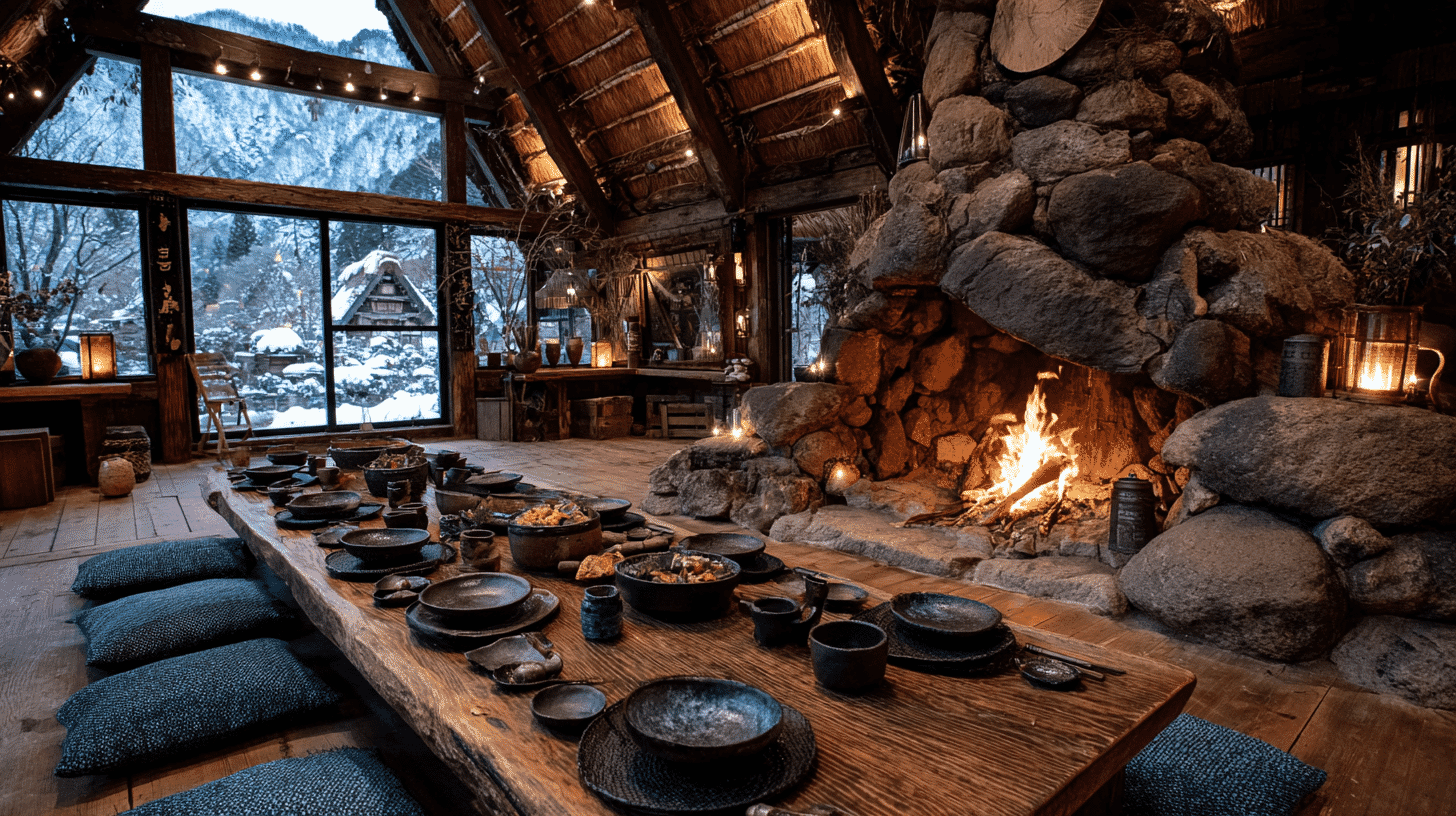
Not gas. Not charcoal. The world's top food lovers are obsessed with cooking over firewood. A tiny restaurant in the mountains of Spain's Basque Country sparked a global revolution, climbing to #2 in the world rankings using nothing but flames and wood. Now Japan's countryside, with its renovated farmhouses and local ingredients, is emerging as the next frontier of this ancient-meets-modern culinary movement.
What Is Wood-Fire Cooking? And Why Is It Different?
Wood-fire cooking, known as maki ryōri in Japanese, is the art of cooking food using flames from burning logs of natural wood. While it may sound similar to a backyard barbecue, the technique is worlds apart from grilling over charcoal or gas.
Charcoal is made by burning specific types of wood at extreme temperatures. It delivers consistent, stable heat, but quality depends heavily on the producer's skill and source materials, so good charcoal tends to be expensive.
Firewood, on the other hand, can come from local forests, split, dried, and ready to use. This means the very land where the ingredients grow also provides the fuel that cooks them. Different wood species create distinct flavor profiles. Cherry wood (sakura) adds a delicate sweetness, while oak (nara) imparts a robust, earthy aroma.
Firewood also makes heat easy to control: by adjusting the amount of wood and the airflow, cooks can move freely from high to low heat. The rising steam and shifting flames create flavors that no modern kitchen appliance can replicate. Each dish becomes a one-of-a-kind creation shaped by fire, wood, and terroir.
The Restaurant That Started It All: Asador Etxebarri
The global wood-fire cooking boom traces back to a single restaurant: Asador Etxebarri, tucked away in the village of Axpe in Spain's Basque Country.
Chef Bittor Arguinzoniz grew up without electricity or gas, watching his mother and grandmother cook over the family hearth. Entirely self-taught, he has spent over 30 years mastering the art of flame-grilled cuisine in this same tiny village.
What makes Etxebarri extraordinary is its total commitment to fire. Every dish, from grilled baby eels and aged beef chops to smoky ice cream for dessert, is touched by wood-fired flames. Arguinzoniz designed his own custom grills, each using a pulley system for millimeter-level height adjustments. He selects different woods for each dish: holm oak for meats, vine shoots for seafood, orange wood for lighter fare.
This obsessive dedication has earned Etxebarri the #2 spot on The World's 50 Best Restaurants list in both 2024 and 2025, along with the title of Best Restaurant in Europe in 2025. The 14-course tasting menu costs around $310, and roughly 70% of guests are regulars who return once or twice a year. Reservations open just three times annually and sell out in minutes.
Why Wood-Fire Cooking Is Trending Now
The rise of wood-fire cooking reflects a broader shift in global gastronomy.
The 2000s were dominated by molecular gastronomy (think science-lab techniques and foam-topped plates) pioneered by Spain's El Bulli. The 2010s saw the New Nordic cuisine wave led by Denmark's Noma, which emphasized foraging and fermentation. Now, in the 2020s, the pendulum has swung toward something far more primal: fire.
After decades of increasingly complex and technology-driven cooking, the world's best chefs are returning to humanity's oldest culinary method. It's both ironic and inevitable.
Food critics describe the appeal as the "beauty of imperfection." The flickering flame, the unique scent of each wood species, the subtle changes from temperature and humidity: these uncontrollable variables make every plate irreplicable. In an era of precision and automation, that unpredictability has become the ultimate luxury.
From Ekstedt in Stockholm (where everything, even boiling water, is done over firewood) to emerging fire-focused restaurants across South America and Asia, the movement has spread far beyond one Basque village. Wood-fire cooking is no longer a trend; it's becoming a new standard in haute cuisine.
Japan's Unique Take: Where Fire Meets Local Gastronomy
Japan's wood-fire cooking scene has evolved along a distinctly different path from Europe's, shaped by both regulation and geography.
In major cities like Tokyo, fire prevention codes make it extremely difficult for restaurants to use firewood. Special exhaust systems and ductwork are required, and in high-rise buildings, it's nearly impossible. But this limitation has turned into an advantage.
Instead of urban fine dining rooms, Japan's wood-fire restaurants have flourished in the countryside, in renovated kominka (traditional farmhouses), hillside retreats, and one-building restaurants surrounded by nature. This dovetails perfectly with Japan's "local gastronomy" (rōkaru gasutoronomi) movement.
The term was coined in 2017 by the lifestyle magazine Jiyujin to describe a philosophy of expressing a region's climate, history, and culture through cuisine, while building sustainable economic systems connecting restaurants, agriculture, and local industry.
Wood-fire cooking is a natural fit for this philosophy. The wood comes from local forests. The ingredients come from local farms and waters. The fire, the fuel, and the food are all rooted in the same land, creating dishes that simply cannot be replicated anywhere else.
In Nagano Prefecture, for example, the restaurant "song" in Komoro uses locally harvested larch wood to fire-cook regional specialties like Miyuki pork and Saku carp. The chef trained in Spain's wood-fire techniques before returning to his hometown to reinterpret traditional dishes through flame, a perfect fusion of global knowledge and local soul.
Japan's Deep History With Fire and Food
Wood-fire cooking isn't new to Japan; it's a return to roots. Before the widespread adoption of gas stoves, Japanese households cooked rice over wood fires in traditional hearths called kamado. An old Japanese saying, "hajime choro choro, naka pappa, akago naitemo futa toru na," is a mnemonic for achieving perfect rice by carefully managing the firewood's heat: start with a gentle flame, build it up, and never lift the lid, even if a baby cries.
The irori, a sunken hearth built into the floor of traditional homes, served as both a cooking station and the family gathering spot. Fish, mountain vegetables, and mochi were slow-grilled over the embers while family members gathered around for warmth and conversation. Fire wasn't just a cooking tool; it was the center of domestic life and human connection.
This deep cultural relationship with fire gives Japanese wood-fire cooking an emotional dimension that goes beyond technique. Today's maki ryōri restaurants are, in a sense, reviving something that was always at the heart of Japanese living.
Why the World's Wealthy Are Heading to Japan's Countryside
International food lovers, particularly wealthy travelers, are increasingly drawn to Japan not for its big cities, but for its rural dining experiences. According to gastronomy experts, food has become the #1 reason affluent travelers visit Japan, and their interest is rapidly shifting from Tokyo and Kyoto to remote regions.
Wood-fire cooking is at the center of this shift. Watching a chef grill local vegetables over flames from nearby mountain wood, dining inside a 100-year-old farmhouse with rice paddies stretching to the horizon: this is an experience money can't buy in any city.
As Kotaro Kashiwabara, president of the Japan Gastronomy Association, puts it: wood-fire cooking is not just a cooking method; it's a deep dialogue with a region's nature, history, and culture. Food is becoming the gateway through which the world discovers Japan's hidden countryside, and the ancient magic of fire is leading the way.
Does your country have its own tradition of cooking with wood fire? From Argentine asado to South African braai, Turkish mangal to American barbecue pit culture, we'd love to hear about the fire-and-food traditions where you live.
References
- https://news.yahoo.co.jp/articles/fc6aa31613dc49c80a65ae517ce6d966e8e6fd0b
- https://www.elle.com/jp/gourmet/g69862530/takefumihamada-2601/
- https://www.elle.com/jp/gourmet/gourmet-restaurants-events/g70181732/japan-gastronomy-trend-2602/
- https://www.theworlds50best.com/the-list/Asador-Etxebarri.html
- https://www.fujingaho.jp/gourmet/gourmet-other/a68125235/japan-gastronomy-8-nagano-251008/




Global Discussion
15 comments