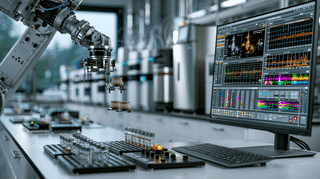
Toyota, Shinshu University and 11 partners are building a self-driving lab where robots run experiments and AI picks what to try next. Here is how Japan's closed-loop materials push compares with Berkeley's A-Lab and China's robot chemist.
In 2004, a University of Tokyo brain scientist said humans are born wired for grammar. In 2022, ChatGPT learned language without any such wiring. The half-century debate Chomsky started is wide open again.
Sony AI's autonomous robot Ace beat elite table tennis players and made the cover of Nature. From its Gran Turismo Sophy roots to the fast-ball wall that stumped DeepMind and a 20.2-millisecond reaction loop, here's how Sony's robot reached elite-competitive level in a real, physical sport.
SBI is rolling Claude out across its entire financial group and bolting it onto the on-chain finance rails it has spent years building. Unlike NEC or Fujitsu, this is a user, not a vendor. We compare how Japan, the US and the EU are wiring AI into finance, regulation included.
On May 27, Fujitsu announced partnerships with two US AI labs at once, Anthropic and OpenAI. We unpack what this dual strategy means versus NEC's single bet, the Forward Deployed Engineer model, and how Japanese IT giants differ from Microsoft-OpenAI and SoftBank.
Kawasaki Heavy Industries—maker of jets, bullet trains and motorcycles—has opened a physical AI development hub in Silicon Valley, teaming up with NVIDIA, Analog Devices, Microsoft and Fujitsu. We unpack why a 130-year-old industrial giant is betting on AI that acts in the real world, and where Japan stands in the US-China robotics race.
OpenAI is moving to offer its newest cyber-focused AI model, GPT-5.5 Cyber, to the Japanese government and industry. Former NSA Director Paul Nakasone, now an OpenAI board member, flew to Tokyo to pitch critical-infrastructure cooperation. We unpack the contrast with Anthropic's tightly controlled Claude Mythos, the China-threat framing, and what it means that OpenAI wants Japan as its first international partner.
Two key Capcom executives explained their AI strategy to 4Gamer: 3,000 hours of QA collapsed to 72 hours by AI, 30,000+ hours of monthly autonomous playtesting, and a three-layer architecture combining Google's Gemini with Capcom's own art-director models. As the DLSS 5 backlash and ResetEra debates continue, here's why Capcom insists AI is for 'releasing creator potential', not making art.
Fujitsu's new Kozuchi Physical OS isn't trying to build a smarter robot brain. It's trying to make the whole physical space intelligent. Here's how its edge-plus-sovereign-cloud design differs from NVIDIA Cosmos and Google DeepMind's Gemini Robotics — and how it fits into Japan's $126B Physical AI ambition.
Anthropic's Head of Global Affairs Michael Sellitto arrived in Tokyo May 15 and confirmed the company is weighing participation in the cyber defense corporate alliance proposed by Japan's ruling LDP. Modeled on US Project Glasswing, the framework will test Japan's distinctive 'middle path' — an AI Promotion Law with no penalties, sitting between the EU AI Act's hard regulation and the deregulatory turn under the Trump administration.
Japan's largest megabank MUFG partnered with Google on May 7, 2026, to build 'agentic banking' — AI agents that autonomously select products, choose the best payment method, and execute transactions. Unlike JPMorgan's employee-facing LLM Suite or BNP Paribas's sovereignty approach, MUFG is betting on consumer-facing autonomous finance.